
Reviewed · AGRA DAY TRIPS FROM DELHI
4 Night 5 Days Golden Triangle (Delhi-Agra-Jaipur) Tour
Golden Triangle, minus the stress of planning. What makes this one work is the A/C private vehicle plus tight guidance around major sites, so you spend less time figuring out routes and more time looking up. I especially like when a driver-turned-guide like Jagadish brings the places to life with practical context, not just facts. One thing to consider: monument entrance fees and meals aren’t included, so your day-to-day budget matters.
This is a classic Delhi–Agra–Jaipur sweep, but paced for sanity. You’ll hit the big names like Qutub Minar, the Taj Mahal, Amber, and Hawa Mahal, plus a few quieter but memorable stops like Agrasen Ki Baoli and Jantar Mantar. It also includes pickup, bottled water, and mobile tickets, which helps keep things smooth.
In This Review
- Key Things That Make This Tour a Solid Choice
- How This Golden Triangle Tour Lets You See More Without Rushing
- Delhi Day: Qutub Minar and Red Fort in One Big, Contrasting Hit
- Humayun’s Tomb, India Gate, and Agrasen Ki Baoli: The Delhi That Feels Like It Breathes
- Agra Day: Taj Mahal and Agra Fort, Plus Fatehpur Sikri’s Different Mood
- Jaipur Day: Amber Palace and Jantar Mantar for the Rajput Meets Science Mix
- City Palace and Hawa Mahal: The Royal Jaipur Finale That’s Built for Views
- Price and Value: What the $240 Covers (and What You Must Budget)
- Should You Book This Golden Triangle Tour?
- FAQ
- What’s included in the tour price?
- Are monument entrance fees included?
- What’s not included?
- Where does the tour start and end?
- Is pickup offered?
- How long is the tour?
- Do I need a passport?
- Can I cancel for a full refund?
Key Things That Make This Tour a Solid Choice
- Private, chauffeur-driven transfers in A/C for all the between-city time
- Major Mughal and Rajput sites without the hassle of self-planning
- An easy, flexible rhythm, with time to breathe between stops
- Safety and calm driving called out by solo travelers and women
- Jagadish-style guidance, including restaurant recommendations and smart timing
How This Golden Triangle Tour Lets You See More Without Rushing
The Golden Triangle is famous for a reason: in one trip you get three cultural flavors that show up in the architecture—British-era Delhi, Mughal Agra, and Rajputana Jaipur. The smart part here is that you don’t do it with a pile of buses and strangers; you’re on a private setup where your group is the only one sharing your itinerary.
The tour also concentrates on a very workable idea: first get you to the headline monuments, then wrap in “supporting actors” that make the trip feel real instead of like a highlight reel. For example, you don’t only get the Taj Mahal—you also get Agra Fort and Fatehpur Sikri. In Jaipur, you don’t only get Amber—you also get Jantar Mantar and the royal core at City Palace.
The pace is also a big deal. One review praised it as relaxing and flexible, and I agree with the logic: when you’re covering Delhi to Agra to Jaipur, the biggest risk isn’t running out of attractions—it’s running out of energy.
Other Agra runs out of Delhi worth a look




Delhi Day: Qutub Minar and Red Fort in One Big, Contrasting Hit
Day one starts with Qutub Minar, and it’s a great way to open. It’s a tall 73-meter victory tower built in 1193, with five distinct storeys and balconies that give you natural “checkpoints” as you look up. Even if you’re not a history nerd, the structure is visually clear: it tapers from about 15 meters at the base to around 2.5 meters at the top.
What I like about starting here is that you set a theme: Delhi isn’t just one era. It’s layered. After that, you roll into the Red Fort (Lal Qila), where the vibe shifts from soaring monument to imperial power. The fort’s red sandstone walls rise roughly 33 meters, built in 1638, and they act like a wall between Old Delhi’s noise and the scale of the Mughal world.
Practical note: both stops list admission tickets as not included, so you’ll want a separate budget for entrances. Also, expect crowds at the headline sites—this is a major tourist corridor—so go with the mindset that you’re there for the experience, not the solitude.
Humayun’s Tomb, India Gate, and Agrasen Ki Baoli: The Delhi That Feels Like It Breathes
Day two gives you a stronger sense of Delhi as a living city, not just a set of postcards. You start at Humayun’s Tomb, described as the first substantial example of Mughal architecture in India. It’s set inside a garden tomb enclosure with the chaharbagh layout: square garden sections with pathways and water channels arranged around a central mausoleum topped with a double dome.
This stop is worth it because it teaches you how Mughal design thinks: geometry first, beauty second, and then emotion. You also get a good “camera break” from the chaos of major street areas.
Then the route turns toward modern memorial space: India Gate and the National War Memorial. India Gate is a 42-meter archway at the center of a crossroad, built to commemorate 70,000 Indian soldiers who died fighting for the British Army in World War I, plus names related to the Afghan war of 1919. The National War Memorial sits in the same India Gate complex and covers sacrifices across a large area.
Finally, you get Agrasen Ki Baoli (Chand Bawdi), a protected stepwell with 103 steps made of red stone, about 60 meters long and 15 meters wide. This is the kind of stop that makes a tour feel thoughtful. It’s quieter than the big-ticket monuments, and it rewards you for looking down, not up.
Big consideration: these are mostly sightseeing stops with limited shade and lots of walking. If you go during peak heat, plan for water breaks (bottled water is included, but you’ll still want to pace yourself).
Agra Day: Taj Mahal and Agra Fort, Plus Fatehpur Sikri’s Different Mood
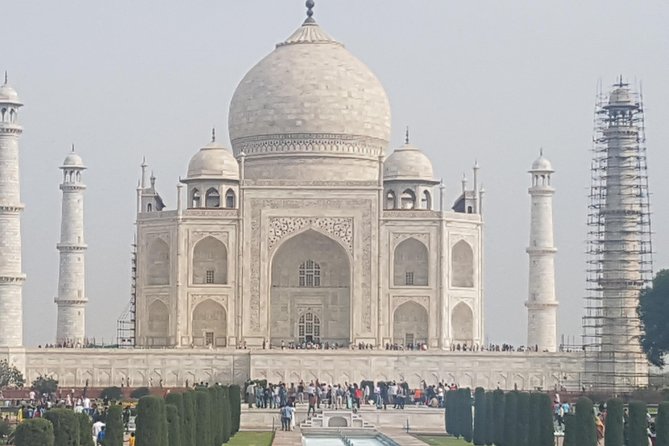
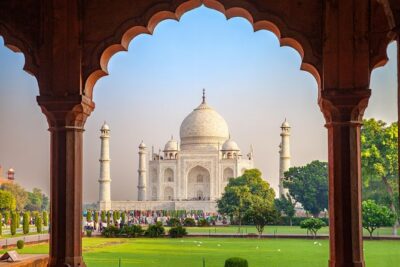
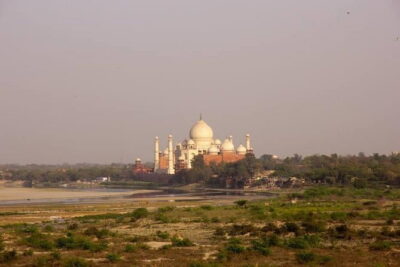
Agra is the emotional center of this trip, with the Taj Mahal as the headline. It’s a UNESCO World Heritage site and an immense white-marble mausoleum commissioned by Shah Jahan in the 1600s. What you should keep in mind is that the Taj is more than an object—you’re watching a whole worldview in stone and symmetry. It’s easy to stare in the best way.
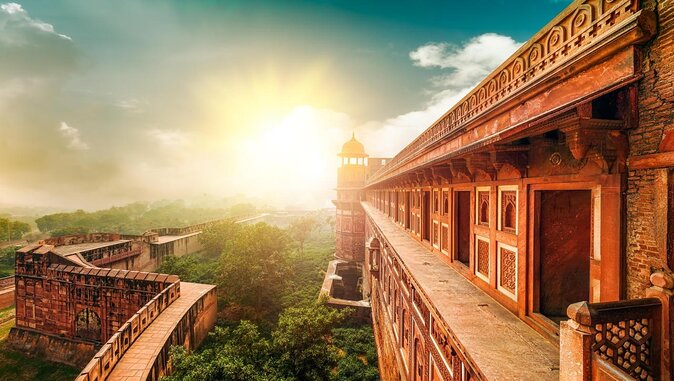
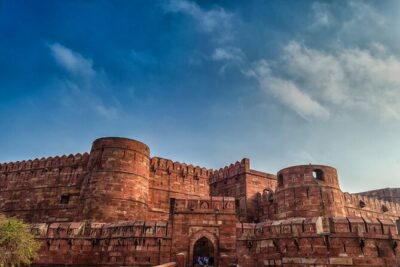
After that, you move to Agra Fort, another UNESCO site and a Mughal fortress close to the Taj gardens. It’s inside a 2.5-kilometer enclosure wall and includes palaces like Jahangir Palace and Khas Mahal, plus audience halls such as Diwan-i-Khas, and two mosques. This is the companion piece to the Taj: instead of romance, you get administration, power, and the daily workings behind the grandeur.
Then comes Fatehpur Sikri, a short ride away, described as a small city founded by a 16th-century Mughal emperor, with red sandstone buildings clustering around the center. The highlights listed are practical landmarks you can actually follow on-site: Buland Darwaza gate, Jama Masjid, the marble Tomb of Salim Chishti, the Diwan-E-Khas hall, Jodha Bai Palace mixing Hindu and Mughal styles, and the Panch Mahal with its five tiers.
Fatehpur Sikri is often a “choose-your-moment” stop. It can feel like a lot because you’re stepping between many named structures. But that’s also why it works on this tour: your earlier Agra focus primes your eyes to see Mughal court life as a system, not just a single building.
Tip for your day: don’t treat Agra as a race. If you rush the Taj, Agra Fort and Fatehpur Sikri will feel like checkboxes. If you slow down slightly, the contrasts start to click.
Jaipur Day: Amber Palace and Jantar Mantar for the Rajput Meets Science Mix
Jaipur day starts with Amber Palace, a UNESCO World Heritage site and the former bastion of the Kachwahas of Amber. It sits in craggy hills, and it’s described as a blend of Hindu and Mughal styles. This is a good choice for starting Jaipur because you get dramatic setting plus architectural details that aren’t as repetitive as the flat-city monuments.
Then you go to Jantar Mantar, also UNESCO-listed. This place is different in a great way: it’s the largest of five astronomical observatories built by Maharaja Sawai Jai Singh II. The site includes sixteen geometric devices designed to measure time, track celestial bodies, and observe orbits. The Interpretation Centre is specifically mentioned to help you understand how the instruments work and the chronology of the observatory.
I love stops like this on a Golden Triangle trip because it stops the pattern of only seeing tombs and forts. It also helps you notice something: Jaipur wasn’t only about royal power—it was about calculation and observation, too.
Practical note: entrance fees aren’t included here, so add that to your budget. Also, since it’s an outdoor site with instruments, plan for sun and take breaks when your feet start complaining.
Chasing the Pink City? More Jaipur day trips
City Palace and Hawa Mahal: The Royal Jaipur Finale That’s Built for Views
The Jaipur finale focuses on two iconic royal-era structures, plus the royal family connection.
First is City Palace of Jaipur, located within the walled city. It was conceived and built by Maharaja Sawai Jai Singh II and is described as a fusion of Mughal and Rajput architecture. It’s still home to the last ruling royal family, with a private section they live in, which gives the site a lived-in feel rather than a fully frozen museum vibe.
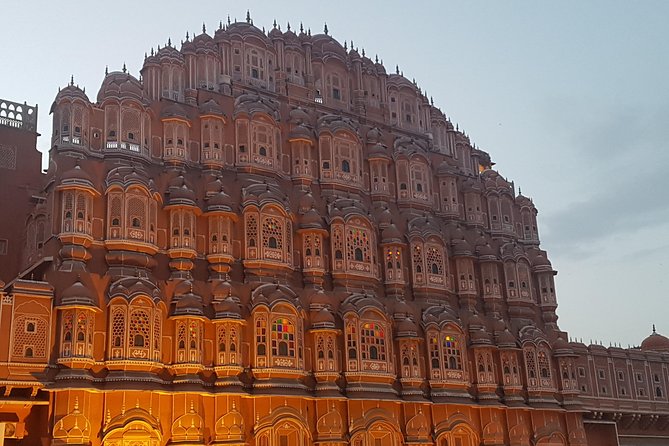
Then you reach Hawa Mahal, the Palace of Wind. Built in 1799, it’s a five-storey structure with jharokhas—small latticed windows—designed so royal women could observe everyday life without being seen. The exterior shape is even said to resemble the crown of Lord Krishna, and it’s a blend of Hindu and Islamic architecture.
Two things to keep in mind here:
- It’s easy to photograph Hawa Mahal quickly, but it’s more satisfying when you also understand why the windows exist.
- City Palace is easier to enjoy at a slower pace; if you rush, you miss the architecture transitions.
This is also where the “private group” part really helps. You can take your time without trying to keep up with a random crowd.
Price and Value: What the $240 Covers (and What You Must Budget)
At $240 per person for a roughly 5-day Golden Triangle with chauffeur-driven A/C private vehicle and transfers, the value is mostly in avoiding friction. Between Delhi–Agra and Agra–Jaipur, transportation time can eat your energy. Here, you’re paying for someone else to handle the driving, fuel-related costs, parking, tolls, and the general logistics of getting you from one timed stop to the next.
Included items you’ll actually feel:
- Bottled water
- Pickup offered
- Mobile ticket
- Fuel, parking, toll & taxes for interstate transfers
- Professional tour guide only if you book the tour option that includes one
Not included items you must plan for:
- Monument entrance fees
- Food and drinks
- Accommodation
- Tips/gratuities (recommended)
- Souvenir photos (optional for purchase)
- Alcoholic drinks (available to purchase)
So the best way to look at this price is like this: you’re buying a structured route and transportation comfort. You’re not buying full-board sightseeing. If you’re the type who already knows you’ll pay entrance fees and eat out each day, this works well. If you’re trying to keep costs ultra-tight, you’ll want to track entrance fees closely for each site.
Should You Book This Golden Triangle Tour?
I’d book it if you want the Golden Triangle in a stress-reducing format: private A/C driving, sensible sequencing, and a guide/driver combo that can keep you oriented. It’s especially a good match if safety and comfort matter for you, and you like the idea of balancing major monuments with a few additional stops like Agrasen Ki Baoli and Jantar Mantar.
I’d hesitate if you hate paying on top of the base price for entrances and meals, since this route includes several major sites where tickets are separate. Also note that accommodation isn’t included, so you’ll need to arrange your own hotel for the nights in Delhi/Agra/Jaipur.
If you’re okay with that budgeting reality, this tour is a practical way to see Delhi, Agra, and Jaipur without burning your trip on logistics.
FAQ
What’s included in the tour price?
The tour includes chauffeur-driven A/C private vehicle for transfers, fuel, parking charges, toll & taxes for interstate transfers, bottled water, and mobile tickets. A professional tour guide is included only if you book the tour option that includes a guide.
Are monument entrance fees included?
No. Monument entrance fees are not included. The listed stops generally show admission tickets as not included, except Fatehpur Sikri where admission is listed as free.
What’s not included?
Not included are monument entrances, alcohol, tips/gratuities, souvenir photos, and food and drinks, plus accommodation.
Where does the tour start and end?
It starts at New Delhi (meeting point in New Delhi, National Capital Territory of Delhi) and ends back at the meeting point, with a final drop at the Jaipur airport.
Is pickup offered?
Yes, pickup is offered.
How long is the tour?
It’s listed as 4 nights / 5 days (approximately), covering Delhi, Agra, and Jaipur.
Do I need a passport?
Yes. A current valid passport is required on the day of travel.
Can I cancel for a full refund?
You can cancel up to 24 hours in advance for a full refund. Changes made less than 24 hours before the start time aren’t accepted, and cancellations within 24 hours aren’t refunded.
The Full Golden Triangle, More Options
- 3-Days Private Golden Triangle Tour: Delhi, Agra & Jaipur by Car
★ 5.0 · 1,107 reviews - 3-Days Private Golden Triangle Tour: Delhi, Agra & Jaipur by Car
★ 5.0 · 1,098 reviews - 3-Day Delhi, Agra and Jaipur Private Tour – India Golden Triangle
★ 5.0 · 812 reviews - Four-Day Private Luxury Golden Triangle Tour to Agra and Jaipur From New Delhi
★ 5.0 · 807 reviews - 5 Nights 6 Days Private Golden Triangle Tour – Delhi Agra Jaipur
★ 5.0 · 574 reviews
Onward to Jaipur: More Day Trips
- 3-Days Private Golden Triangle Tour: Delhi, Agra & Jaipur by Car
★ 5.0 · 1,107 reviews - 3-Days Private Golden Triangle Tour: Delhi, Agra & Jaipur by Car
★ 5.0 · 1,098 reviews - 3-Day Delhi, Agra and Jaipur Private Tour – India Golden Triangle
★ 5.0 · 812 reviews - Four-Day Private Luxury Golden Triangle Tour to Agra and Jaipur From New Delhi
★ 5.0 · 807 reviews - Jaipur Day Trip from Delhi by Car or Train – All Inclusive
★ 5.0 · 663 reviews
More Agra Day Trips out of Delhi
- Same Day Taj Mahal, Agra Fort & Baby Taj Tour from Delhi by Car
★ 5.0 · 4,304 reviews - Full Day Taj Mahal, Agra Fort & Baby Taj Tour from Delhi by Car
★ 5.0 · 3,647 reviews - From Delhi: Taj Mahal & Agra Private Day Trip with Transfers
★ 4.9 · 3,181 reviews - From Delhi: Taj Mahal and Agra Fort Private Sunrise Tour
★ 4.9 · 2,270 reviews - Sunrise Taj Mahal, Agra Fort & Baby Taj Tour from Delhi by Car
★ 5.0 · 2,243 reviews
Just added: more New Delhi reviews to browse
- 7 Days Golden Triangle Private Tour – Delhi Agra Jaipur Tour from Delhi★ 5.0 · 5 reviews
- 5-Day Private Luxury Golden Triangle Tour to Agra and Jaipur★ 5.0 · 5 reviews
- Agra: Taj Mahal Vip tickets with Professional Photographer★ 3.6 · 5 reviews
- Taj Mahal Tour By Superfast Train From Delhi★ 5.0 · 5 reviews
- Private Night View of Delhi Tour 4 Hours★ 5.0 · 5 reviews
- From Delhi: Same Day Taj Mahal, Agra Day Tour By Car★ 5.0 · 5 reviews
Agra Day Trips from Delhi, compared.
 ★ 5.0Same Day Taj Mahal, Agra Fort & Baby Taj Tour from Delhi by CarFrom $624,304 reviews
 ★ 5.0Full Day Taj Mahal, Agra Fort & Baby Taj Tour from Delhi by CarFrom $623,647 reviews
 ★ 4.9From Delhi: Taj Mahal & Agra Private Day Trip with TransfersFrom $43,181 reviews
 ★ 4.9From Delhi: Taj Mahal and Agra Fort Private Sunrise TourFrom $592,270 reviews
 ★ 5.0Sunrise Taj Mahal, Agra Fort & Baby Taj Tour from Delhi by CarFrom $622,243 reviews
 ★ 5.0Taj Mahal and Agra Private Car Tour from Delhi with 5* LunchFrom $331,633 reviews
 ★ 4.9From Delhi: Private Taj Mahal and Agra Tour by Express TrainFrom $751,605 reviews
 ★ 5.0Taj Mahal, Agra Fort, Baby Taj Tour from Delhi by Superfast TrainFrom $751,494 reviews
Browse the lists this tour appears in