
Reviewed · AGRA DAY TRIPS FROM DELHI
3-Day Delhi, Agra and Jaipur Private Tour – India Golden Triangle
If you like your sightseeing with a plan, this one fits. You cover Delhi, Agra, and Jaipur in a private, air-conditioned vehicle, with local guides and most key entry tickets handled for you. The big win is pacing: you get a full old-and-new Delhi day, then an early Taj Mahal sunrise, then the Jaipur classics without feeling rushed… too much.
I especially love the mix of big-ticket icons and hands-on street time, like the rickshaw ride through Chandni Chowk after Jama Masjid. I also like the comfort factor: you travel door-to-door with pickup, bottled water, and a real break from constant transit headaches.
One thing to consider: the schedule is packed, and a few stops are viewpoint-only (or entry is restricted), like seeing Red Fort from outside and taking photos at spots where you can’t go in.
In This Review
- Key highlights you’ll actually feel
- Price and logistics: what you’re paying for
- Day 1 in Delhi: Old Delhi lanes, Mughal monuments, and a smooth photo plan
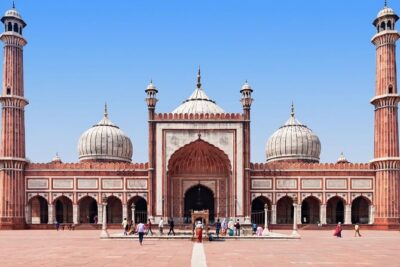
- Jama Masjid: start where the city’s energy lives
- Chandni Chowk by rickshaw: street-level Delhi
- Red Fort from outside: big sights, smart timing
- Humayun’s Tomb and New Delhi monuments: Mughal to imperial Delhi
- Qutub Minar and Lotus Temple: two very different UNESCO-era vibes
- Day 2: sunrise Taj Mahal, Agra Fort, and a long Fatehpur Sikri stop
- The Taj Mahal at sunrise: not just a photo, a mood
- Agra Fort: the Taj’s tougher neighbor
- Fatehpur Sikri on the route: a big culture hit without extra city hotel time
- Day 3 Jaipur: City Palace, Jantar Mantar, and classic skyline photos
- Jal Mahal: palace on the lake, photo-friendly reality
- City Palace: where the rulers lived and ruled
- Jantar Mantar: the royal observatory that still feels clever
- Hawa Mahal: the Palace of Winds, viewpoint-only
- Patrika Gate and your early afternoon finish
- Guides and drivers: why this tour feels easier than DIY
- What might not fit everyone
- Who should book this private Golden Triangle tour?
- Should you book? My practical take
- FAQ
- What cities does the tour cover?
- What time does the Taj Mahal sunrise start?
- Is transport private and air-conditioned?
- Are monument entrance fees included?
- Does the tour include hotel stays?
- Are breakfast meals included?
- Does the tour include pickup in Delhi?
- Is there a rickshaw ride?
- Which stops are viewpoint-only?
- What’s the cancellation policy?
Key highlights you’ll actually feel
- Sunrise Taj Mahal at 6:00 AM: early pickup to catch the light before the day crowds.
- Old Delhi by rickshaw: narrow lanes, spice markets, and a guide to make sense of what you’re seeing.
- Comfort-first private transport: air-conditioned car with driver across three cities.
- Guides plus key entry tickets: monument fees are handled when the option is booked, with guided context throughout.
- Fatehpur Sikri stop on the road: a long transit-day moment that’s more than just driving.
- Jaipur photo stops where entry is restricted: great views even when you’re not going inside.
Price and logistics: what you’re paying for
At $176.72 per person for three days, the value here comes less from “cheap” and more from “organized.” You’re paying for a private driver and vehicle, private local guides across multiple sites, and (when your option includes it) the monument entrance fees. You also get two nights of hotel in Agra and Jaipur, each with breakfast.
For a Golden Triangle route, the real cost usually isn’t the monuments. It’s the time and stress of moving between cities and figuring out tickets, queues, and transport. This tour takes those decisions off your plate and gives you a clear day-by-day flow.
The one tradeoff is that “private” still means “tight schedule.” You’re on the road a lot, and some attractions are treated as photo-and-exterior stops. If you’re the type who wants long, slow museum time or lots of free wandering, you’ll want to keep some buffer days elsewhere.
Other Agra runs out of Delhi worth a look




Day 1 in Delhi: Old Delhi lanes, Mughal monuments, and a smooth photo plan
Your day starts with pickup at 9:00 AM from your chosen location, then you jump into Old and New Delhi in one connected sweep. The structure works: you begin with major Mughal-era landmarks while you’re still fresh, then you shift toward Delhi’s more modern landmarks later.
Jama Masjid: start where the city’s energy lives
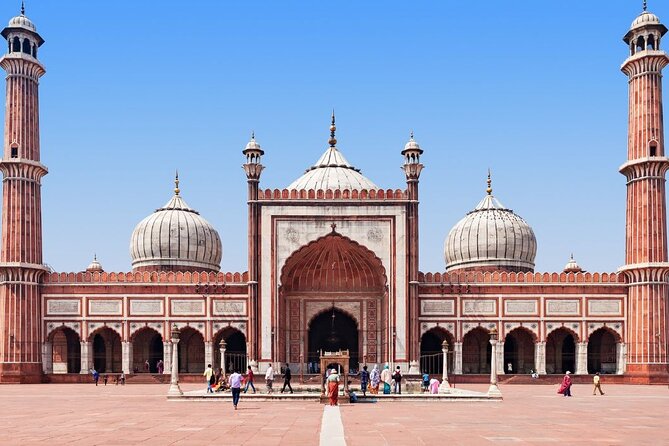
You visit Jama Masjid with an admission ticket included. It’s one of Delhi’s headline mosques, and the guide context matters here because the place isn’t just pretty architecture—it’s part of how people experience the city today. Going early in the day also helps with crowds.
Chandni Chowk by rickshaw: street-level Delhi
Next comes Chandni Chowk, where you do a rickshaw ride through the narrow shopping lanes. This is where your eyes do most of the work: spice stalls, busy lanes, and all that visual noise that makes Old Delhi feel real instead of staged.
If you’ve ever wished a guide could explain what you’re seeing (and keep you from feeling lost), this is that moment. Also, the rickshaw segment makes it easier to cover the area without walking every inch.
Red Fort from outside: big sights, smart timing
Then you head to Red Fort, but you’ll view it from outside. The tour notes that a large part is acquired by the Indian Army, so you’re not going to do a full inside visit here. Still, it’s a strong photo stop, and your guide can point you to what you should notice from the exterior.
Chasing the Pink City? More Jaipur day trips
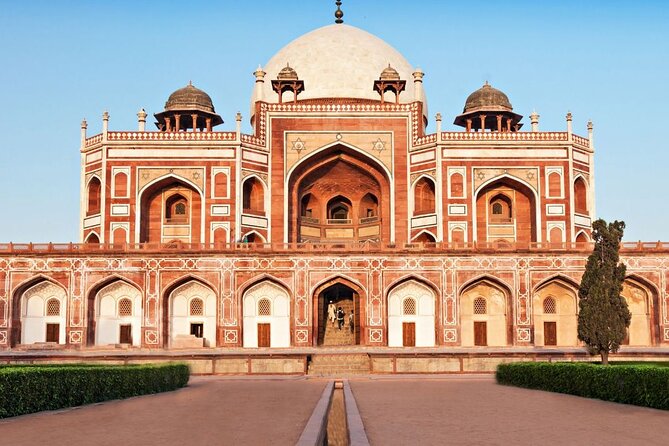
Humayun’s Tomb and New Delhi monuments: Mughal to imperial Delhi
After lunch, you shift to Humayun’s Tomb (included), another Mughal landmark tied to the emperor Humayun. It’s a good contrast to the chaos of Old Delhi—more orderly, more spaced out, and easier to take in slowly.
Then you drive past India Gate and Parliament House for photo time. These stops are quick, but they’re useful because your guide frames what these buildings mean in Delhi’s story. You aren’t losing a whole block of time to them, so the day stays efficient.
Qutub Minar and Lotus Temple: two very different UNESCO-era vibes
You finish with Qutub Minar (included), part of the Qutb complex, which is listed as a UNESCO World Heritage Site. This is a great “architecture brain” stop—when you look at it with context, the minaret feels like part of a larger complex rather than a standalone tower.
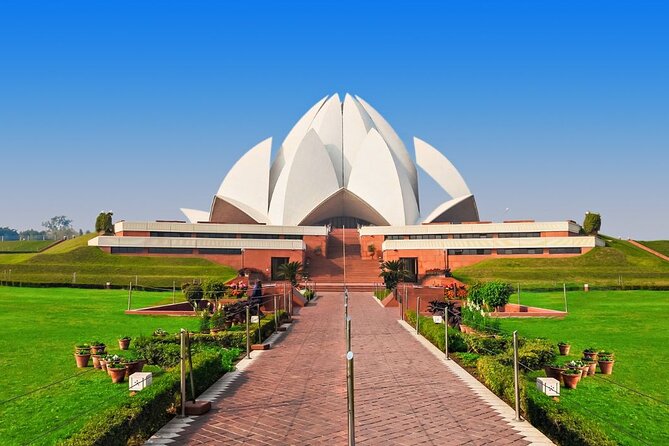
Finally, Lotus Temple is on the list (free). It’s a Bahá’í House of Worship with a flower-like shape and a calm, modern feel. It’s short on time, but it gives your day a clean landing.
Day 1 value: you stack the most important Delhi signals—Old Delhi intensity, Mughal artistry, then New Delhi landmarks—without bouncing around randomly.
Day 2: sunrise Taj Mahal, Agra Fort, and a long Fatehpur Sikri stop
Day 2 is the day Golden Triangle trips live or die by. You get an early pickup at 6:00 AM to see the sunrise view of the Taj Mahal, then you head back to the hotel afterward.
The Taj Mahal at sunrise: not just a photo, a mood
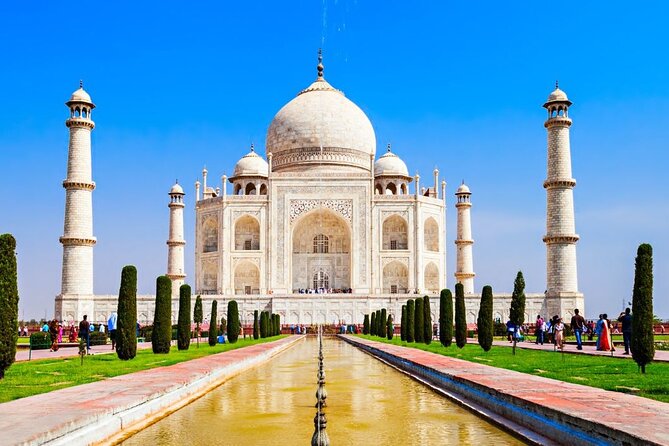
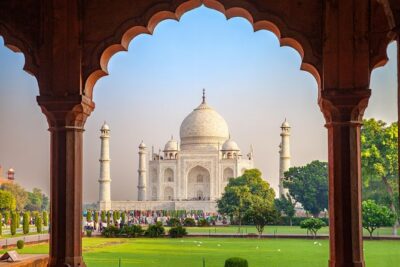
You’ll spend about two hours at the Taj Mahal with an admission ticket included. Sunrise here matters because the lighting shifts the marble’s tone and gives the mausoleum a softer presence than midday glare. You’ll also beat some of the day rush, so you can actually look instead of just queue.
This is the one stop where you’ll feel like the “Golden Triangle” label earns its name. Even if you’ve seen photos before, seeing it in person changes the scale. The details of the marble work and the setting along the river bank hit differently when you’re there.
Agra Fort: the Taj’s tougher neighbor
After breakfast and check-out, you visit Agra Fort (about one hour, included). The fort is a historical power base tied to Agra’s rulers. It’s a different energy than the Taj: more defensive, more stone-and-structure, less pure symmetry.
Fatehpur Sikri on the route: a big culture hit without extra city hotel time
Then you drive toward Jaipur with a stop at Fatehpur Sikri Fort, with around 5 hours noted. This is a major value add. It turns a transit day into a meaningful sightseeing day because Fatehpur Sikri is a full, immersive place rather than a quick stop.
The key point: you’re not just traveling between cities. You’re getting a Mughal-era site that feels like a step into another era of statecraft and city planning.
Day 2 value: the morning Taj sets your emotional high point, and Fatehpur Sikri stops the drive from feeling like wasted time.
Day 3 Jaipur: City Palace, Jantar Mantar, and classic skyline photos
You start Jaipur with breakfast, then the day shifts into Jaipur’s landmark rhythm: palace power, scientific royal planning, and iconic facades built for views.
Jal Mahal: palace on the lake, photo-friendly reality
You head to Jal Mahal (Palace on the Lake), with time around 30 minutes. Entrance is prohibited, but you can click photos from the outside. It’s one of those Jaipur scenes that makes sense as a short stop: you get the postcard view without losing half your day hunting for access.
City Palace: where the rulers lived and ruled
Next is City Palace (about 2 hours, included). The tour context highlights that the palace was established when Jaipur was founded, linked to Maharaja Sawai Jai Singh II, and that the court moved from Amber to Jaipur in 1727. That background helps because it stops City Palace from being just “another palace.” It becomes a living center of power and continuity.
Jantar Mantar: the royal observatory that still feels clever
Then you visit Jantar Mantar, the observatory area (about 1 hour, included). The tour notes it’s a set of nineteen architectural astronomical instruments, completed in 1734, built by Sawai Jai Singh II. This is a great stop if you like learning how old people solved big problems with stone tools.
It’s also good pacing. It breaks up the palace-and-fort flow with something more “thinky,” but it still looks dramatic.
Hawa Mahal: the Palace of Winds, viewpoint-only
You finish the Jaipur monument core with Hawa Mahal. Entrance is prohibited, but you can take photos. This is exactly why it works in a day tour: you get the famous facade moment without turning the day into a long interior visit.
Patrika Gate and your early afternoon finish
Before you wrap up, the tour includes Patrika Gate as a photography stop, then ends around 2:00 PM. That timing is actually practical. If you’re catching an airport, or you just want a head start on your own Jaipur evening plans, you’re not stuck waiting until late night.
Day 3 value: you get the headline Jaipur sights plus a science stop, and you’re done early enough to breathe afterward.
Guides and drivers: why this tour feels easier than DIY
The tour’s success depends on the humans driving it. The reviews you provided point to a pattern: guides who explain clearly and drivers who keep things on time.
For Delhi and Old Delhi, names like Danish show up with notes about patience and help, and for Agra, Varun Gupta is mentioned for strong guide work around the Taj. In Jaipur, Kamran appears often, with comments about friendliness and detailed explanations. Other guides named include Karma, Vipin (with a fun note about singing), and Kishor (described as very informative). On the driving side, Zeeshan is mentioned as punctual with a comfortable car and good AC, and MD Raja is also called out as a top driver.
You can’t assume you’ll get the exact same guide, of course. But you can plan for what the experience is designed to do: reduce your effort and increase your understanding so the monuments land with meaning.
What might not fit everyone
This tour is ideal for people who like structure. If you want long breaks or lots of free time at each site, the schedule may feel tight. A big clue is that several highlights are explicitly viewpoint-only: Red Fort from outside, Jal Mahal with entrance prohibited, and Hawa Mahal with entrance prohibited. Those are still great experiences, but they’re not the same as going in and wandering at your own pace.
Also, consider energy levels. Day 2 begins very early for the Taj Mahal sunrise. If you’re not a morning person, you’ll still get it done, but expect it to feel like an early start day rather than a relaxed vacation morning.
Who should book this private Golden Triangle tour?
This is a strong choice if you:
- Want private transport with a driver and air-conditioning, especially for comfortable city-to-city driving.
- Prefer having local guides so the history connects to what you’re seeing.
- Like a trip that hits the major sights efficiently—Taj Mahal, Agra Fort, Fatehpur Sikri, City Palace, Jantar Mantar, and the Jaipur skyline shots.
- Travel as a group or family and want the schedule tailored to fewer people.
It may be less ideal if you:
- Want lots of unplanned time in each city.
- Hate early mornings or long driving days.
- Are specifically looking for lots of interior access at every stop (some are viewpoint-only).
Should you book? My practical take
Yes, if you want a smooth, guided Golden Triangle with less logistics work and a sunrise Taj Mahal plan. The value isn’t just in the sites. It’s in the coordination: pickup, guides, key admissions (when included), hotel nights with breakfast, and a driver who keeps the days moving.
If you’re flexible about a few restricted-entry photo stops and you can handle a big early morning, this tour makes the route feel manageable. It’s the kind of itinerary that gives you real highlights without turning your vacation into an all-day problem-solving exercise.
FAQ
What cities does the tour cover?
It’s a 3-day road trip covering Delhi, Agra, and Jaipur.
What time does the Taj Mahal sunrise start?
You get an early pickup from your hotel at 6:00 AM for the sunrise view.
Is transport private and air-conditioned?
Yes. You travel in private air-conditioned transport with a driver.
Are monument entrance fees included?
Entrance fees are included when the option is booked. Some stops are listed as free admission tickets, depending on the site.
Does the tour include hotel stays?
Yes. It includes two nights of 3- or 5-star accommodation in Agra and Jaipur, with breakfast.
Are breakfast meals included?
Breakfast is included for two days.
Does the tour include pickup in Delhi?
Yes. Hotel or airport pickup and drop-off in Delhi is included, and pickup can be arranged from your preferred location on Day 1.
Is there a rickshaw ride?
Yes. You take a rickshaw ride through Chandni Chowk.
Which stops are viewpoint-only?
The tour includes outside viewing for Red Fort, and entrance is prohibited at Jal Mahal and Hawa Mahal (photos only).
What’s the cancellation policy?
There is free cancellation up to 24 hours in advance for a full refund.
The Full Golden Triangle, More Options
- 3-Days Private Golden Triangle Tour: Delhi, Agra & Jaipur by Car
★ 5.0 · 1,107 reviews - 3-Days Private Golden Triangle Tour: Delhi, Agra & Jaipur by Car
★ 5.0 · 1,098 reviews - 3-Day Delhi, Agra and Jaipur Private Tour – India Golden Triangle
★ 5.0 · 812 reviews - Four-Day Private Luxury Golden Triangle Tour to Agra and Jaipur From New Delhi
★ 5.0 · 807 reviews - 5 Nights 6 Days Private Golden Triangle Tour – Delhi Agra Jaipur
★ 5.0 · 574 reviews
Onward to Jaipur: More Day Trips
- 3-Days Private Golden Triangle Tour: Delhi, Agra & Jaipur by Car
★ 5.0 · 1,107 reviews - 3-Days Private Golden Triangle Tour: Delhi, Agra & Jaipur by Car
★ 5.0 · 1,098 reviews - 3-Day Delhi, Agra and Jaipur Private Tour – India Golden Triangle
★ 5.0 · 812 reviews - Four-Day Private Luxury Golden Triangle Tour to Agra and Jaipur From New Delhi
★ 5.0 · 807 reviews - Jaipur Day Trip from Delhi by Car or Train – All Inclusive
★ 5.0 · 663 reviews
More Agra Day Trips out of Delhi
- Same Day Taj Mahal, Agra Fort & Baby Taj Tour from Delhi by Car
★ 5.0 · 4,304 reviews - Full Day Taj Mahal, Agra Fort & Baby Taj Tour from Delhi by Car
★ 5.0 · 3,647 reviews - From Delhi: Taj Mahal & Agra Private Day Trip with Transfers
★ 4.9 · 3,181 reviews - From Delhi: Taj Mahal and Agra Fort Private Sunrise Tour
★ 4.9 · 2,270 reviews - Sunrise Taj Mahal, Agra Fort & Baby Taj Tour from Delhi by Car
★ 5.0 · 2,243 reviews
Just added: more New Delhi reviews to browse
- 4 days Golden Triangle Tour★ 5.0 · 3 reviews
- Discover Old & New Delhi: Private Tour with Street Food★ 5.0 · 3 reviews
- Taj Mahal Tour From Delhi By Private Car★ 4.5 · 3 reviews
- Golden Triangle Tour 5 Days★ 5.0 · 3 reviews
- Taj Mahal: Express Entry Ticket For Sunset Tour with guide★ 5.0 · 3 reviews
- Agra Taj Mahal Sunrise & Sunset Tour from Delhi★ 5.0 · 3 reviews
Agra Day Trips from Delhi, compared.
 ★ 5.0Same Day Taj Mahal, Agra Fort & Baby Taj Tour from Delhi by CarFrom $624,304 reviews
 ★ 5.0Full Day Taj Mahal, Agra Fort & Baby Taj Tour from Delhi by CarFrom $623,647 reviews
 ★ 4.9From Delhi: Taj Mahal & Agra Private Day Trip with TransfersFrom $43,181 reviews
 ★ 4.9From Delhi: Taj Mahal and Agra Fort Private Sunrise TourFrom $592,270 reviews
 ★ 5.0Sunrise Taj Mahal, Agra Fort & Baby Taj Tour from Delhi by CarFrom $622,243 reviews
 ★ 5.0Taj Mahal and Agra Private Car Tour from Delhi with 5* LunchFrom $331,633 reviews
 ★ 4.9From Delhi: Private Taj Mahal and Agra Tour by Express TrainFrom $751,605 reviews
 ★ 5.0Taj Mahal, Agra Fort, Baby Taj Tour from Delhi by Superfast TrainFrom $751,494 reviews