
Reviewed · TAJ MAHAL TOURS FROM DELHI
4 days Golden Triangle tour of Delhi, Taj Mahal in Agra & Jaipur with Guide
Four days, three cities, one big wow. This Golden Triangle style tour strings together Delhi’s landmark Mughal and early Indian sites, Jaipur’s royal sights, and Agra’s world-class monuments, with Taj Mahal as the emotional payoff and Qutub Minar as the perfect opener. You ride in a private car with an included guide, so you’re not just moving between crowds—you’re getting context as you go.
I especially like the way the day in Delhi mixes scale and mystery: Qutub Minar sets the tone, and the Iron Pillar’s rust-resistant legend adds a fun, real-world puzzle. I also like that the guide and driver can make it feel smooth in the real world—Balwinder, in particular, comes up as patient, flexible, and comfortable with English so you can ask questions and adjust when you need to.
The main tradeoff is pace. With an early start and multiple major stops packed in, you’ll spend serious time on the road between cities, and you may have extra costs for meals (and note that tickets for Jal Mahal and Hawa Mahal are marked as not included).
In This Review
- Key highlights
- Golden Triangle in four days: what the pace really feels like
- Delhi starts with Qutub Minar and the Iron Pillar puzzle
- Humayun’s Tomb, India Gate, and Rashtrapati Bhavan in one day
- The drive to Jaipur: Amber Fort at late-morning light
- Jal Mahal and Hawa Mahal: two Jaipur icons with different vibes
- City Palace and Jantar Mantar: Jaipur’s planning side
- Fatehpur Sikri: Akbar’s red-sandstone world near Agra
- The Taj Mahal: why the tour includes details beyond the postcard
- Price and logistics: when this feels like good value
- Who should book this Golden Triangle with a guide?
- Should you book this tour?
- FAQ
- What cities are included in this Golden Triangle tour?
- How long is the tour and how many nights does it include?
- What time does the tour start?
- Is transportation and a guide included?
- Are entrance tickets included?
- Are meals included?
- Is this a private tour or a shared group?
- What is the cancellation and refund timing?
- What happens if the tour can’t run due to weather?
Key highlights
- Private car + guide focus so you get explanations, not just photos
- Iron Pillar and Qutub Minar for history with built-in mystery
- Amber Fort + palace architecture stops in Jaipur without feeling rushed through “just photos”
- Jantar Mantar’s giant stone sundial for a side of India that’s less tour-bus standard
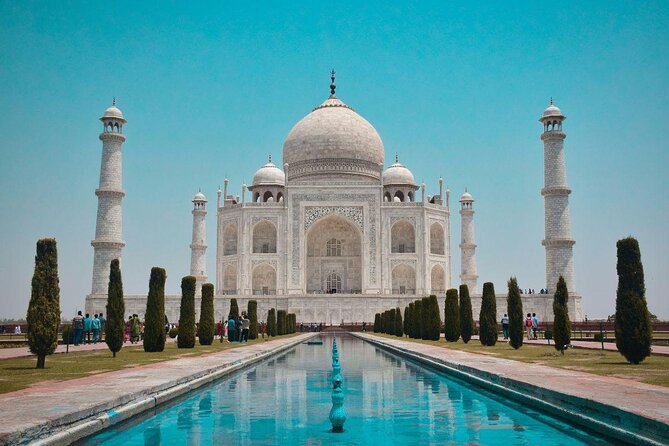
- Taj Mahal materials story that makes the monument feel even more human
Golden Triangle in four days: what the pace really feels like
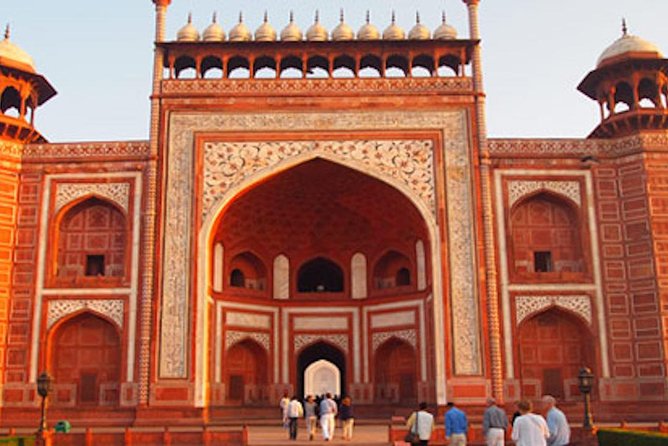
This is a classic fast loop through Delhi, Agra, and Jaipur, designed to hit big-name World Heritage sites while still adding a few well-chosen extras. The route starts with an early departure and then keeps momentum—so you should treat it like a structured sightseeing sprint, not a slow “wander and linger” trip.
If you like to see a lot and you’re fine with early mornings, this format works. You’ll get a day-by-day sense of theme too: Delhi for the Mughal and early Sultanate feel, Jaipur for Rajput grandeur and city design, Agra for Mughal mastery plus the emotional center of the Taj. And because it’s a private setup for your group, you’re more likely to get pacing that fits your needs.
The best part is that the guide is there for transitions—how one empire’s style influences the next, and why certain monuments were built the way they were. That context is what turns a checklist trip into something that sticks in your head.
More ways to reach the Taj, weighed side by side



Delhi starts with Qutub Minar and the Iron Pillar puzzle
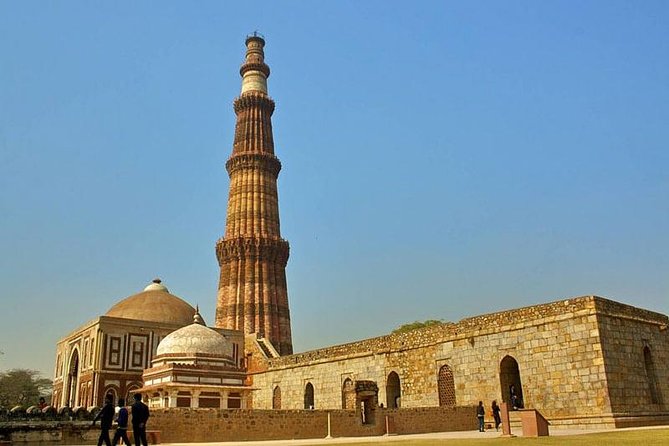
You kick off Delhi at Qutub Minar, a huge statement from the Sultanate era. Construction is credited to Qutub-ud-din Aibak, starting around 1199, with completion by Iltutmish in 1236—so the monument carries layers of time in its very existence. If you’ve only ever seen one “tower” in India before, this one changes your scale expectations.
Right after, you hit the Iron Pillar, where the wow is not just size (it stands about 24 feet and weighs around 6 tons) but also the rust story. The pillar is made of 98% wrought iron, and the mystery is that it’s resisted rust for centuries. People argue about its original purpose—everything from a royal marker to a sun-dial idea—so even if you don’t solve it, you’ll feel like you stepped into a real historical riddle.
These two stops work together. Qutub Minar shows power made visible through architecture; the Iron Pillar shows knowledge and craftsmanship that seems to have outlived the reasons we can no longer fully explain.
Humayun’s Tomb, India Gate, and Rashtrapati Bhavan in one day
The day keeps its Mughal momentum with Humayun’s Tomb, built with the feel of a palace rather than a simple burial spot. It’s often described as the first strong example of Mughal architecture in India, and it’s one of the better-preserved sites in that style. You’ll get the sense that the Mughals weren’t just building monuments—they were building a whole worldview.
Then you shift from Mughal grandeur to national memory at India Gate. The memorial commemorates soldiers who lost their lives in World War I, tied specifically to the Afghan war of 1919, and it lists names of more than 13,516 British and Indian soldiers. Even if you’re not a history-nerd, this stop gives the day emotional grounding.
Rashtrapati Bhavan closes the loop with modern power placed inside older design ideas. The Mughal Gardens behind the presidential residence blend Mughal and English landscaping styles and include lots of flowers. It’s a quick visit, but it helps you understand how Delhi holds different eras at the same address.
The drive to Jaipur: Amber Fort at late-morning light
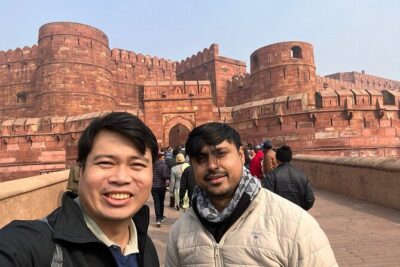
After an early departure from Delhi, Jaipur arrives on schedule—built for efficiency, not spontaneity. The first major stop is Amber Fort, and you’ll likely feel why people treat it as a must. Amber’s walls were meant to defend residents, and the mix of red sandstone with white marble gives it that classic “royal drama” look.
Amber Fort is also a place where you can appreciate how rulers projected control—through defenses, through building materials, and through decoration. The backdrop of Maota Lake adds a calmer visual frame around all that stone.
You’ll have about an hour here, which is enough to see the main impressiveness without turning it into a blur. Still, if you hate crowds, try to keep your expectations flexible. Fort sites can get busy, and the best strategy is to focus on key viewpoints and let the rest happen around you.
Jal Mahal and Hawa Mahal: two Jaipur icons with different vibes
From the fortress energy, you go to the lake setting of Jal Mahal, the Water Palace. It sits low-rise on the water of Sagar Lake and looks like it floats, with light sand-colored stone contrasting against deep blue water. It’s short and scenic, a good palate cleanser after Amber’s walls.
Then comes Hawa Mahal, the Palace of Wind. Built in 1798 by Maharaja Sawai Pratap Singh, it’s famous for its five-storey honeycomb shape and 953 small windows called jharokas, all with lattice work. The fun part is the design logic: the windows were planned so cool breezes could travel inside across seasons.
One practical note: the admission tickets for Jal Mahal and Hawa Mahal are marked as not included. That doesn’t ruin the day, but it means you should budget a little extra if you want to go in rather than just view from outside.
These two stops are a contrast pair. Jal Mahal is quiet and reflective; Hawa Mahal is a visual maze, more about design and city life than sweeping landscape.
Other Agra runs out of Delhi worth a look

City Palace and Jantar Mantar: Jaipur’s planning side
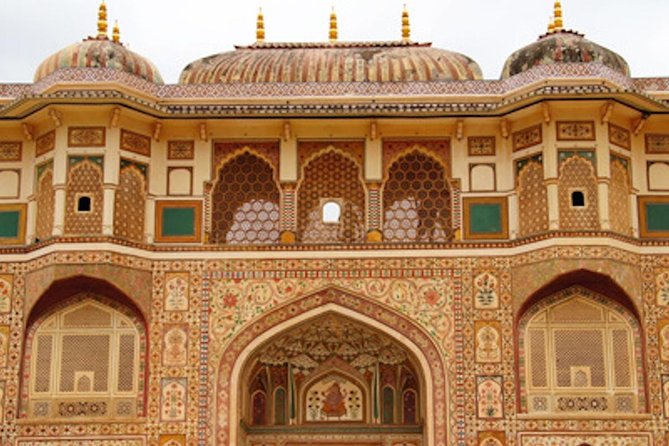
At City Palace, you get the royal center with a mix of gardens, courtyards, temples, and a museum area. The architecture reflects a fusion of Mughal and Rajput styles, which helps explain why Jaipur feels different from other Rajasthan cities. Instead of being only about defense or only about temples, City Palace shows the in-between role of a capital: administration, ritual, and daily power.
After that, the tour shifts toward the brainy and surprising with Jantar Mantar. This is an 18th-century astronomical observatory built by Sawai Jai Singh in 1730, designed to correct astronomical tables for planetary positions. The collection includes 19 instruments, and the highlight is the Smarat Yantra, described as the world’s biggest stone sundial.
If your last museum stop was just rooms of objects, this one hits differently. You’re looking at tools built for measurement, not display cases, and it helps you understand how science and empire-building went together. Even if you don’t read the instruments, you’ll likely find it more memorable than a typical palace “walk-through.”
Fatehpur Sikri: Akbar’s red-sandstone world near Agra
On the way to Agra, you go to Fatehpur Sikri, the ancient city near Agra built by Akbar. It’s known for Persian design influence, reportedly inspired by Persian courts connected to Timur, but you also see elements of Hindu and Jain architectural styles in the red sandstone structures. That blend matters: it shows empire as a design project, not only a military one.
You’ll have about an hour here, which is enough to appreciate the big layout and standout buildings without pretending you can fully master a whole lost capital in one stop. The best way to enjoy it is to focus on what you can see clearly: material choices, symmetry, and how different styles sit side by side.
Then you continue on toward Agra, where the trip’s emotional arc heads straight for the Taj Mahal.
The Taj Mahal: why the tour includes details beyond the postcard
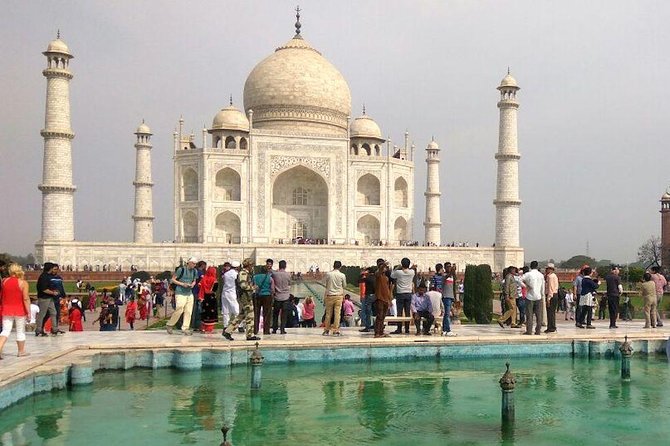
The Taj Mahal is built over 22 years, from 1631 to 1653, commissioned by Shah Jahan for Mumtaz Mahal. The story element matters here, but what really upgrades the visit is the construction scope. Materials came from far away: red sandstone from Fatehpur Sikri, jasper from Punjab, jade and crystal from China, turquoise from Tibet, and lapis lazuli plus sapphire from Sri Lanka.
You also get the scale of the workforce—around 20,000 workers—and the fact that specific craftspeople were sourced across regions, including sculptors from Bukhara and calligraphers from Syria and Persia. Even if you’ve seen pictures your whole life, those specifics help the monument feel less like a random icon and more like a coordinated human machine.
The tour also includes the drive back from Agra to Delhi after the Taj visit, so you won’t be stuck “overnight in transit.” Just know that you’re moving right through the day once you reach Agra.
Price and logistics: when this feels like good value
The listed price is about $1,045.34 per person for four days and three nights, and it includes a private car, a guide, entrance charges, and three breakfasts. You also get a mobile ticket, plus pickup is offered.
That package can be good value if you want someone to handle the connections between sites—timing, entry logistics, and the explanations that make monuments worth your attention. Since food and beverages are not included, you’ll still spend on lunches and drinks, but you can treat those meals as intentional breaks rather than forced stops.
The private-car setup is the big difference-maker. In this kind of loop, the time you save by not figuring out transit and ticket coordination often matters as much as the monuments themselves.
Who should book this Golden Triangle with a guide?
Book this if you like major sights with context, and if you’re comfortable with an efficient schedule. It’s also a strong choice if you want your guide to explain the why behind the what—Qutub Minar’s builders and timeline, Humayun’s architectural significance, Fatehpur Sikri’s style blend, and the Taj’s materials and scale.
Consider another pace if you’re hoping for slow mornings, long unplanned museum time, or lots of downtime. This tour is structured, and that structure is part of the deal.
It also fits families and mixed ages well when the guide is patient and flexible. In prior trips, guides and drivers like Balwinder have been praised for staying calm, adapting to family needs, and keeping things comfortable.
Should you book this tour?
If your goal is a well-organized Golden Triangle highlight run—Delhi icons, Jaipur forts and palaces, plus Agra’s Taj—this is a sensible way to do it with less stress. You’re paying for the private car and guide time, and that’s what turns a pile of ticketed sites into a story you can follow.
If you’re budget-sensitive on snacks and lunch, or if you dislike early starts and lots of driving, plan carefully. Also remember the admission tickets are marked as not included for Jal Mahal and Hawa Mahal, so check how much you’ll want to add for those.
If you want a smooth, story-rich version of the Golden Triangle, this one is built for that.
FAQ
What cities are included in this Golden Triangle tour?
You’ll visit Delhi, Agra (for the Taj Mahal and Fatehpur Sikri), and Jaipur.
How long is the tour and how many nights does it include?
The tour runs for about 4 days and 3 nights.
What time does the tour start?
The start time is 6:30 am.
Is transportation and a guide included?
Yes. A private car and a guide are included.
Are entrance tickets included?
Entrance charges are included in the package, but the admission tickets for Jal Mahal and Hawa Mahal are specifically marked as not included in the plan.
Are meals included?
Breakfast is included for 3 days. Food and beverages are not included.
Is this a private tour or a shared group?
It’s private. Only your group participates.
What is the cancellation and refund timing?
You can cancel up to 6 days in advance for a full refund. Cancel 2–6 full days before for a 50% refund, and cancellations less than 2 days before are not refunded.
What happens if the tour can’t run due to weather?
This experience requires good weather. If it’s canceled due to poor weather, you’ll be offered a different date or a full refund.
Onward to Jaipur: More Day Trips
- 3-Days Private Golden Triangle Tour: Delhi, Agra & Jaipur by Car
★ 5.0 · 1,107 reviews - 3-Days Private Golden Triangle Tour: Delhi, Agra & Jaipur by Car
★ 5.0 · 1,098 reviews - 3-Day Delhi, Agra and Jaipur Private Tour – India Golden Triangle
★ 5.0 · 812 reviews - Four-Day Private Luxury Golden Triangle Tour to Agra and Jaipur From New Delhi
★ 5.0 · 807 reviews - Jaipur Day Trip from Delhi by Car or Train – All Inclusive
★ 5.0 · 663 reviews
More Agra Day Trips out of Delhi
- Same Day Taj Mahal, Agra Fort & Baby Taj Tour from Delhi by Car
★ 5.0 · 4,304 reviews - Full Day Taj Mahal, Agra Fort & Baby Taj Tour from Delhi by Car
★ 5.0 · 3,647 reviews - From Delhi: Taj Mahal & Agra Private Day Trip with Transfers
★ 4.9 · 3,181 reviews - From Delhi: Taj Mahal and Agra Fort Private Sunrise Tour
★ 4.9 · 2,270 reviews - Sunrise Taj Mahal, Agra Fort & Baby Taj Tour from Delhi by Car
★ 5.0 · 2,243 reviews
The Taj, Reached a Few More Ways
- Same Day Taj Mahal, Agra Fort & Baby Taj Tour from Delhi by Car
★ 5.0 · 4,304 reviews - Taj Mahal Day Tour from Delhi by Superfast Train – TOP RATED TOUR
★ 5.0 · 4,166 reviews - Full Day Taj Mahal, Agra Fort & Baby Taj Tour from Delhi by Car
★ 5.0 · 3,647 reviews - From Delhi: Taj Mahal & Agra Private Day Trip with Transfers
★ 4.9 · 3,181 reviews - Taj Mahal Tour from Delhi by Express Train (Viator Award Winner)
★ 5.0 · 2,849 reviews
Just added: more New Delhi reviews to browse
- 4 days Golden Triangle Tour★ 5.0 · 3 reviews
- Discover Old & New Delhi: Private Tour with Street Food★ 5.0 · 3 reviews
- Taj Mahal Tour From Delhi By Private Car★ 4.5 · 3 reviews
- Golden Triangle Tour 5 Days★ 5.0 · 3 reviews
- Taj Mahal: Express Entry Ticket For Sunset Tour with guide★ 5.0 · 3 reviews
- Agra Taj Mahal Sunrise & Sunset Tour from Delhi★ 5.0 · 3 reviews
Taj Mahal Tours from Delhi, compared.
 ★ 5.0Same Day Taj Mahal, Agra Fort & Baby Taj Tour from Delhi by CarFrom $624,304 reviews
 ★ 5.0Taj Mahal Day Tour from Delhi by Superfast Train – TOP RATED TOURFrom $1004,166 reviews
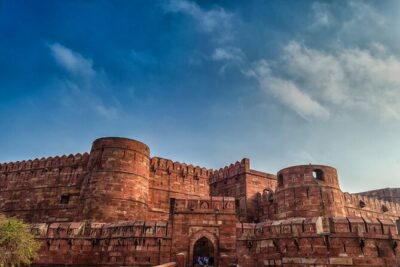 ★ 5.0Full Day Taj Mahal, Agra Fort & Baby Taj Tour from Delhi by CarFrom $623,647 reviews
 ★ 4.9From Delhi: Taj Mahal & Agra Private Day Trip with TransfersFrom $43,181 reviews
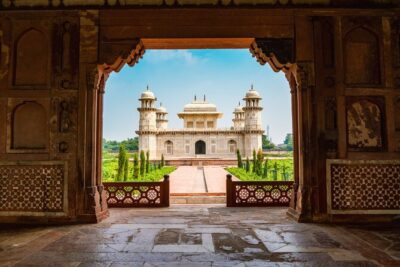 ★ 5.0Taj Mahal Tour from Delhi by Express Train (Viator Award Winner)From $752,849 reviews
 ★ 5.0All Inclusive Private Taj Mahal Luxury Tour from Delhi by CarFrom $622,564 reviews
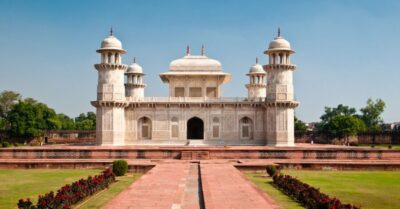 ★ 4.9Same Day Taj Mahal, Fort & Baby Taj Tour from Delhi by CarFrom $502,534 reviews
 ★ 4.9From Delhi: Taj Mahal and Agra Fort Private Sunrise TourFrom $592,270 reviews