
Reviewed · AGRA DAY TRIPS FROM DELHI
4 Days Golden Trianlge Tour to Delhi Agra Jaipur
Four days across Delhi, Agra, and Jaipur.
This Golden Triangle route is a fast way to see the big hitters of North India, from Mughal monuments to Gandhi’s memorial and modern Delhi icons, all while someone else handles the driving and timing. With free pickup and drop-off, you can start sightseeing without that first-day scramble.
I like the air-conditioned private vehicle and the fact that your day is run by an English-speaking driver who keeps you moving between sights. The guided stops in Delhi, Agra, and Jaipur are also useful because you get the background behind what you’re looking at, not just the basic photo spots.
One watch-out: several major monument entrance fees are listed as not included, and Day 1 is packed with stops. You’ll want a bit of stamina and a small extra budget so the days feel exciting, not stressful.
In This Review
- Key points at a glance
- Why the Golden Triangle fits a 4-day schedule
- Day 1 in Delhi: Old City Mughal sites plus modern icons
- The main drawback to plan around on Day 1
- Day 2 in Agra: Taj Mahal plus Agra Fort
- Budget note for Day 2
- Day 3 in Jaipur: Amber Fort, palaces, and Jantar Mantar
- Jaipur pacing tip
- The real value: driver-led logistics and the guide factor
- A balanced caution
- Price and entrance fees: what you’ll actually spend
- Where the value usually lands
- Practical tips for a smoother 4-day run
- Should you book this Delhi–Agra–Jaipur tour?
- FAQ
- What cities are included in this 4-day Golden Triangle tour?
- Is pickup and drop-off included?
- What is included in the price?
- Are monument entrance fees included?
- Will there be a guide at the monuments?
- What vehicle will you use?
- What is the cancellation policy?
Key points at a glance
- Pickup and drop-off included from the airport, hotel, or your location in Delhi
- Private transport in AC with vehicle size matched to your group
- Guides at each city stop to explain what you’re seeing and the monument story
- Battery bus included for the Taj Mahal approach up to the site parking area
- Taj Mahal and major forts require paid entry even though the tour covers the logistics
- Service focus on comfort with bottled water each day, plus included tolls, parking, and road costs
Why the Golden Triangle fits a 4-day schedule
The Golden Triangle (Delhi–Agra–Jaipur) is famous for a reason: you’re not just ticking off famous places. You’re watching three different chapters of India’s story line up close together in time and distance.
In four days, you get a strong mix. Delhi shows you Mughal power and British-era city planning side by side. Agra zooms in on the peak of Shah Jahan’s era through the Taj Mahal and Agra Fort. Jaipur brings you into Rajasthan’s royal architecture, from fort palaces to science instruments.
What makes this particular tour practical is that it’s built around driving and guided stops, not long gaps in your day. You’ll spend less time figuring out transport between neighborhoods and more time actually looking, reading, and asking questions.
Other Agra runs out of Delhi worth a look




Day 1 in Delhi: Old City Mughal sites plus modern icons
Day 1 is a big orientation day. You get the feeling of Delhi as a city of layers: empire monuments in the Old City, plus New Delhi’s grand official buildings and memorial spaces.
India Gate and the war memorial layer
You stop at India Gate, the famous war memorial. It ties into the Imperial War Graves Commission and the First World War, with the foundation stone laid on 10 February 1921. Even if you don’t read every plaque, it gives you a quick view of Delhi under British rule and how the city holds that history in stone.
Humayun’s Tomb: the first garden-tomb idea
Humayun’s Tomb is one of the best “slow down” stops on Day 1. It was commissioned by Humayun’s first wife and chief consort, Empress Bega Begum, and built in a garden-tomb style. The site is also described as the first garden-tomb on the Indian subcontinent, and it’s the first structure to use red sandstone at that scale. It became a UNESCO World Heritage Site in 1993.
If you like architecture, you’ll appreciate the layout: it’s not just a building, it’s a designed setting.
Lotus Temple: Bahá’í worship in plain sight
Next is the Lotus Temple, a Bahá’í House of Worship dedicated in December 1986. It’s open to everyone regardless of religion, which makes it a refreshing break from the strictly Mughal and imperial monuments. Architect Fariborz Sahba’s lotus-like form is the attraction here, and it works well as a quick reset when your brain is already full of tombs and forts.
Red Fort: Mughal peak, then political damage
Red Fort is the grand Old Delhi headline. Shah Jahan commissioned it starting 12 May 1638 after shifting the capital from Agra to Delhi. The tour frames it as a high point of Mughal architecture, with Persianate palace style mixed with Indian traditions.
Also pay attention to the later history mentioned for the fort: it was plundered during Nader Shah’s 1739 invasion, and later British actions led to demolition of many marble structures. This makes the fort feel less like a frozen postcard and more like a monument that survived major political churn.
Qutub Minar: victory tower and UNESCO scale
Qutub Minar is built between 1199 and 1220 and is a UNESCO World Heritage Site. It’s one of those sites where the height alone makes your photos feel smaller. Even if you only spend about half an hour here, it’s worth focusing on details at the base and along the tower’s shape.
Raj Ghat and Jama Masjid: memory and faith
Raj Ghat is a memorial dedicated to Mahatma Gandhi: a black marble platform marking the spot of his cremation on 31 January 1948, with an eternal flame burning at one end. It’s open to the sky, which keeps the mood reflective rather than museum-like.
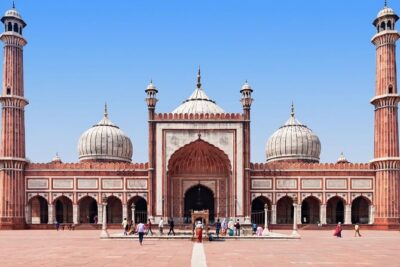
Then there’s Jama Masjid, one of Delhi’s largest mosques. Built by Shah Jahan between 1650 and 1656, it sits at the highest point of Shahjahanabad. The monument story includes the design credit to Ustad Ahmad Lahori and completion by Ustad Khalil, with roughly 5000 workers listed in the description, from different regions and backgrounds. The result is a scale you can feel even in short stops.
Rashtrapati Bhavan: New Delhi’s official architecture
You also see Rashtrapati Bhavan, associated with the President of India and designed by Sir Edwin Lutyens and Herbert Baker. The tour description highlights Lutyens conceptualizing the H-shaped building and the estate scale of 330 acres, with 5 acres covered by the structure. It’s brief, but it helps you understand why New Delhi looks so different from the Old City.
The main drawback to plan around on Day 1
Day 1 stacks a lot of sights and covers both Old Delhi and New Delhi. It’s exciting, but it’s also long. If you’re the type who gets “sight overload,” you’ll want to save energy by taking quick notes, slowing down at just one or two sites you truly care about, and letting the rest be solid orientation.
Day 2 in Agra: Taj Mahal plus Agra Fort
Agra is where the tour earns its reputation. The Taj Mahal is the big moment, but Agra Fort gives the day balance so you’re not only seeing one style of Mughal glory.
Taj Mahal: the jewel and the purpose behind it
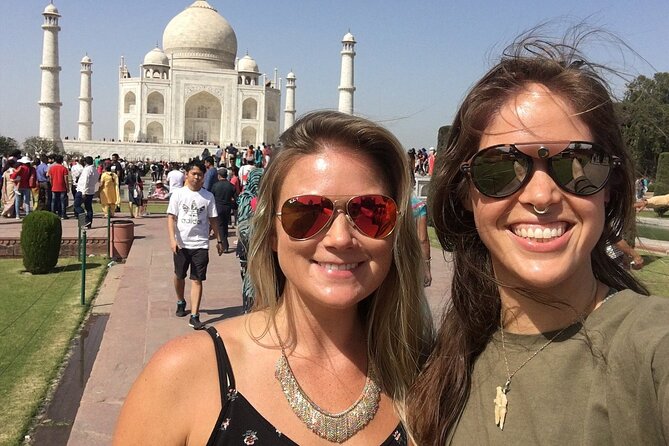
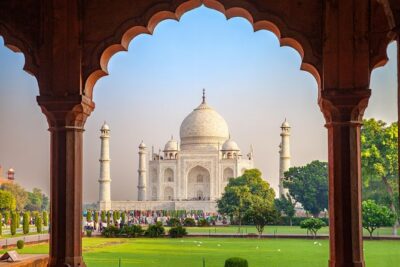
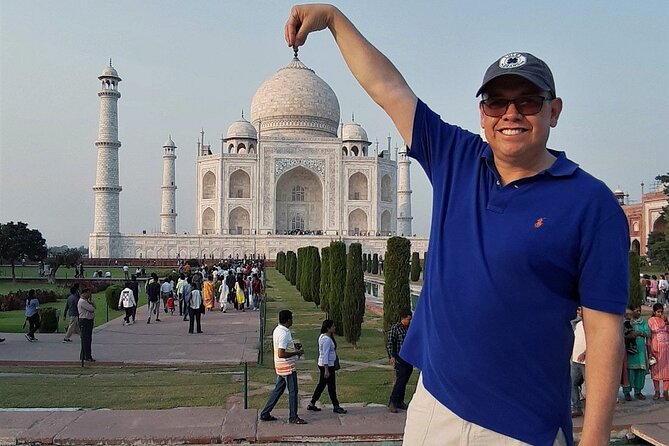
The Taj Mahal was commissioned in 1631 by Shah Jahan to house the tomb of Mumtaz Mahal, and it also includes Shah Jahan’s own tomb. The centerpiece sits in a 17-hectare complex with gardens bounded by a crenellated wall, plus a mosque and a guest house. Construction is described as involving some 20,000 artisans, led by the board of architects with Ustad Ahmad Lahori listed as court architect. UNESCO recognition in 1983 is tied to it being the jewel of Muslim art in India and one of the world’s universally admired masterpieces.
Why this matters for you: having a guide explain the complex layout and the “why” behind the design makes your visit feel more meaningful than just standing in front of a famous façade.
Battery bus ride: a small thing that saves real energy
The tour includes a battery bus ride to and from the Taj Mahal parking lot up to the Taj Mahal area. This matters because it reduces walking time during a day when you already have travel and city driving. It’s the kind of detail that keeps a short tour from feeling exhausting.
Agra Fort: Humayun, Akbar, and the shift to Delhi
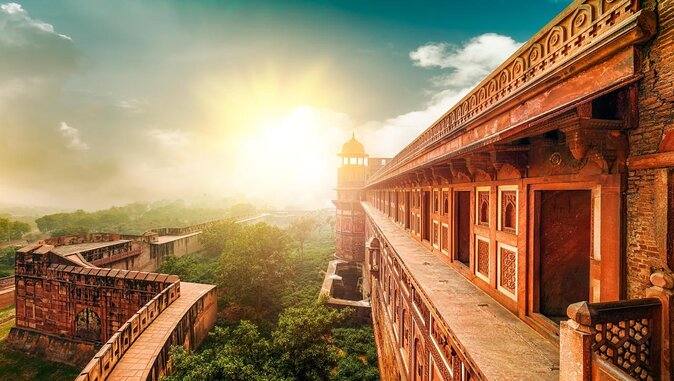
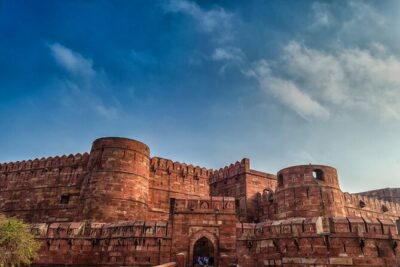
Agra Fort, also known as Agra’s Red Fort, has its own timeline. Humayun was crowned there, Akbar renovated it in 1565, and the present-day structure was completed in 1573. It served as the main residence of Mughal rulers until the capital shifted from Agra to Delhi in 1638. It’s also known as Lal-Qila.
This is your “another angle” day: Taj Mahal is romance and design symmetry, while the fort is power, governance, and shifting capitals.
Budget note for Day 2
Taj Mahal and Agra Fort entrance fees are listed as not included. That’s not a deal-breaker, but it’s something you should expect upfront so you’re not surprised when you arrive.
Chasing the Pink City? More Jaipur day trips
Day 3 in Jaipur: Amber Fort, palaces, and Jantar Mantar
Jaipur is the day of royal architecture and big shapes. It also has a smart variety built in: fort and palace, a reflective stop at Jal Mahal, then science and city icon photos.
Amber Fort: Rajput architecture with Mughal influence
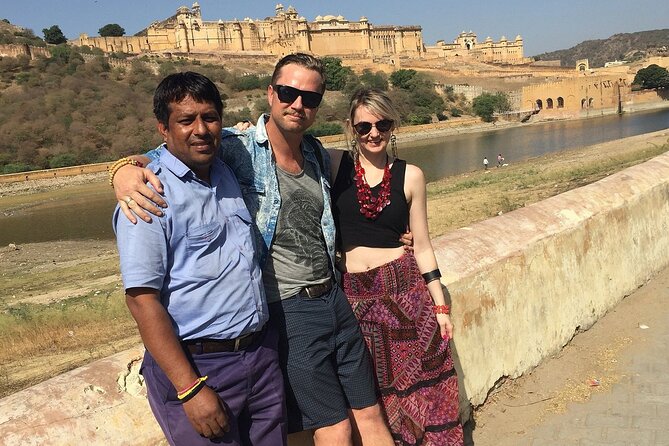
Amber Fort (Amer Fort) is the classic fort palace stop. Construction is described as started by Man Singh I in 1592, and it’s highlighted as a great example of Rajput architecture with some influence from Mughal architecture. The fort’s hilltop location is the reason it feels dramatic even when you only spend around an hour.
Jal Mahal: Water Palace on Man Sagar Lake
Jal Mahal is short but memorable because it’s a palace in the middle of Man Sagar Lake. The palace was originally constructed in 1699 and later renovated and enlarged in the 18th century by Maharaja Jai Singh II.
Even if you only have a brief view, it gives you contrast: forts and palaces built for defense and status, now re-imagined with water and reflection.
City Palace: museum space and living royal connection
City Palace is described as the royal residence and former administrative headquarters of the rulers of Jaipur. Construction is stated as completed in 1732. Today it houses the Maharaja Sawai Man Singh II Museum and continues as the home of the Jaipur royal family. The complex is described with courtyards, galleries, restaurants, and museum buildings.
For you, this can work well because you get a blend of architecture and curatorial space in one location.
Jantar Mantar: 19 instruments and a stone sundial
Jantar Mantar is the observatory stop. It’s described as a collection of 19 astronomical instruments built by Sawai Jai Singh, completed in 1734, and includes the world’s largest stone sundial. It’s also described as UNESCO World Heritage and tied to Ptolemaic positional astronomy shared by many civilizations.
This is where many people enjoy a slower pace because it’s different from forts and towers. If you like maps, math, and how people used instruments long before modern tech, you’ll appreciate it.
Hawa Mahal: 953 windows for royal viewing
Hawa Mahal, Palace of Wind, is built from red and pink sandstone and sits by the City Palace edge, extending to the women’s chambers. It was built in 1799 by Maharaja Sawai Pratap Singh and designed by Lal Chand Ustad. The exterior has five floors and a honeycomb-like structure with 953 small windows (jharokhas). The original intent in the description: let royal ladies observe street life and festivals without being seen.
Albert Hall Museum: colonial-era public museum roots
Albert Hall Museum is noted as the oldest museum of Rajasthan state and functions as the state museum. The building was designed by Samuel Swinton Jacob, assisted by Mir Tujumool Hoosein, opened as public museum in 1887, and named after King Edward VII after whose visit as Prince of Wales the foundation stone was laid on 6 February 1876.
It’s a shorter stop, but it adds a modern layer to Jaipur that many first-timers don’t expect.
Birla Mandir: white marble and a modern temple form
Birla Mandir is the Lakshmi Narayan Temple built by the B.M. Birla Foundation in 1988. It’s constructed solely of white marble and dedicated to Lakshmi and Lord Vishnu (Narayan). It’s brief, but it’s a clean visual break from sandstone and fort stone.
Jaipur pacing tip
Day 3 is also action-heavy, but it spreads the work across different types of sites. If you’re tired by the end of the day, you still finish with a great variety: a fort viewpoint, lake and city architecture, then monuments of design and science.
The real value: driver-led logistics and the guide factor
On this kind of tour, the driver can make or break the day. The good news is that the service here has a strong track record of friendly, helpful driving and problem-solving. People have specifically credited drivers like Sultan Singh for being proactive and good company, and also mentioned Javed for being helpful in getting things done and setting up the itinerary. Other names that come up include Narender, Ratan Singh, Ratan, and Bhupendra.
You should expect an English-speaking professional driver plus guides in Delhi, Agra, and Jaipur, offered in English or another chosen language for those cities. In a short multi-city trip, a guide who explains the monument story helps you connect the dots. For example, knowing why Humayun’s Tomb is described as a garden-tomb structure makes the layout feel intentional, not random.
A balanced caution
Not every guide experience is identical. If you strongly care about deep explanation at every stop, plan to ask questions early and don’t assume every stop will get the same depth. Still, the overall structure is designed so you aren’t stuck guessing what you’re looking at.
Price and entrance fees: what you’ll actually spend
The tour price is listed at $162.22 per person for the 4-day experience. That covers a lot of what usually costs extra on the Golden Triangle: private AC transport, hotel nights, breakfast, pickup/drop-off, bottled water, tolls and road taxes, and the Taj Mahal battery bus ride.
But you do need to budget for monument entries. The not-included list is clear and includes major charges like:
- Taj Mahal (not included, listed as $12 USD)
- Agra Fort (not included)
- Delhi entrances like Red Fort, Qutub Minar, and Humayun’s Tomb (each listed as $6 USD)
- Jaipur entrances like Amber Fort and City Palace (each listed as $6 USD)
- Jantar Mantar (listed as $2 USD)
The tour also lists an entrance fees estimate of about USD 50 per person including all monuments. Because some sights are marked free, your final amount can land near that range. The key is to plan for it so you don’t feel nickeled and dimed at the gate.
Where the value usually lands
If you’ve ever tried to DIY this route, you know the real costs are time, transport headaches, and figuring out ticket logistics. Paying for a driver and guided stops is often worth it when you only have four days and want to keep your energy for looking at the monuments.
Practical tips for a smoother 4-day run
- Pick your must-see first. With so many major sites, you’ll enjoy the day more if you choose two or three priorities and let the rest be bonuses.
- Bring comfortable walking shoes. Forts and heritage sites mean uneven ground and lots of steps, even when you skip long museum-style wandering.
- Use the flexibility. The tour states you can start sightseeing at a time you prefer. If you want fewer crowds, ask to set priority sites early.
- Keep some cash for entrances. Since specific monuments are not included, it helps to be ready when you reach ticket points.
- Stay hydrated. Bottled water is included (two 500 ml bottles per person per day), but it’s still a hot, active route in general.
Should you book this Delhi–Agra–Jaipur tour?
Book this tour if you want:
- A private Golden Triangle in only four days with hotel and airport pickup handled for you
- Guided stops in Delhi, Agra, and Jaipur so you don’t miss the meaning behind the monuments
- Air-conditioned transport and a driver who makes the route practical, especially between Old Delhi, Agra, and Rajasthan
Skip it or rethink it if:
- You hate paying separate entrance fees for major sights like the Taj Mahal
- You’re looking for a slow, flexible style day with lots of free time built in. This route is structured and full.
If you want a high-value first-timer route that hits the headline monuments and gives you enough context to enjoy them, this is a solid choice.
FAQ
What cities are included in this 4-day Golden Triangle tour?
It covers Delhi, Agra, and Jaipur, with sightseeing in major attractions in each city across four days.
Is pickup and drop-off included?
Yes. Free pickup and drop-off are included from the airport, hotel, or railway station.
What is included in the price?
You get 3 nights accommodation (as per the option selected), 3 days breakfast (if booking with hotels), AC vehicle transport, an English-speaking professional driver, bottled water each day, and key logistics like tolls and parking. The tour also includes the battery bus ride for the Taj Mahal approach.
Are monument entrance fees included?
No. Entrance fees are listed as not included, with an estimate of around USD 50 per person including all monuments, plus specific fees such as Red Fort (Delhi) $6, Qutub Minar $6, Humayun’s Tomb $6, Taj Mahal $12, Agra Fort $6, Amber Fort $6, City Palace $6, and Jantar Mantar $2.
Will there be a guide at the monuments?
Yes. There is a guide at locations in Delhi, Agra, and Jaipur, and the guide can be English speaking or another chosen language for those cities.
What vehicle will you use?
It depends on group size: a 4-seater AC sedan for 1–2 people, a 6-seater AC MUV for 3–4 people, and a 10-seater AC van for 5–10 people.
What is the cancellation policy?
You can cancel for a full refund if you cancel at least 24 hours before the experience start time. If you cancel less than 24 hours before, the amount paid is not refunded.
More Tour Reviews in New Delhi
- Old & New Delhi City Tour – Half or Full Day Options Available
★ 5.0 · 4,811 reviews - Half Day Private Delhi City Tour
★ 5.0 · 4,474 reviews - Same Day Taj Mahal, Agra Fort & Baby Taj Tour from Delhi by Car
★ 5.0 · 4,304 reviews - Taj Mahal Day Tour from Delhi by Superfast Train – TOP RATED TOUR
★ 5.0 · 4,166 reviews - Delhi: Old and New Delhi Private Full or Half-Day Tour
★ 4.9 · 3,776 reviews
Onward to Jaipur: More Day Trips
- 3-Days Private Golden Triangle Tour: Delhi, Agra & Jaipur by Car
★ 5.0 · 1,107 reviews - 3-Days Private Golden Triangle Tour: Delhi, Agra & Jaipur by Car
★ 5.0 · 1,098 reviews - 3-Day Delhi, Agra and Jaipur Private Tour – India Golden Triangle
★ 5.0 · 812 reviews - Four-Day Private Luxury Golden Triangle Tour to Agra and Jaipur From New Delhi
★ 5.0 · 807 reviews - Jaipur Day Trip from Delhi by Car or Train – All Inclusive
★ 5.0 · 663 reviews
More Agra Day Trips out of Delhi
- Same Day Taj Mahal, Agra Fort & Baby Taj Tour from Delhi by Car
★ 5.0 · 4,304 reviews - Full Day Taj Mahal, Agra Fort & Baby Taj Tour from Delhi by Car
★ 5.0 · 3,647 reviews - From Delhi: Taj Mahal & Agra Private Day Trip with Transfers
★ 4.9 · 3,181 reviews - From Delhi: Taj Mahal and Agra Fort Private Sunrise Tour
★ 4.9 · 2,270 reviews - Sunrise Taj Mahal, Agra Fort & Baby Taj Tour from Delhi by Car
★ 5.0 · 2,243 reviews
Just added: more New Delhi reviews to browse
- 4 days Golden Triangle Tour★ 5.0 · 3 reviews
- Discover Old & New Delhi: Private Tour with Street Food★ 5.0 · 3 reviews
- Taj Mahal Tour From Delhi By Private Car★ 4.5 · 3 reviews
- Golden Triangle Tour 5 Days★ 5.0 · 3 reviews
- Taj Mahal: Express Entry Ticket For Sunset Tour with guide★ 5.0 · 3 reviews
- Agra Taj Mahal Sunrise & Sunset Tour from Delhi★ 5.0 · 3 reviews
Agra Day Trips from Delhi, compared.
 ★ 5.0Same Day Taj Mahal, Agra Fort & Baby Taj Tour from Delhi by CarFrom $624,304 reviews
 ★ 5.0Full Day Taj Mahal, Agra Fort & Baby Taj Tour from Delhi by CarFrom $623,647 reviews
 ★ 4.9From Delhi: Taj Mahal & Agra Private Day Trip with TransfersFrom $43,181 reviews
 ★ 4.9From Delhi: Taj Mahal and Agra Fort Private Sunrise TourFrom $592,270 reviews
 ★ 5.0Sunrise Taj Mahal, Agra Fort & Baby Taj Tour from Delhi by CarFrom $622,243 reviews
 ★ 5.0Taj Mahal and Agra Private Car Tour from Delhi with 5* LunchFrom $331,633 reviews
 ★ 4.9From Delhi: Private Taj Mahal and Agra Tour by Express TrainFrom $751,605 reviews
 ★ 5.0Taj Mahal, Agra Fort, Baby Taj Tour from Delhi by Superfast TrainFrom $751,494 reviews