
Reviewed · AGRA DAY TRIPS FROM DELHI
4-Days Private Golden Triangle Tour India – Delhi Agra Jaipur Tour
Golden Triangle in four days feels fast. This private route links Delhi–Agra–Jaipur with Taj Mahal sunrise and a real guide, so you get the big sights without turning your trip into a navigation contest. I like the way your guide helps with entrance-fee purchases so you spend less time stuck in ticket lines, but one drawback is that monument entrance fees are extra and can add up.
What makes this feel practical is the built-in pacing: you’re not only moving between cities, you’re also getting guided time at the key stops. Plus, the service emphasis shows up in the names that keep coming up in feedback I saw, including Rajendra Dewan (Mr. Raj/Raju) as a point person and drivers like Sandip and Param for punctual, clean rides. Still, it’s a tight schedule, so if you hate “on the clock” sightseeing, you’ll want to plan for early starts and long drives.
In This Review
- Key highlights that make this Golden Triangle worth your time
- Why this 4-day Golden Triangle works (even when you have limited time)
- Delhi day: from Qutub Minar to India Gate (and why the order matters)
- Qutub Minar: the stone statement you’ll remember
- Lotus Temple: a calm pause in a busy city
- India Gate, Parliament House, Rashtrapati Bhavan: photo stops that set the scene
- Lunch and then the Agra drive
- Taj Mahal sunrise in Agra: the logistics you’ll thank your driver for
- Getting there smoothly: the battery bus detail
- Taj Mahal itself: the famous symmetry, seen at the right hour
- Agra Fort: Mughal power you can walk through
- Itmad-ud-Daula: the jewel-box effect
- Lunch and then the road to Jaipur
- Fatehpur Sikri en route and Jaipur arrival: turning the drive into a chapter
- Fatehpur Sikri: a small city stop with big atmosphere
- Why arriving in Jaipur matters
- Jaipur in daylight: Hawa Mahal, City Palace, and the stops that feel specific
- Hawa Mahal: the famous facade from the right viewing angles
- City Palace: where rulers actually lived
- Jantar Mantar and the science-meets-stone mood
- Jal Mahal: the palace in the lake
- Panna Meena ka Kund: stepwell geometry that stops you
- Amer Fort (Fort at Amer): the main event on Day 3
- Private car value: what you’re really paying for in $300
- The budget reality: entrances and gratuities
- Extra flexibility that you’ll notice on vacation
- Who this tour fits best (and who should choose slower options)
- Final verdict: should you book this private Golden Triangle?
- FAQ
- What’s included in the 4-day Golden Triangle tour?
- Are entrance fees included for the monuments?
- Will I have an English-speaking guide?
- How do we get to the Taj Mahal once we reach the parking area?
- Where can you pick me up and drop me off?
- How are hotel rooms handled?
- Can I cancel, and how late?
Key highlights that make this Golden Triangle worth your time
- Taj Mahal sunrise with the handy battery-bus ride from the parking area to the monument entrance
- Private local guides in each city, in English, with help buying entrance fees
- Door-to-door pickup and drop-offs in Delhi, plus hotel or airport access
- AC private transportation sized to your group (sedan/SUV/minivan options)
- Big Delhi morning stops ranging from Qutub Minar to India Gate and the presidential/government zone
- Two city-change days that pair sightseeing with the drive to the next hotel, not just transit
Why this 4-day Golden Triangle works (even when you have limited time)
A Golden Triangle trip can go two ways. It’s either a smooth, memorable overview—or a scramble of tickets, taxis, and missed entrances. This one is built to help you get your bearings fast.
You’re covering three major cities: Delhi, Agra, and Jaipur. The core win is that you get guided time at the headline sights, plus comfortable, pre-arranged transport between them. That matters because the driving time is real in north India, especially when you’re moving across morning traffic and highway stretches.
You’ll also get meals handled for you in the hotel block (breakfast daily, and dinner is included). That sounds basic, but it’s underrated for short trips—food planning and restaurant hunting can quietly steal hours from a 4-day schedule.
One thing to keep in mind: the trip description doesn’t perfectly match itself about the number of nights in the hotel (you’ll see both two and three-nights language). The itinerary itself clearly places you in Delhi for your first night and Jaipur for your last sightseeing day. I’d treat the “nights included” detail as something to confirm at booking so there’s no surprise.
Other Agra runs out of Delhi worth a look




Delhi day: from Qutub Minar to India Gate (and why the order matters)
Delhi in a single day can feel like a blur unless you’re oriented first. This plan starts at the Qutb complex area with Qutub Minar, then moves toward softer, iconic landmarks like the Lotus Temple and India Gate.
Qutub Minar: the stone statement you’ll remember
Qutub Minar sits in the Qutb complex in South Delhi and is tied to Delhi’s older fortified history (Lal Kot, linked to the Tomar Rajputs). Even if you’re not the type to love architecture details, the site gives you a “this place is older than your mental map” feeling.
Practical note: admission isn’t included, so you should expect entrance-fee handling through your guide. The tour also calls out Qutub Minar specifically as an extra fee item, so budget for it.
Lotus Temple: a calm pause in a busy city
Right after the monument-heavy start, the Lotus Temple offers a different energy. It’s known for its lotus-flower design and was inaugurated in 1986. Even when you’re not religious, this stop works because it gives you a break from the “keep moving” tempo.
This stop is also a good place to slow down and reset your senses before the big government-landmark photo zone.
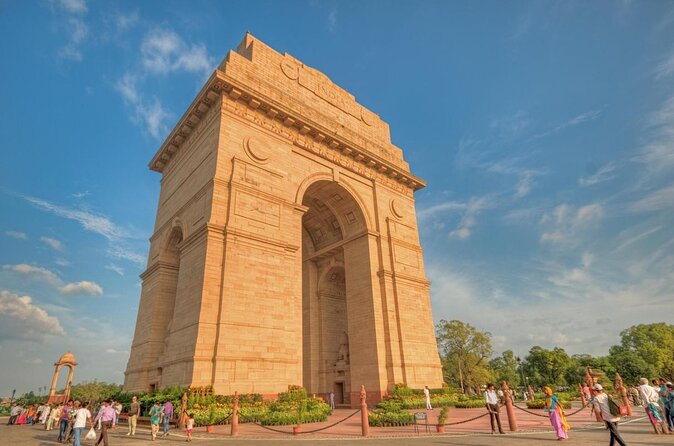
India Gate, Parliament House, Rashtrapati Bhavan: photo stops that set the scene
India Gate is one of the most recognizable memorials in Delhi. The tour then continues into the Parliament House and the Rashtrapati Bhavan area—both designed by Sir Edwin Lutyens and Herbert Baker and both emblematic of India’s national identity.
Expect these as short, structured viewing stops rather than deep museum time. Admission isn’t listed as included, so don’t plan on turning them into long indoor visits. The value here is seeing them in context and getting the geography of central Delhi straight.
Chasing the Pink City? More Jaipur day trips

Lunch and then the Agra drive
You’ll have time for lunch at a local restaurant, then you set off by car toward Agra (the route is described as about a 3-hour drive through the Yamuna Expressway).
This is a smart use of Day 1. Instead of spending your entire daylight just in Delhi, you get to stretch your time and still arrive with enough energy to settle into your hotel in Agra.
Taj Mahal sunrise in Agra: the logistics you’ll thank your driver for
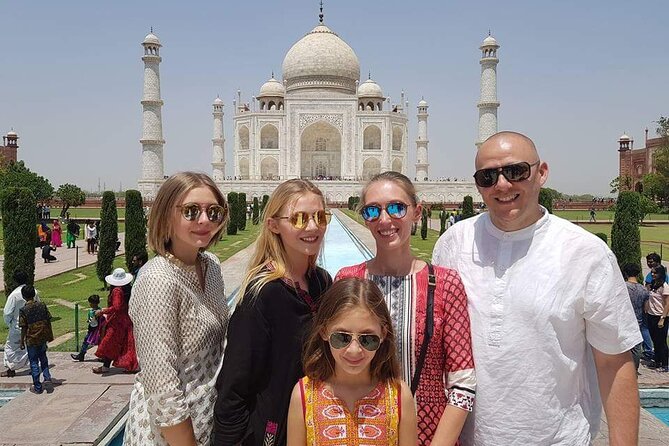
For most people, Taj Mahal is the reason the Golden Triangle exists. The tour builds around a sunrise visit, which is great because you’re chasing better light and fewer crowds.
Getting there smoothly: the battery bus detail
Here’s a very specific detail that makes the visit easier: the itinerary includes a battery-powered bus between the Taj Mahal parking area and the monument itself.
That little “shuttle” piece matters because the Taj complex can be physically tiring if you’re walking long distances in the morning. It also helps you stay on schedule—your guide can keep the group moving instead of waiting for everyone to regroup after a long trek.
Taj Mahal itself: the famous symmetry, seen at the right hour
The Taj Mahal is described in the itinerary as a masterpiece with a balanced approach to design and execution. The early light is where you’ll really notice the way the marble plays with shadows.
Also, having a guide is useful here. You’ll likely pick up the story behind what you’re seeing, and you’ll be less likely to rush past the small details that make the building feel so intentional.
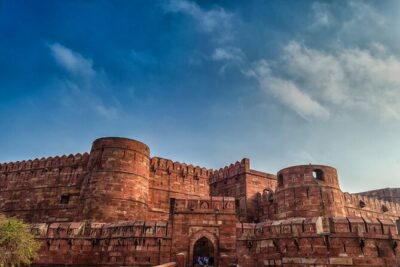
Agra Fort: Mughal power you can walk through
After Taj, you head to Agra Fort, a fort built during Akbar’s period (1565–1573) and tied to shifting Mughal and Rajput use over time. This stop works because it’s not a single-face “look at this one thing” situation—you’re seeing a fortified landscape.
If you like history at street level, you’ll probably enjoy the walk-through feel more than you expect.
Itmad-ud-Daula: the jewel-box effect
Then there’s Itmad-ud-Daula, sometimes nicknamed the Baby Taj. This is one of those “not the headline, still worth it” sites. It lets you zoom in on the craftsmanship vibe after the grand sweep of the Taj Mahal.
A nice sequencing trick here: Taj gives you the wow. Agra Fort adds scale and power. Itmad-ud-Daula gives you the close-up beauty.
Lunch and then the road to Jaipur
You’ll have time for lunch at a local restaurant, then it’s about a 4 to 5 hour drive toward Jaipur. The itinerary includes an en-route visit to Fatehpur Sikri, which helps turn what could be pure transit time into another high-value stop.
Fatehpur Sikri en route and Jaipur arrival: turning the drive into a chapter
The Golden Triangle can feel like a series of hotel check-ins. The best versions add something meaningful during the long highway hours. Fatehpur Sikri is that bridge stop.
Fatehpur Sikri: a small city stop with big atmosphere
Fatehpur Sikri is described as a small city just west of Agra. Even without extra museum time, it gives you a different feel from the Taj-and-fort axis.
This is also useful because it prevents fatigue from building. You go from marble-white grandeur into fortified/city ruins, and your brain gets a new visual pattern to follow.
Why arriving in Jaipur matters
The day’s rhythm keeps your arrival in Jaipur relatively efficient. You’ll be in time for your next full day of sights, rather than losing your energy on a late evening with no plan.
Even if you’re not a “rest on vacation” person, a trip like this needs a little down time. Your hotel and dinner inclusion help make that realistic.
Jaipur in daylight: Hawa Mahal, City Palace, and the stops that feel specific
Jaipur is where the Golden Triangle shifts from monumental to more textured and everyday-looking. You’ll spend Day 3 moving through “Pink City” highlights with a sequence that mixes iconic silhouettes and more photogenic details.
Hawa Mahal: the famous facade from the right viewing angles
The tour includes Hawa Mahal, the Palace of Wind. It’s pink sandstone, built in 1799, and recognized for its five-storey structure with latticed jharokhas.
The best part of this stop is that it’s instantly understandable. Even if you only see the outside facade, you’ll still get why it’s such a signature of Jaipur.
City Palace: where rulers actually lived
Next is the City Palace in the heart of Jaipur. This is where you’ll learn about how the Maharaja’s seat worked, since the palace complex includes areas like Chandra Mahal and Mubarak Mahal.
Your scheduled time here is longer (about 2 hours). That’s a good sign, because City Palace is the kind of place where you can’t rush if you want to remember what you saw later.
Jantar Mantar and the science-meets-stone mood
Then there’s Jantar Mantar, described as architectural astronomy instruments. This stop is short in time, but it gives you a different angle on the city—less about facades, more about measurement, angles, and how people once used public spaces for knowledge.
Jal Mahal: the palace in the lake
Jal Mahal sits in the middle of Man Sagar Lake. You’ll see it from the viewpoints that make it feel like a floating palace.
This one is mostly about the visual effect, so don’t expect it to replace the bigger forts. It’s a palate cleanser.
Panna Meena ka Kund: stepwell geometry that stops you
Next is Panna Meena ka Kund, a square-design well with eight levels of diamond-shaped step patterns leading down to a deep green pool.
This is a great stop for travelers who like details. It’s also a nice reminder that Jaipur isn’t only forts and palaces—you also see engineering and design for everyday water needs.
Amer Fort (Fort at Amer): the main event on Day 3
The final Jaipur stop is Amer Fort. The itinerary frames it as a two-hour guided experience of its fort, palaces, squares, and monuments, with gates and ramps included in the tour plan.
Amer Fort tends to be the point where people stop thinking of Jaipur as “pretty buildings” and start seeing it as a power system—how the city was organized and defended, and how court life worked inside a fortified world.
If you like photos, you’ll get them here. If you like history, you’ll also get your money’s worth because the layout helps you understand how everything connects.
Private car value: what you’re really paying for in $300
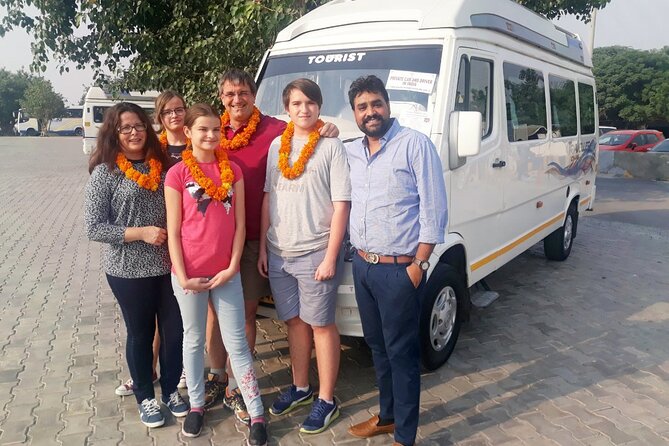
Let’s talk value without the sales gloss.
At $300 for a 4-day private Golden Triangle experience, you’re not just paying for a checklist of sights. You’re paying for:
- private transportation with AC
- a guide for each city’s scheduled blocks
- hotel and meals during the tour window (breakfast daily and dinner are included in the included list)
- built-in logistics for the Taj Mahal visit (including the battery-bus ride)
- pickup and drop-offs from Delhi-area locations like airport/railway/hotel
That’s why this can beat doing it yourself—DIY is cheaper on paper, but you’ll spend more on taxis, entrance ticket management, and time lost to coordination. Here, your schedule is already built and your guide handles entrance-fee purchases so you don’t waste half a morning.
The budget reality: entrances and gratuities
Entrance fees are not included, and the listing cites about $60 per person for monuments, with Qutub Minar specifically called out at $60 per person. Your total can depend on how the provider structures ticket categories. I’d plan for additional payments in the roughly $60-and-up range per person and confirm the exact breakdown for your travel dates.
Gratuities are optional.
Extra flexibility that you’ll notice on vacation
One surprisingly helpful perk: the tour includes a vehicle with a driver who’s described as available if you want a cab for dinner at a city restaurant or shopping at any time during the trip. That turns the private-car benefit into something more useful than just getting from stop to stop.
Who this tour fits best (and who should choose slower options)

This is a good match if you:
- want a first-timer friendly Golden Triangle overview in limited days
- prefer private guiding over self-guided chaos
- like having meals and hotels handled so you can focus on sightseeing
- don’t mind long road segments between Delhi, Agra, and Jaipur
You might want a different pace if you:
- hate early starts (sunrise Taj Mahal usually means you’ll be up and moving)
- want a lot of free time to wander without a set route
- dislike schedules that move from city to city each day
The tour also notes moderate physical fitness is best. Most stops are timed, and you’ll do walking around fort and palace areas.
Final verdict: should you book this private Golden Triangle?
If you want the classic Delhi–Agra–Jaipur hits with minimal friction, I think this is a strong buy. The biggest reasons are simple: sunrise Taj Mahal planning, a guide who helps handle ticket purchasing, and private transportation that keeps the day moving.
Before you book, do two quick checks:
- Confirm how many hotel nights are included in your exact option (the description language varies).
- Confirm the entrance-fee breakdown for Qutub Minar and the other monuments so you can budget cleanly.
If those two points look good, you’re likely to feel like you got real value for your time—and you’ll spend your energy on the sights, not on logistics.
FAQ
What’s included in the 4-day Golden Triangle tour?
The package includes private transportation, private local guides for city sightseeing, breakfast daily, and dinner (listed in the included details). Hotel or airport pickup and drop-off are included, along with bottled water during journeys, state tax/GST, and all applicable hotel taxes. It also includes the battery-powered bus ride to the Taj Mahal from the parking lot.
Are entrance fees included for the monuments?
No. Entrance fees are listed as not included. The listing also specifically calls out Qutub Minar entrance fees as an additional $60 per person.
Will I have an English-speaking guide?
Yes. The tour states you’ll get an English-speaking guide. If you need another language, you must inform the provider in special requirements at booking.
How do we get to the Taj Mahal once we reach the parking area?
The included details say a battery-powered bus takes you to and from the Taj Mahal parking lot to the monument itself.
Where can you pick me up and drop me off?
Pickup is offered from the airport, railway station, hotel, or any pickup location in Delhi, Noida, and Gurugram. On the last day, you’ll either be dropped back in Delhi or dropped off at Jaipur airport.
How are hotel rooms handled?
Rooms are usually twin-sharing. If booking for three people, rooms are provided on a triple-sharing basis. If three guests prefer two rooms, an additional charge may apply.
Can I cancel, and how late?
The tour offers free cancellation if you cancel at least 24 hours before the experience’s start time. Canceling less than 24 hours before won’t be refunded.
The Full Golden Triangle, More Options
- 3-Days Private Golden Triangle Tour: Delhi, Agra & Jaipur by Car
★ 5.0 · 1,107 reviews - 3-Days Private Golden Triangle Tour: Delhi, Agra & Jaipur by Car
★ 5.0 · 1,098 reviews - 3-Day Delhi, Agra and Jaipur Private Tour – India Golden Triangle
★ 5.0 · 812 reviews - Four-Day Private Luxury Golden Triangle Tour to Agra and Jaipur From New Delhi
★ 5.0 · 807 reviews - 5 Nights 6 Days Private Golden Triangle Tour – Delhi Agra Jaipur
★ 5.0 · 574 reviews
Onward to Jaipur: More Day Trips
- 3-Days Private Golden Triangle Tour: Delhi, Agra & Jaipur by Car
★ 5.0 · 1,107 reviews - 3-Days Private Golden Triangle Tour: Delhi, Agra & Jaipur by Car
★ 5.0 · 1,098 reviews - 3-Day Delhi, Agra and Jaipur Private Tour – India Golden Triangle
★ 5.0 · 812 reviews - Four-Day Private Luxury Golden Triangle Tour to Agra and Jaipur From New Delhi
★ 5.0 · 807 reviews - Jaipur Day Trip from Delhi by Car or Train – All Inclusive
★ 5.0 · 663 reviews
More Agra Day Trips out of Delhi
- Same Day Taj Mahal, Agra Fort & Baby Taj Tour from Delhi by Car
★ 5.0 · 4,304 reviews - Full Day Taj Mahal, Agra Fort & Baby Taj Tour from Delhi by Car
★ 5.0 · 3,647 reviews - From Delhi: Taj Mahal & Agra Private Day Trip with Transfers
★ 4.9 · 3,181 reviews - From Delhi: Taj Mahal and Agra Fort Private Sunrise Tour
★ 4.9 · 2,270 reviews - Sunrise Taj Mahal, Agra Fort & Baby Taj Tour from Delhi by Car
★ 5.0 · 2,243 reviews
Just added: more New Delhi reviews to browse
- 4 days Golden Triangle Tour★ 5.0 · 3 reviews
- Discover Old & New Delhi: Private Tour with Street Food★ 5.0 · 3 reviews
- Taj Mahal Tour From Delhi By Private Car★ 4.5 · 3 reviews
- Golden Triangle Tour 5 Days★ 5.0 · 3 reviews
- Taj Mahal: Express Entry Ticket For Sunset Tour with guide★ 5.0 · 3 reviews
- Agra Taj Mahal Sunrise & Sunset Tour from Delhi★ 5.0 · 3 reviews
Agra Day Trips from Delhi, compared.
 ★ 5.0Same Day Taj Mahal, Agra Fort & Baby Taj Tour from Delhi by CarFrom $624,304 reviews
 ★ 5.0Full Day Taj Mahal, Agra Fort & Baby Taj Tour from Delhi by CarFrom $623,647 reviews
 ★ 4.9From Delhi: Taj Mahal & Agra Private Day Trip with TransfersFrom $43,181 reviews
 ★ 4.9From Delhi: Taj Mahal and Agra Fort Private Sunrise TourFrom $592,270 reviews
 ★ 5.0Sunrise Taj Mahal, Agra Fort & Baby Taj Tour from Delhi by CarFrom $622,243 reviews
 ★ 5.0Taj Mahal and Agra Private Car Tour from Delhi with 5* LunchFrom $331,633 reviews
 ★ 4.9From Delhi: Private Taj Mahal and Agra Tour by Express TrainFrom $751,605 reviews
 ★ 5.0Taj Mahal, Agra Fort, Baby Taj Tour from Delhi by Superfast TrainFrom $751,494 reviews