
Reviewed · AGRA DAY TRIPS FROM DELHI
7 Days Private Tour to New Delhi, Agra, and Jaipur
Golden Triangle, made easier with a private guide. This 7-day plan strings together Old Delhi street life and major Mughal landmarks, then adds India’s most famous white monument at the right time of day. You also get a smooth setup for airport start, hotel transfers, and guided sightseeing across Delhi, Agra, and Jaipur.
Two things I really like about this tour are the sunrise Taj Mahal timing and the way the day in Delhi mixes big-ticket monuments with real market wandering. You’ll see landmarks like Red Fort, Jama Masjid, Qutub Minar, and Humayun’s Tomb, then still have time for Chandni Chowk—the kind of place where your guide can help you navigate without turning it into stress.
One consideration: the itinerary is packed and travel days include long road stretches, so you’ll feel the long driving days more than you might expect. Also, lunch and dinner aren’t included, so you’ll want to budget and plan a bit around meal stops.
In This Review
- Key highlights you’ll actually feel
- The value of a 7-day private Golden Triangle
- Day 1: Arrival in Delhi, then a soft landing
- Day 2 in Delhi: Old Delhi icons plus Qutub Minar and Humayun’s Tomb
- Red Fort and Jama Masjid (big Mughal scale)
- Chandni Chowk (where you get your bearings fast)
- India Gate, then the UNESCO-style Mughal landmarks
- Lotus Temple and Birla Mandir (spiritual calm after crowds)
- Day 3 to Agra: Fort, Taj Mahal, and Itmad-ud-Daula
- Agra Fort and Taj Mahal (the main two)
- Itmad-ud-Daula (the “mini” Taj feel)
- Day 4: Sunrise Taj Mahal plus Fatehpur Sikri on the way to Jaipur
- Fatehpur Sikri: Akbar’s fortified city
- On to Jaipur
- Day 5 in Jaipur: Jal Mahal, Hawa Mahal, City Palace, Jantar Mantar, Albert Hall
- Jal Mahal (palace in the water)
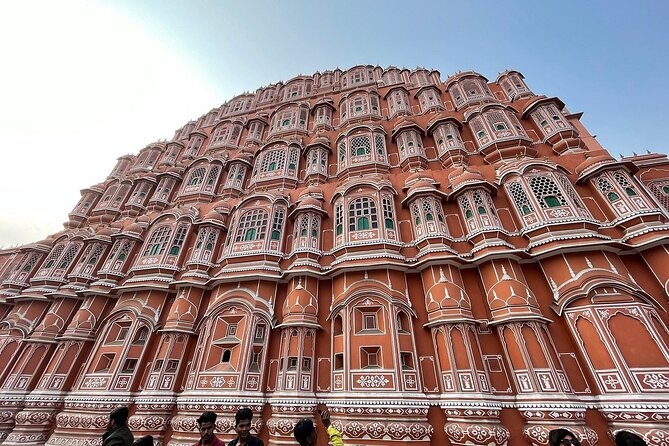
- Hawa Mahal (953 small windows)
- City Palace (Rajput and Mughal mix)
- Jantar Mantar (stone astronomy)
- Albert Hall Museum (oldest in Rajasthan)
- Day 6: Transfer back to Delhi for your departure window
- Day 7: Leaving from Indira Gandhi International Airport
- What you’re really paying for (and what costs extra)
- Who this tour fits best
- Should you book this private Golden Triangle tour?
- FAQ
- What cities are included in the 7-day tour?
- Where does the tour start?
- Is airport pickup or meet-and-greet included?
- Is this tour private?
- Are entrance fees included?
- Does the itinerary include a sunrise Taj Mahal visit?
- Is lunch and dinner included?
- Can I cancel for a full refund?
- Is an air-conditioned vehicle provided?
Key highlights you’ll actually feel
- Private, air-conditioned transportation across three cities, which makes the schedule livable
- Sunrise Taj Mahal for that calmer start and better photo chances
- Old Delhi + modern Delhi mix, from Red Fort and Jama Masjid to India Gate and Lotus Temple
- Jaipur’s variety: forts/palaces area plus Jantar Mantar and Albert Hall Museum
- Driver-and-guide support that helps with timing, English-speaking assistance, and practical needs (including extra stops)
- Camera fees may add up, since the tour includes monument entry but not all add-ons
The value of a 7-day private Golden Triangle
This tour is built around the classic Golden Triangle route—Delhi to Agra to Jaipur—and it does it in a way that’s meant to feel practical rather than frantic. For about $339.23 per person, you’re paying for a lot more than a ticketed sightseeing list. You’re buying protected time: airport meet-up, private transport, and professional guides who can keep the day moving while still giving you context.
Here’s what that means for you on the ground. In India’s bigger cities, the hardest part is often not the sights—it’s the logistics: where to go next, how long security lines take, how to deal with crowds, and how to avoid losing half your day to transit mistakes. Having an air-conditioned vehicle and a guide reduces that friction.
One more value point: your tour model is private, so it’s “just your group” rather than a shared herd experience. In real-world terms, that usually gives you better flexibility for the pacing—especially helpful on days like Delhi, where you’re hopping between major monuments and busy markets.
Other Agra runs out of Delhi worth a look




Day 1: Arrival in Delhi, then a soft landing
Your day starts at Indira Gandhi International Airport. You’ll meet a representative, then get escorted to your pre-booked hotel for check-in. That’s a smart first move because it gets you settled before you try to handle traffic, directions, and language on your own.
After that, you’re not forced into a tight first-day sightseeing sprint. Even without specific monuments scheduled for Day 1, this “settle-in” time matters. Delhi can hit you fast with traffic and sensory overload. A calm start helps you enjoy the next day’s Old Delhi highlights.
Day 2 in Delhi: Old Delhi icons plus Qutub Minar and Humayun’s Tomb
Day 2 is where Delhi shows its range—Mughal grandeur, large religious architecture, and street-level shopping.
Red Fort and Jama Masjid (big Mughal scale)
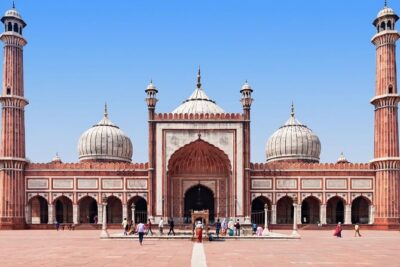
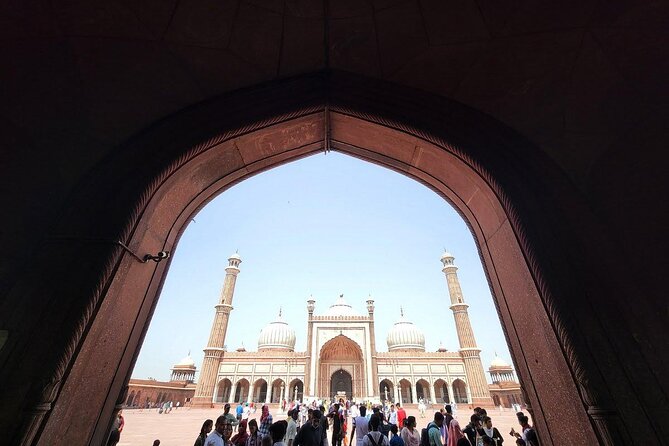
You’ll visit Red Fort first. It’s the kind of place where your guide can explain how Mughal power was expressed through architecture, not just through weapons. Next is Jama Masjid, India’s largest mosque, designed to hold a huge number of devotees at once. The setting is massive, and it also gives you a different lens on Delhi—less about sightseeing and more about how the city functions as a living place.
Chandni Chowk (where you get your bearings fast)
Then you head to Chandni Chowk, Old Delhi’s famous street market. This is narrow-lane territory where crowds and bikes mix with shopping. With a guide, you can focus on what to buy and what to skip, instead of spending your limited time just trying to figure out which way is forward.
Practical tip: bring comfortable shoes. Even if the scheduled stop is about an hour, the “real time” in a market stretches fast once you start looking closely.
Chasing the Pink City? More Jaipur day trips
India Gate, then the UNESCO-style Mughal landmarks
You’ll pass India Gate, built as a memorial for martyrs of World War I, and enjoy the gardens that align it. After that, there’s a note that Rashtrapati Bhawan access is restricted, so you won’t plan your day around getting inside. That’s normal for major capitals—still, you’ll get the key view context from the outside area.
Then comes the architectural heavyweights:
- Qutub Minar, a 73-meter brick minaret with carved detail across levels
- Humayun’s Tomb, a UNESCO World Heritage Mughal complex that influenced later design, including ideas that echo forward toward the Taj Mahal
Lotus Temple and Birla Mandir (spiritual calm after crowds)
To wrap Delhi’s day, you’ll visit Lotus Temple, known for symbolizing multiple faith traditions, and then Birla Mandir (Lakshmi Narayan), a well-known Hindu shrine. These stops help break the day up—your eyes get a rest from fort and mosque scale, and you get a calmer pace for photos and quiet.
Day 3 to Agra: Fort, Taj Mahal, and Itmad-ud-Daula
Today you trade Delhi for the Agra area. The drive is about 250 kilometers and roughly 5 hours, so expect a longer day than a “half-day” excursion. An A/C vehicle helps a lot here, because the only thing worse than long distances is long distances in heat.
Agra Fort and Taj Mahal (the main two)
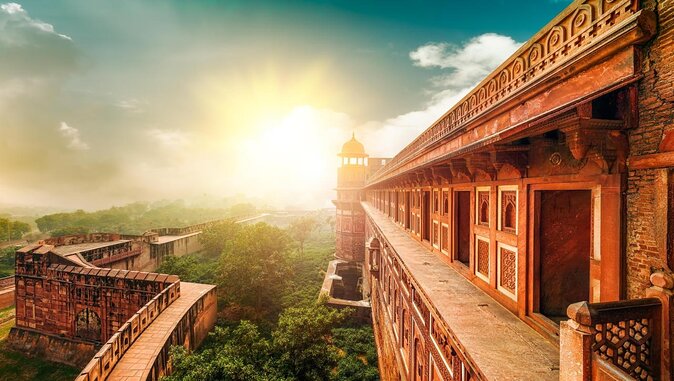
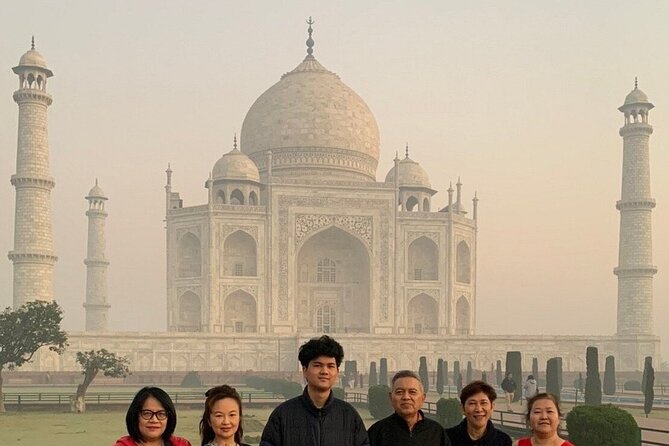
In Agra, you’ll start with Agra Fort, then move to the Taj Mahal. The Taj is easy to understand even before you learn the details: it’s symmetrical, bright white, and designed to make the viewer slow down. Your guide can explain the story, but the bigger takeaway is the setting. It sits beside the Yamuna River, and that riverfront context changes how the monument looks through the day.
Itmad-ud-Daula (the “mini” Taj feel)
You’ll also visit Itmad-ud-Daula, a tomb complex on the Yamuna with delicate marble work and a garden-like feel. This stop is more than filler. It helps you understand the design language—masonry, marble inlay, and the “garden meets mausoleum” layout—that later explodes in the Taj Mahal.
If you’re the kind of traveler who likes how major works influence each other, this is a good day for you.
Day 4: Sunrise Taj Mahal plus Fatehpur Sikri on the way to Jaipur
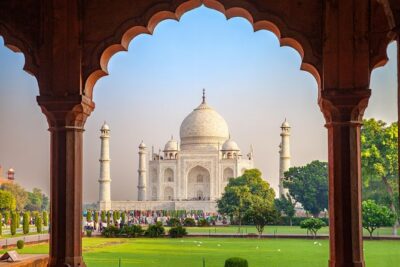
Day 4 starts early. You’ll do a sunrise Taj Mahal visit, scheduled as an early-morning activity with a note to wake up early for the best shots. This is one of those rare tour upgrades that actually changes the experience.
At sunrise, the air tends to feel calmer, the light is softer, and the monument doesn’t feel like it’s only for crowds with selfie sticks. You’ll also likely appreciate the Taj more because you’re not just checking a box—you’re seeing how it behaves with light and time.
Fatehpur Sikri: Akbar’s fortified city
After the Taj, you drive toward Fatehpur Sikri (about 40 kilometers from Agra). It’s a fortified city founded in 1571 by Mughal Emperor Akbar, and the reason it matters is that it wasn’t just a monument. It was a full imperial setup—built as a city, then used as a capital for about 15 years.
This is a great stop when you want a break from the Taj’s emotional punch. Fatehpur Sikri is more about structure, planning, and how power shows up in city design.
On to Jaipur
Then you continue to Jaipur with a drive around 240 kilometers and about 4 hours. By the time you arrive, you’ll probably be grateful your tour doesn’t pretend you’ll keep walking nonstop. You’ll be escorted to your pre-booked hotel.
Day 5 in Jaipur: Jal Mahal, Hawa Mahal, City Palace, Jantar Mantar, Albert Hall
Jaipur’s day is a mix of postcard icons and smart stops that help you understand how the city thinks.
Jal Mahal (palace in the water)
You’ll begin with Jal Mahal, a five-storied palace in Man Sagar Lake. It’s a visually striking place, and it also gives you a quick lesson in why Jaipur’s architecture and landscape planning feel connected.
Hawa Mahal (953 small windows)
Next is Hawa Mahal, the five-storied red-and-pink sandstone facade known for 953 small windows. It’s the kind of monument where even if you know it by name, it looks different in person—less like a drawing and more like a clever solution to how people lived, moved, and watched from within the city.
City Palace (Rajput and Mughal mix)
You’ll visit City Palace, located in the heart of Jaipur. This one is valuable because it’s not just a building. It’s a design blend: Rajput and Mughal styles working together, which helps explain why Jaipur feels both royal and practical.
Jantar Mantar (stone astronomy)
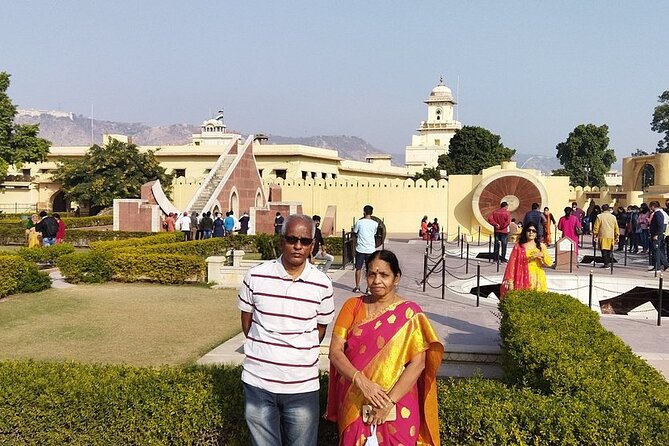
Then comes Jantar Mantar, an astronomical observatory. It includes the world’s largest stone sundial plus multiple instruments. This stop is great if you like the “old science” side of travel—places where the architecture is the tool.
Albert Hall Museum (oldest in Rajasthan)
Finally, you’ll see Albert Hall Museum, described as the oldest museum in Rajasthan. If you’re tired of only monuments and prefer artifacts and context, this balances the day nicely. Even if you don’t read everything, it gives your trip a “how people lived” perspective.
Day 6: Transfer back to Delhi for your departure window
Day 6 is mostly a travel day. You’ll head from Jaipur to New Delhi, covering about 308 kilometers in around 6 hours. Your tour provides an assisted transfer, which matters because this is exactly the kind of route where solo travel can get stressful with traffic and route uncertainty.
Because the provided schedule doesn’t specify major sightseeing details for Day 6, I’d treat this as your decompression day. Use the time to rest, hydrate, and keep your energy for the airport day.
Day 7: Leaving from Indira Gandhi International Airport
Your tour ends at Indira Gandhi International Airport with departure for your onward destination. The experience concludes back at the meeting point, so you’re not left wondering how to handle timing the last morning.
What you’re really paying for (and what costs extra)
Let’s talk value plainly. You’re paying around $339.23 per person for:
- Private transportation in an air-conditioned vehicle
- Professional private tour guides
- Mineral water bottle
- Monument entrance fees for sights mentioned
- Airport meet-up and hotel transfers built into the start
A big reason this can feel like good value is that Golden Triangle sightseeing is heavily dependent on time management. A driver and guide handle the “glue” work that otherwise turns into wasted hours.
What’s not included matters too:
- Lunch and dinner for 6 days
- Camera fees at monuments (these can be separate from entry)
- Anything outside what’s listed in inclusions
- Accommodation with breakfast only if you choose the suitable option
My practical advice: plan a daily meal budget and carry a little flexibility. You’ll likely be stopping for food near the sights, and in markets it’s easy to get tempted by snacks and drinks.
Who this tour fits best
This is a strong match if you want:
- A guided Golden Triangle, not a DIY scramble
- Comfort for the long drives between cities
- Key landmarks plus some local textures (especially the Delhi market time)
- A sunrise-style upgrade for the Taj Mahal
It’s also a good fit for couples or small groups who want a private setup. The tour model is built for “only your group,” which tends to keep things calmer and easier to manage.
If you hate early starts, know that sunrise Taj Mahal is part of the plan. If you’re sensitive to travel time, the long road segments (Delhi–Agra, Agra–Jaipur, Jaipur–Delhi) are real.
Should you book this private Golden Triangle tour?
I’d book it if you want your Delhi–Agra–Jaipur trip to feel organized, guided, and comfortable, with the Taj Mahal handled at sunrise instead of as a midday checklist.
I would think twice if your top priority is maximum downtime, because the schedule balances major sights with travel time—and you’ll be on the move each day. Also, if you don’t want to manage meal budgeting, remember lunch and dinner aren’t included.
Overall: for a private, guide-led Golden Triangle that hits the headline sights and still gives room for real Delhi market energy, this is a solid way to do it.
FAQ
What cities are included in the 7-day tour?
The tour covers New Delhi, Agra, and Jaipur.
Where does the tour start?
It starts at Indira Gandhi International Airport in New Delhi.
Is airport pickup or meet-and-greet included?
Yes. You’ll be met by a representative at Indira Gandhi International Airport and escorted to your pre-booked hotel.
Is this tour private?
Yes. It’s a private tour/activity, meaning only your group participates.
Are entrance fees included?
The tour includes monument entrance fees for sights mentioned. Camera fees at monuments are not included.
Does the itinerary include a sunrise Taj Mahal visit?
Yes. Day 4 includes a sunrise Taj Mahal tour with a note to wake up early for the best shot.
Is lunch and dinner included?
No. Lunch and dinner are not included for the days listed in the tour.
Can I cancel for a full refund?
Yes. There is free cancellation, and you can cancel up to 24 hours in advance for a full refund.
Is an air-conditioned vehicle provided?
Yes. The tour includes private transportation in an air-conditioned vehicle.
More Tour Reviews in New Delhi
- Old & New Delhi City Tour – Half or Full Day Options Available
★ 5.0 · 4,811 reviews - Half Day Private Delhi City Tour
★ 5.0 · 4,474 reviews - Same Day Taj Mahal, Agra Fort & Baby Taj Tour from Delhi by Car
★ 5.0 · 4,304 reviews - Taj Mahal Day Tour from Delhi by Superfast Train – TOP RATED TOUR
★ 5.0 · 4,166 reviews - Delhi: Old and New Delhi Private Full or Half-Day Tour
★ 4.9 · 3,776 reviews
Onward to Jaipur: More Day Trips
- 3-Days Private Golden Triangle Tour: Delhi, Agra & Jaipur by Car
★ 5.0 · 1,107 reviews - 3-Days Private Golden Triangle Tour: Delhi, Agra & Jaipur by Car
★ 5.0 · 1,098 reviews - 3-Day Delhi, Agra and Jaipur Private Tour – India Golden Triangle
★ 5.0 · 812 reviews - Four-Day Private Luxury Golden Triangle Tour to Agra and Jaipur From New Delhi
★ 5.0 · 807 reviews - Jaipur Day Trip from Delhi by Car or Train – All Inclusive
★ 5.0 · 663 reviews
More Agra Day Trips out of Delhi
- Same Day Taj Mahal, Agra Fort & Baby Taj Tour from Delhi by Car
★ 5.0 · 4,304 reviews - Full Day Taj Mahal, Agra Fort & Baby Taj Tour from Delhi by Car
★ 5.0 · 3,647 reviews - From Delhi: Taj Mahal & Agra Private Day Trip with Transfers
★ 4.9 · 3,181 reviews - From Delhi: Taj Mahal and Agra Fort Private Sunrise Tour
★ 4.9 · 2,270 reviews - Sunrise Taj Mahal, Agra Fort & Baby Taj Tour from Delhi by Car
★ 5.0 · 2,243 reviews
Just added: more New Delhi reviews to browse
- 4 days Golden Triangle Tour★ 5.0 · 3 reviews
- Discover Old & New Delhi: Private Tour with Street Food★ 5.0 · 3 reviews
- Taj Mahal Tour From Delhi By Private Car★ 4.5 · 3 reviews
- Golden Triangle Tour 5 Days★ 5.0 · 3 reviews
- Taj Mahal: Express Entry Ticket For Sunset Tour with guide★ 5.0 · 3 reviews
- Agra Taj Mahal Sunrise & Sunset Tour from Delhi★ 5.0 · 3 reviews
Agra Day Trips from Delhi, compared.
 ★ 5.0Same Day Taj Mahal, Agra Fort & Baby Taj Tour from Delhi by CarFrom $624,304 reviews
 ★ 5.0Full Day Taj Mahal, Agra Fort & Baby Taj Tour from Delhi by CarFrom $623,647 reviews
 ★ 4.9From Delhi: Taj Mahal & Agra Private Day Trip with TransfersFrom $43,181 reviews
 ★ 4.9From Delhi: Taj Mahal and Agra Fort Private Sunrise TourFrom $592,270 reviews
 ★ 5.0Sunrise Taj Mahal, Agra Fort & Baby Taj Tour from Delhi by CarFrom $622,243 reviews
 ★ 5.0Taj Mahal and Agra Private Car Tour from Delhi with 5* LunchFrom $331,633 reviews
 ★ 4.9From Delhi: Private Taj Mahal and Agra Tour by Express TrainFrom $751,605 reviews
 ★ 5.0Taj Mahal, Agra Fort, Baby Taj Tour from Delhi by Superfast TrainFrom $751,494 reviews
Browse the lists this tour appears in