
Reviewed · AGRA DAY TRIPS FROM DELHI
Private Train Tour: 3-Day Golden Triangle Delhi, Agra, Jaipur from Delhi
Three cities, two trains, zero guesswork. This private Golden Triangle trip strings together Delhi’s big Mughal and imperial sights, a super-fast run to Agra for the Taj Mahal, then a classic Jaipur day with private guides handling the details.
I really like that the schedule mixes famous monuments with quieter stops like Lotus Temple and the Sikh beauty of Bangla Sahib, so your eyes don’t just get to the next photo spot. I also like the private air-conditioned vehicle and door-to-door pickups, because traffic and timing can be a headache on your own.
One thing to watch: the days start early and end late. If you want a slow, lazy pace, this plan can feel like you’re constantly moving between stops.
In This Review
- Key things that make this Golden Triangle plan work
- Price and value: $400 per person, and what you really get
- What’s not included (so you don’t get surprised)
- Day 1 in Delhi: Mughal grandeur, a tall tower, and a few calm breaks
- Humayun’s Tomb: geometry, symmetry, and the “floating” effect
- Qutub Minar complex: ruins, tombs, and a 73-meter vertical landmark
- Lotus Temple: where the city slows down
- India Gate and the seat of power: a memorial and a national address
- Gurudwara Bangla Sahib: faith, color, and free community meals
- The early train to Agra: how the schedule protects your energy
- Taj Mahal in Agra: why a guided visit beats a random stop
- Practical tip that actually helps: plan for the “getting there” part
- Agra Fort: the other Mughal masterpiece you shouldn’t skip
- Jaipur by road: the Pink City transition (and what to expect)
- Amber Palace: Rajput architecture, huge views, and one choice you can opt out of
- Elephant/jeep rides: not included, but you’ll see them
- Jal Mahal and Hawa Mahal: photo stops with real purpose
- Jal Mahal: the Water Palace picture
- Hawa Mahal: the Palace of Wind
- City Palace and Jantar Mantar: where royal life meets math
- City Palace: courtyards, gardens, and the royal family residence
- Jantar Mantar Observatory: geometric science you can see
- Trains, drivers, and guides: the real comfort factor
- What to plan for on your own: meals, photos, and realistic pacing
- Meals
- Camera fees
- Monday planning
- Who this tour suits best
- Should you book this 3-day private Golden Triangle tour?
- FAQ
- What time does the tour start?
- Do I get pickup from my location in Delhi?
- Are train rides included between the cities?
- What meals are included, and is there a vegetarian option?
- Is Lotus Temple open every day?
- Are entrance fees, camera fees, and Amber Fort rides included?
Key things that make this Golden Triangle plan work
- Door-to-door pickup and station help so you’re not hunting for taxis or ticket lines.
- Super-fast train legs (Delhi→Agra and Jaipur→Delhi) to cut down the long-haul fatigue.
- Private local guides at the key monuments so you actually understand what you’re seeing.
- Entrance fees included for the sights listed, which makes budgeting easier.
- Taj Mahal parking shuttle included (battery bus/e-rickshaw return), a small detail that saves time.
- Flexibility for your group (the private setup lets you adjust or even skip stops if timing works).
Price and value: $400 per person, and what you really get
At $400 per person for three days, this tour isn’t a budget backpacker deal. But it also isn’t just a “driver and tickets” package. You’re paying for a stack of things that usually cost you money and time separately: hotel nights with breakfast (in the hotel-included option), private guides, entrance fees at the scheduled monuments, and two super-fast train transfers between cities.
Think about the savings in practical terms. If you DIY this route, you’d spend time coordinating trains, hiring multiple guides, and re-buying entry tickets while trying to keep everyone on schedule. Here, those moving parts are stitched together. For couples, that matters even more: it’s the difference between enjoying the day and spending the day checking maps.
Other Agra runs out of Delhi worth a look




What’s not included (so you don’t get surprised)
Camera fees at monuments are not included. Also, lunch and most drinks aren’t included unless stated. And at Amber Fort, the elephant/jeep ride is not included. You can still enjoy the fort without it, but if that’s a must for your group, you’ll need to budget extra.
Day 1 in Delhi: Mughal grandeur, a tall tower, and a few calm breaks
Delhi can feel chaotic fast, so I like Day 1’s rhythm. You get a tight loop of landmark sites, then you’re given little islands of quiet where the city noise drops.
Humayun’s Tomb: geometry, symmetry, and the “floating” effect
Humayun’s Tomb is a UNESCO stop that’s all about proportion. The building looks like it floats above its symmetrical gardens, and the facade is described with bands of white marble and red sandstone. The design is tied to Islamic geometry and even emphasizes the number eight, which makes the place feel intentional instead of just decorative.
If you like architecture, this is a great opener. It’s also a nice way to start your Golden Triangle story: it sets up the Mughal visual language you’ll keep seeing later in Agra and beyond.
Qutub Minar complex: ruins, tombs, and a 73-meter vertical landmark
Next is the UNESCO Qutub Minar complex. The highlight is the Qutab Minar, a 73m-tall tower from the 12th century. Around it, you’ll notice ruined tombs and other monuments that make the complex feel layered rather than single-theme.
This stop is one of those “you’ll look up a lot” moments. The tower dominates, but the surrounding monuments help you understand the site as a whole.
Chasing the Pink City? More Jaipur day trips
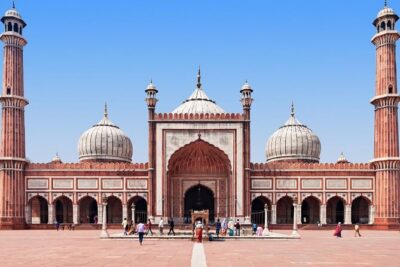
Lotus Temple: where the city slows down
Lotus Temple is a free admission stop and, on the right day, it’s a reset button. It’s shaped like a lotus with 27 white-marble petals, and visitors are invited to pray or meditate silently according to their own beliefs.
Two practical notes. First, it remains closed every Monday, so if your trip lands on a Monday, you’ll want the operator to adjust the plan. Second, even when you’re just sightseeing, the atmosphere tends to be calmer than many other Delhi monuments.
India Gate and the seat of power: a memorial and a national address
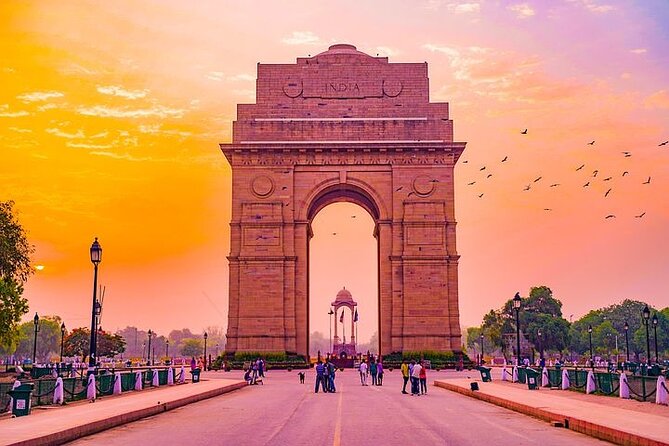
India Gate is a 42m-high stone memorial arch designed by Lutyens in 1921, honoring roughly 90,000 Indian army soldiers from WWI and later campaigns. It’s a recognizable symbol of the city, but it also works as a moving break between major heritage sites.
After that, you’ll have a stop at the circular, colonnaded building linked to the 1947 handover of power. Parliament still meets there, so it’s one of those “history you can’t ignore” places.
Then you get Rashtrapati Bhavan (President House). The details are part of why it’s interesting: it has 340 rooms and about 2.5km of corridors. You typically get a peek from the outside/nearby rather than a full guided interior tour, but just seeing the scale helps you understand how grand the design is.
Gurudwara Bangla Sahib: faith, color, and free community meals
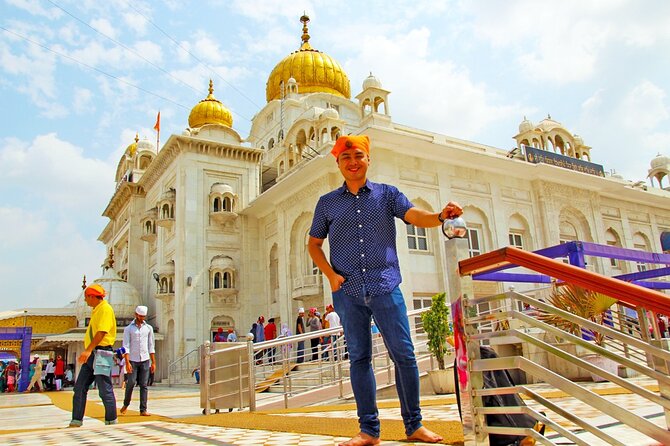
Gurudwara Bangla Sahib is one of my favorite kinds of stops on these trips: a major religious site where the spiritual vibe and daily life both show. It’s a white-marble gurdwara with golden onion domes, built at the site where the eighth Sikh guru, Harkrishan Dev, stayed before his 1664 death.
You’ll also hear live devotional songs, and at gurdwaras free meals are served daily. Even if you don’t time a meal, the fact that the meal part is built into the place’s routine is a real cultural detail, not a “tourist add-on.”
The early train to Agra: how the schedule protects your energy
Agra is the Golden Triangle headline, but the best part here is how you get there. You board a super-fast express train from Delhi in the early morning window (6am–8am). Breakfast is served onboard while you watch the countryside roll by.
This is the kind of travel move that pays off. Instead of losing most of your day to road time, you “spend” the morning in comfort, then use the arrival window for Taj Mahal and Agra Fort.
You’ll meet a local guide at Agra at the main exit gate, which matters because Agra can be busy. A guide at the right place helps you start the day without wasting it.
Taj Mahal in Agra: why a guided visit beats a random stop
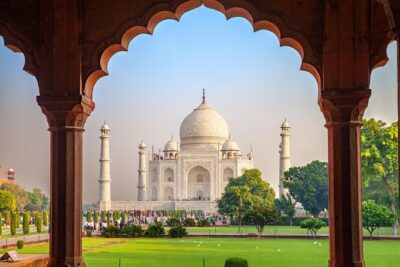
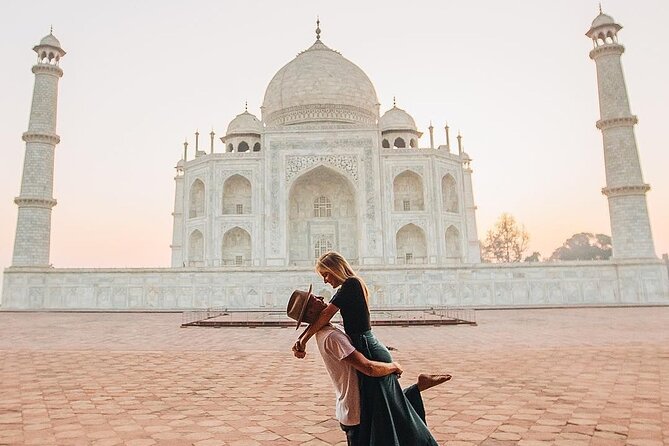
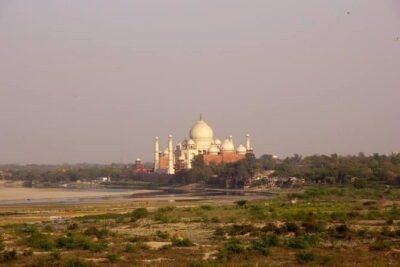
Taj Mahal is UNESCO-listed, and it’s widely treated as the most beautiful building in the world. The story is tied to Shah Jahan building it as a memorial for his third wife, Mumtaz Mahal, who died in 1631 giving birth to their 14th child.
I like that your guide isn’t just reciting dates. They help you look at the building’s components and how the complex is composed. Poet Rabindranath Tagore famously described it as a tear on eternity’s cheek, and once you see the symmetry and the way the marble shifts with light, that line makes sense.
Practical tip that actually helps: plan for the “getting there” part
The tour includes a battery bus/e-rickshaw return ride from Taj Mahal parking. That’s small, but it saves time and hassle. When you’re standing in a busy parking area with everyone trying to move at once, having that return transport included reduces stress.
The Taj visit here is scheduled for about two hours, which is long enough to take your time without feeling like the site owns your whole day.
Agra Fort: the other Mughal masterpiece you shouldn’t skip
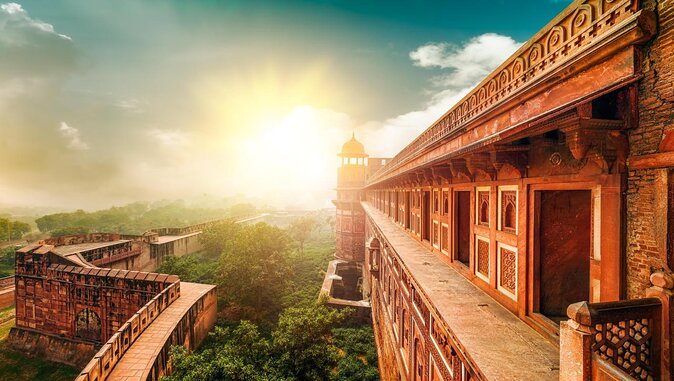
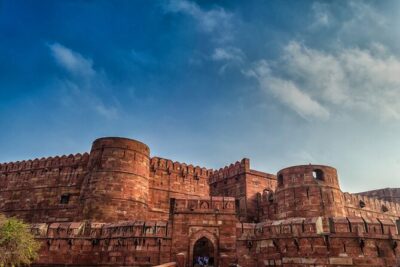
After Taj Mahal, you head to Agra Fort in the afternoon. This UNESCO site sits along the Yamuna River and served as a main residence of Mughal emperors until 1638. It’s one of the finest Mughal forts in India, and that’s not just marketing language. Fort architecture gives you a different feel than the Taj: you start thinking about power, defense, and how life was organized inside walls.
The timing here is about one hour with admission included. That length is reasonable. You’ll see key areas without draining yourself, and it keeps your energy for the transfer onward to Jaipur.
Jaipur by road: the Pink City transition (and what to expect)
From Agra, you drive to Jaipur, check in at your pre-booked hotel, and settle in for the next day’s sightseeing. The transfer time is approximate and depends on traffic, so don’t plan anything tight for the immediate arrival evening.
What I like about arriving by road rather than another instant train jump is that the day-to-day “feel” changes. Your eyes go from river and Mughal monuments to Rajasthan’s city rhythm. Then you’re ready for Amber and the rest.
Amber Palace: Rajput architecture, huge views, and one choice you can opt out of
Amber Palace (Amer) is the big Jaipur must-see. It rises from a rocky mountainside about 11km northeast of Jaipur and is described as honey-hued and formidable. The palace complex is built from pale yellow and pink sandstone plus white marble, divided into four main sections, each with its own courtyard.
This is the kind of place where a guide helps you spot what you’d otherwise miss: how the different sections relate, where you should focus for photos, and what each space was meant to do.
Elephant/jeep rides: not included, but you’ll see them
The elephant/jeep ride at Amber Fort is not included. If you want the traditional ride, you’ll have to arrange it separately. If you don’t, you can still have an excellent visit. The palace itself is the real draw.
Jal Mahal and Hawa Mahal: photo stops with real purpose
Jaipur’s schedule includes photo stops that break up the bigger “walk-and-see” sites.
Jal Mahal: the Water Palace picture
Jal Mahal is a photo stop at the Water Palace near the cenotaphs of the maharanis of Jaipur, set in Man Sagar. It’s described as dreamlike, and its origins are uncertain, though it’s believed to have been extensively restored and possibly built by Jai Singh II (1734).
A 15-minute stop is short, but it’s enough for the classic view if your timing is right. Even if you can’t linger long, it helps you get a sense of how water features shaped royal city design.
Hawa Mahal: the Palace of Wind
Hawa Mahal is another quick photo stop. This five-storey honeycombed facade rises in pink paint, built in 1799 by Maharaja Sawai Pratap Singh so royal women could watch city life and processions.
If you only spend a moment here, that’s still okay. The value is visual: you’ll recognize it immediately and connect it to the idea of Jaipur’s social life and layered street activity.
City Palace and Jantar Mantar: where royal life meets math
After the quick visuals, the tour brings you to two places that feel different from each other, which I appreciate.
City Palace: courtyards, gardens, and the royal family residence
City Palace is the residence of the royal family and a complex of courtyards, gardens, and buildings. It’s noted as a striking blend of Rajasthani and Mughal architecture, with some palace buildings dating from the early 20th century.
A guide here helps you read the site. Without interpretation, you can walk through and just think it’s “beautiful old buildings.” With interpretation, you start noticing how the styles overlap and how the complex is organized like a working home, not just a museum set.
Jantar Mantar Observatory: geometric science you can see
Jantar Mantar is UNESCO-listed and described as curving geometric buildings calibrated to monitor the movement of stars and planets. It’s not just a bunch of structures you photograph. It’s a system you can understand with the right explanation.
This stop is about one hour with admission included. It’s a great “brain break” between forts and palaces.
Trains, drivers, and guides: the real comfort factor
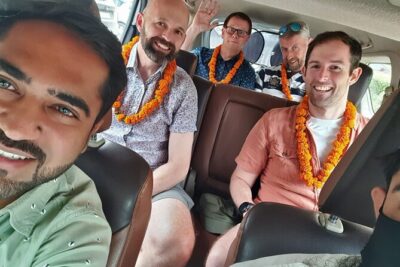
This tour is built around private logistics: private air-conditioned vehicle for sightseeing and transfers, bottled water throughout the trip, and assistance at train stations for pick-up and drop-off.
That’s not glamorous, but it’s the difference between a smooth trip and a stressful one. In the kind of places where trains run at specific times and monuments cluster across different neighborhoods, having someone who knows where you’re going is a big deal.
It’s also private, meaning only your group participates. That helps you move at a pace that makes sense for you, and it’s where the couple-friendly “romantic” angle comes from. You’re not stuck waiting for a big group to reassemble, and private guides can pace explanations around your interests.
And one standout detail from the operator’s track record: service has been praised for door-to-door coordination, including driver DK Shwarma and a full set of three guides delivering smooth train-and-city handoffs.
What to plan for on your own: meals, photos, and realistic pacing
Meals
Dinner is included, and breakfasts (two) plus breakfast and dinner during the train rides are included. That still leaves lunch and extra snacks as your responsibility. If you’re sensitive to hunger, plan to carry water and something small, even though bottled water is provided in the vehicle.
Camera fees
Camera fees at monuments are not included. This matters because some sites charge separately for photography equipment. If you use a larger camera setup, check before you arrive with it.
Monday planning
If your trip date puts you in Delhi on a Monday, Lotus Temple will be closed. The good news is that your day isn’t only built around one stop; Delhi has plenty of alternatives in the plan.
Who this tour suits best
This is a strong fit if you want a comfortable, guided Golden Triangle without the hassle of coordinating everything yourself. It’s especially good for couples because the route mixes iconic monuments with calmer spiritual stops, and the private nature keeps you from being pushed along.
It also fits if you like history explained in a way that helps you look. Humayun’s Tomb’s design rules, Taj Mahal’s story of Mumtaz Mahal, and the measurable focus of Jantar Mantar all reward attention.
If you’re traveling solo and want value, you’ll still likely find it worth it because the tour handles guides and transfers. Just keep in mind the schedule is active and relies on train timing.
Should you book this 3-day private Golden Triangle tour?
If you want the Taj Mahal and Amber Palace experience without the logistical stress, I’d lean yes. The biggest reasons are practical: private guides, entrance fees included for the listed sights, and super-fast train legs that keep your energy up.
Skip it if you want a slow vacation where you drift between sites and don’t care about structured timing. Also, if you strongly want an elephant/jeep ride at Amber Fort, budget for that since it’s not included.
If you’re the kind of traveler who likes understanding what you’re seeing while someone else handles the route, this package is built for you.
FAQ
What time does the tour start?
The tour starts at 9:00am.
Do I get pickup from my location in Delhi?
Yes. Pickup is offered from your desired location in Delhi, Gurugram, or Noida.
Are train rides included between the cities?
Yes. Super-fast deluxe train rides are included from Delhi to Agra and from Jaipur to Delhi, with breakfast or dinner served on board as stated.
What meals are included, and is there a vegetarian option?
Dinner is included, and breakfast (2) plus breakfast and dinner during the train rides are included. A vegetarian meal option is available; you should advise dietary requirements at booking.
Is Lotus Temple open every day?
No. Lotus Temple remains closed every Monday.
Are entrance fees, camera fees, and Amber Fort rides included?
Entrance fees for the sights mentioned in the itinerary are included. Camera fees at monuments and the elephant/jeep ride at Amber Fort are not included.
The Full Golden Triangle, More Options
- 3-Days Private Golden Triangle Tour: Delhi, Agra & Jaipur by Car
★ 5.0 · 1,107 reviews - 3-Days Private Golden Triangle Tour: Delhi, Agra & Jaipur by Car
★ 5.0 · 1,098 reviews - 3-Day Delhi, Agra and Jaipur Private Tour – India Golden Triangle
★ 5.0 · 812 reviews - Four-Day Private Luxury Golden Triangle Tour to Agra and Jaipur From New Delhi
★ 5.0 · 807 reviews - 5 Nights 6 Days Private Golden Triangle Tour – Delhi Agra Jaipur
★ 5.0 · 574 reviews
Onward to Jaipur: More Day Trips
- 3-Days Private Golden Triangle Tour: Delhi, Agra & Jaipur by Car
★ 5.0 · 1,107 reviews - 3-Days Private Golden Triangle Tour: Delhi, Agra & Jaipur by Car
★ 5.0 · 1,098 reviews - 3-Day Delhi, Agra and Jaipur Private Tour – India Golden Triangle
★ 5.0 · 812 reviews - Four-Day Private Luxury Golden Triangle Tour to Agra and Jaipur From New Delhi
★ 5.0 · 807 reviews - Jaipur Day Trip from Delhi by Car or Train – All Inclusive
★ 5.0 · 663 reviews
More Agra Day Trips out of Delhi
- Same Day Taj Mahal, Agra Fort & Baby Taj Tour from Delhi by Car
★ 5.0 · 4,304 reviews - Full Day Taj Mahal, Agra Fort & Baby Taj Tour from Delhi by Car
★ 5.0 · 3,647 reviews - From Delhi: Taj Mahal & Agra Private Day Trip with Transfers
★ 4.9 · 3,181 reviews - From Delhi: Taj Mahal and Agra Fort Private Sunrise Tour
★ 4.9 · 2,270 reviews - Sunrise Taj Mahal, Agra Fort & Baby Taj Tour from Delhi by Car
★ 5.0 · 2,243 reviews
Just added: more New Delhi reviews to browse
- 4 days Golden Triangle Tour★ 5.0 · 3 reviews
- Discover Old & New Delhi: Private Tour with Street Food★ 5.0 · 3 reviews
- Taj Mahal Tour From Delhi By Private Car★ 4.5 · 3 reviews
- Golden Triangle Tour 5 Days★ 5.0 · 3 reviews
- Taj Mahal: Express Entry Ticket For Sunset Tour with guide★ 5.0 · 3 reviews
- Agra Taj Mahal Sunrise & Sunset Tour from Delhi★ 5.0 · 3 reviews
Agra Day Trips from Delhi, compared.
 ★ 5.0Same Day Taj Mahal, Agra Fort & Baby Taj Tour from Delhi by CarFrom $624,304 reviews
 ★ 5.0Full Day Taj Mahal, Agra Fort & Baby Taj Tour from Delhi by CarFrom $623,647 reviews
 ★ 4.9From Delhi: Taj Mahal & Agra Private Day Trip with TransfersFrom $43,181 reviews
 ★ 4.9From Delhi: Taj Mahal and Agra Fort Private Sunrise TourFrom $592,270 reviews
 ★ 5.0Sunrise Taj Mahal, Agra Fort & Baby Taj Tour from Delhi by CarFrom $622,243 reviews
 ★ 5.0Taj Mahal and Agra Private Car Tour from Delhi with 5* LunchFrom $331,633 reviews
 ★ 4.9From Delhi: Private Taj Mahal and Agra Tour by Express TrainFrom $751,605 reviews
 ★ 5.0Taj Mahal, Agra Fort, Baby Taj Tour from Delhi by Superfast TrainFrom $751,494 reviews
Browse the lists this tour appears in