
Reviewed · GOLDEN TRIANGLE TOURS
3 Nights Golden Triangle Tour India
A five-star Golden Triangle with zero driving stress. This private tour is a practical way to see Delhi, Agra, and Jaipur in a tight schedule, with hotel pickup and a guide to keep the day moving.
What I like most is how the plan focuses on the big, iconic stops without making you wrestle with tickets, traffic, or finding the right entrances.
You’ll get two things that genuinely matter: door-to-door private transfers and a live guide who helps you understand what you’re looking at. I also like that the hotel stays are higher-end (including breakfast), so long days don’t turn into long nights in basic rooms.
One thing to consider: monument fees are not included, and you’ll spend several hours on the road between cities. Start early, plan for extra cash for admissions, and wear comfy layers under that formal dress code.
In This Review
- Key points before you go
- Price and Logistics: what $220 really buys
- The real rhythm of the itinerary (and why it works)
- Day 1 in Delhi: India Gate, Sansad Marg drive pass, and Qutub Minar
- India Gate and Sansad Marg (quick hits)
- Qutub Minar: the UNESCO stop you shouldn’t skip
- Humayun’s Tomb: Mughal design with real emotional weight
- Overnight in Agra
- Day 2 in Agra: Taj Mahal first, then fort and Fatehpur Sikri
- The Taj Mahal: what to look for besides the obvious
- Agra Fort: power, not postcard views
- Fatehpur Sikri: a short detour that feels like a whole world
- Check in Jaipur
- Day 3 in Jaipur: Amer Fort to wind-windows and the big astronomical tools
- Amber (Amer) Palace: the hill-fort experience
- Hawa Mahal: the 950-window facade
- City Palace of Jaipur: Mughal-Chalukya mix and the Maharaja seat
- Jantar Mantar: the science stop that doesn’t feel boring
- Back to the hotel
- Day 4: Galta Ji (Monkey Temple) and then back to Delhi
- Galta Ji (Monkey Temple): a pink-stone pilgrimage with water reservoirs
- Drive to Delhi airport
- What made this tour stand out in real feedback
- Who should book this tour (and who shouldn’t)
- Should you book 3 Nights Golden Triangle (Delhi–Agra–Jaipur)?
- FAQ
- FAQ
- What time does the tour start?
- Is pickup from the airport or hotel included?
- Is this a private tour?
- Are monument or monument entrance fees included?
- How many breakfasts are included?
- What is the dress code?
Key points before you go
- Private, just-your-group touring: you can keep the pace you prefer with your guide and driver.
- Early start with daily pickup/drop-off: you start at 6:00am, which helps you beat crowds later in the day.
- Five-star stays with breakfast: you’re set up in Radisson Hotel Agra and Sarovar Premiere in Jaipur, with breakfast included for 3 days.
- Guide-led history at the key sites: from Qutub Minar to the Taj Mahal, you’re not just looking, you’re getting context.
- Monuments cost extra: tickets are listed as not included for several headline stops.
- A well-built Golden Triangle route: Delhi on day 1, Taj Mahal + forts on day 2, palaces + viewpoints on day 3.
Price and Logistics: what $220 really buys
On paper, $220 per person sounds like a deal for India’s Golden Triangle. In practice, the value depends on what’s included versus what you’ll pay on top.
Here’s the core of the package:
- Private vehicle transport across the route
- A tour guide following the itinerary
- Fuel surcharge and local taxes handled
- Bottled water included
- Round-trip private transfers each day
- Higher-end hotel stays (labeled as 5 star), plus breakfast for 3 mornings
- A mobile ticket (helpful if you prefer less paperwork)
What’s not included:
- Monuments fees (explicitly listed as not included for several major sights)
- Food and drinks (you buy them yourself)
- Alcoholic drinks (also available to purchase)
The way I think about value: this tour is paying for time-saving logistics and guided access to the top sites—so you can spend your energy on looking, not planning. If you’re the type who hates last-minute ticket hunting or waiting around for transport, the private format is worth it.
Delhi, Agra and Jaipur: more full circuits



The real rhythm of the itinerary (and why it works)
This is a “fast and focused” Golden Triangle plan:
- Day 1: Delhi highlights + Qutub Minar + Humayun’s Tomb, then drive to Agra
- Day 2: Taj Mahal + Agra Fort + Fatehpur Sikri, then check in Jaipur
- Day 3: Amer (Amber) Fort + Hawa Mahal + City Palace + Jantar Mantar, then evening back to hotel
- Day 4: Galta Ji (Monkey Temple) and then drive to the airport in Delhi
The good part of this rhythm is that each day has a clear theme: Mughal Delhi, Mughal Agra, royal Jaipur. The drawback is obvious: you’ll be in a car a lot. If you enjoy travel as movement plus sightseeing, you’ll be fine. If you want slow days and zero driving, this schedule may feel tight.
Day 1 in Delhi: India Gate, Sansad Marg drive pass, and Qutub Minar
You start early, and you start smart. With pickup from the airport or your hotel and an itinerary that begins around 6:00am, you get through Delhi landmarks while the day is still waking up.
India Gate and Sansad Marg (quick hits)
First you roll past major landmarks on the way through Delhi:
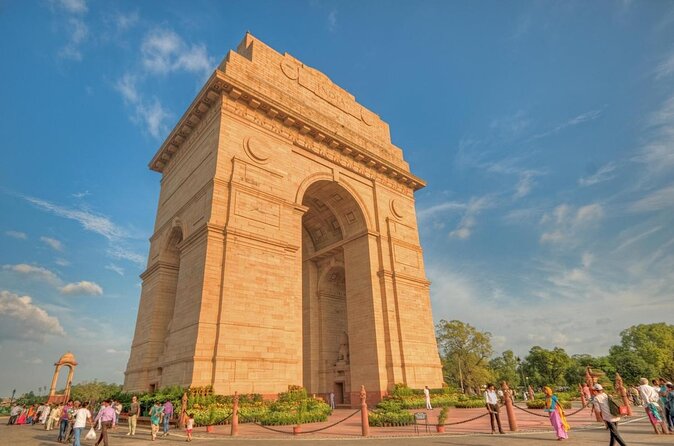
- India Gate (with its official name Delhi Memorial). It’s the monumental sandstone arch dedicated to troops of British India who died in wars fought between 1914 and 1919. It sits at the eastern end of Rajpath (formerly Kingsway).
This stop works best if you treat it like a photo + orientation moment, not a long hangout.
- Sansad Marg is a drive pass of India’s grand Parliament building. It was opened in 1927 and features 144 sandstone columns in a circular design. There’s an important note: an “insight visit” is not allowed for visitors.
So, expect to view it from the outside and move on.
Qutub Minar: the UNESCO stop you shouldn’t skip
Then comes Qutub Minar, part of the Qutb/Qutab complex, a UNESCO World Heritage Site. This is one of those places where even a short visit feels like a big win. Qutub Minar is a tall minaret made of cylindrical and flanged shafts with balconies along the way.
I like this stop because it’s not just pretty. It’s a real architectural clue about how Delhi’s skyline has layers—centuries stacked vertically.

Humayun’s Tomb: Mughal design with real emotional weight
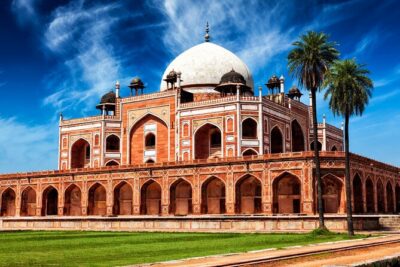
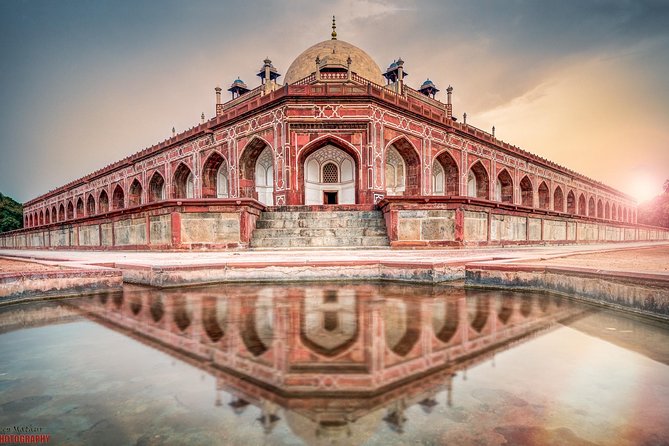
Next is Humayun’s Tomb, a UNESCO-level kind of site even when you only have an hour. The story matters here:
- Commissioned in 1569–70 by Empress Bega Begum
- Designed by Persian architects Mirak Mirza Ghiyas and Sayyid Muhammad
- Built thanks to the initiative of Humayun’s widow Hamida Banu Begum, who began the construction of the mausoleum in 1565, nine years after Humayun’s death
This stop is ideal if you like gardens and symmetry. It’s also a calmer counterweight after the city drive.
Overnight in Agra
After Delhi sightseeing, you drive to Agra (about 3 hours listed), then check into Radisson Hotel Agra. You’ve earned a rest day that actually feels like a rest.
Practical tip: for Day 2, plan to be ready for another early start after your breakfast. Keep your basics packed for a quick shower, quick outfit change, and straight into photos.
Day 2 in Agra: Taj Mahal first, then fort and Fatehpur Sikri
This is the day you’re here for. The itinerary starts with Taj Mahal right after breakfast.
The Taj Mahal: what to look for besides the obvious
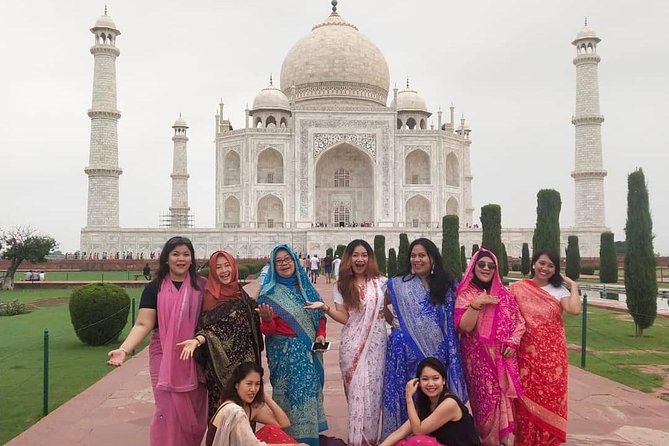
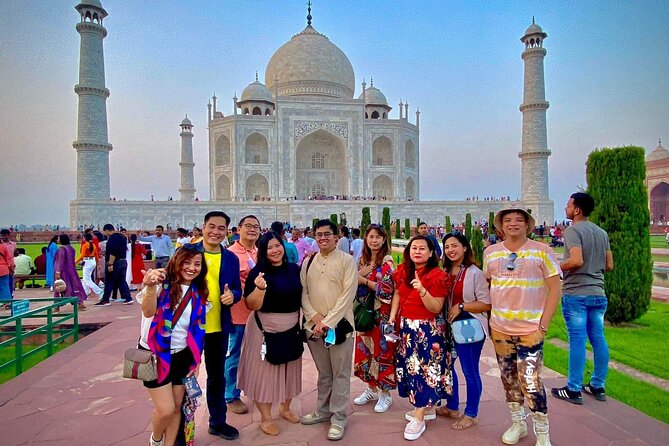
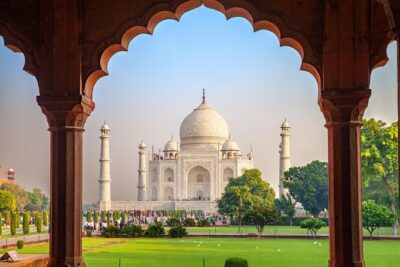
The Taj Mahal is an ivory-white marble mausoleum on the south bank of the Yamuna River. It was commissioned in 1632 by Mughal emperor Shah Jahan to house the tomb of his favorite wife, Mumtaz Mahal. Shah Jahan is also buried there.
Most people go to see the Taj Mahal. The smarter goal is to notice how the place is built to frame your attention:
- The marble changes tone depending on light
- The complex layout keeps you moving in a way that builds the “wow” gradually
You’ll get about 2 hours here, and that’s enough to see it properly if you don’t rush and try to collect every photo angle in one breath.
Agra Fort: power, not postcard views
After the Taj Mahal, you head to Agra Fort. This was the symbol of power and resilience in Mughal times. It served as the main residence of Mughal emperors until 1638, when the capital shifted to Delhi. It later saw occupation by the Marathas before British capture.
This is the stop for people who like understanding systems of rule—how empires defended themselves and lived inside walls.
Fatehpur Sikri: a short detour that feels like a whole world
Then you continue to Fatehpur Sikri, described here as having red sandstone buildings clustered at its center. Key features in your itinerary:
- Buland Darwaza gate, which is the entrance to Jama Masjid mosque
- Near it is the marble Tomb of Salim Chishti
- The Diwan-E-Khas hall has a carved central pillar
- Jodha Bai’s Palace mixes Hindu and Mughal styles
- The Panch Mahal is a five-story structure overlooking the site
This stop is listed as admission free, which is a nice little bonus in a day full of paid tickets elsewhere. About 2 hours is enough to get the feel of the complex without turning it into a marathon.
Check in Jaipur
After Fatehpur Sikri, you arrive in Jaipur and check into Sarovar Premiere. This is a good break point in the schedule because Jaipur tends to deliver more sights per hour if your energy is decent.
Day 3 in Jaipur: Amer Fort to wind-windows and the big astronomical tools
Day 3 is royal Jaipur, with forts and palaces in a packed arc.
Amber (Amer) Palace: the hill-fort experience
You start at Amber Palace (Amer Fort), a principal attraction about 11 km from Jaipur. Amer is on a hilltop, and the fort is part of UNESCO’s Hill Forts of Rajasthan group.
This is one of those places where scale matters. Expect an about 2-hour stop, and yes, you’ll be climbing and walking—plan for sun and stairs.
Hawa Mahal: the 950-window facade
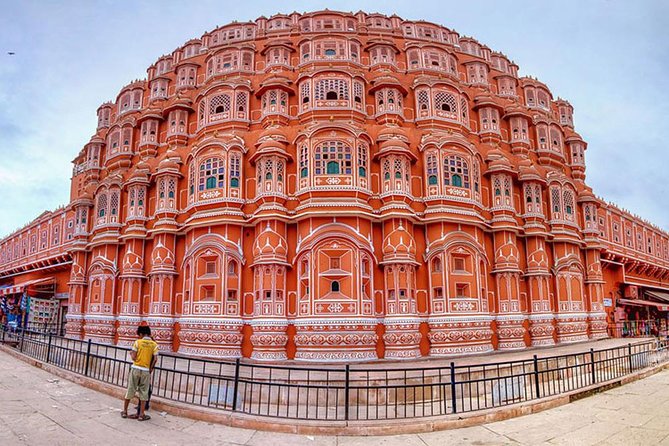
Next is Hawa Mahal (Palace of Wind), a five-storey red and pink sandstone structure with more than 950 windows. It sits along the edge of the City Palace complex and extends into the zenana, the women’s quarters area. It was built in 1799 by Maharaja Sawai Pratap Singh.
I like Hawa Mahal because it’s instantly readable. Even if you skip every detail, you still understand what it’s for: air, light, and visibility through the lattice of windows.
City Palace of Jaipur: Mughal-Chalukya mix and the Maharaja seat
Then you visit City Palace of Jaipur, a palace complex that includes Chandra Mahal and Mubarak Mahal. The itinerary notes architectural mix including Mughal and Chalukya styles. It was the seat of the Maharaja of Jaipur and the head of the Kachwaha Rajput clan.
This stop is ideal if you enjoy architecture that shows how rulers blended styles, not just how they decorated.
Jantar Mantar: the science stop that doesn’t feel boring
Finally, you go to Jantar Mantar, a UNESCO-listed collection of nineteen astronomical instruments built by Rajput king Sawai Jai Singh II and completed in 1734. It includes the world’s largest stone sundial, and it was used to find positions of heavenly bodies.
This can feel surprisingly fun if you treat it like giant outdoor math. Even if you don’t remember every explanation, you’ll walk away understanding that Jaipur wasn’t only about palaces; it was also about measuring the sky.
Back to the hotel
In the evening, you return to Sarovar Premiere for overnight. Your Day 4 is not as rushed, but after three big days, sleep matters.
Day 4: Galta Ji (Monkey Temple) and then back to Delhi
Day 4 is your “finish strong” day.
Galta Ji (Monkey Temple): a pink-stone pilgrimage with water reservoirs
You visit Galta Ji, also known as the Monkey Temple. It’s described as a highly-regarded Hindu pilgrimage and a famous stop in the Pink City. The temple is built out of pink rocks and is known for seven kunds (reservoirs of holy water) filled by nearby streams and waterfalls.
The itinerary also notes people associate the place with positive energy—healing and motivation. That part is personal, but the setting is real. If you like spiritual sites that feel lived-in rather than purely staged, you’ll probably enjoy this one.
Expect around 2 hours.
Drive to Delhi airport
Then it’s off to Indira Gandhi International Airport. The drive time listed is about 5 hours. Plan to arrive with buffer time so you’re not sprinting through departures.
What made this tour stand out in real feedback
I paid close attention to what keeps coming up: service, timing, and guides who actually explain things.
The pattern is clear:
- A professional, punctual driver. One named example is Neeraj, repeatedly described as friendly and on time.
- A guide who brings the historical context to life. One named example is Gupta, highlighted for studying history and being friendly while explaining what matters.
Hotels also get credit for feeling like part of the trip, not an afterthought. If you care about sleeping well between city-hops, this route is built to support that.
Finally, the overall itinerary planning tends to land well for people who want the big sites without constantly coordinating rides and timing on their own.
Who should book this tour (and who shouldn’t)
This tour fits you if:
- You want a private Golden Triangle with less logistics stress
- You’re seeing India for the first time or want an organized highlight circuit
- You care about guided context at Taj Mahal, fort sites, and major UNESCO stops
- You prefer staying in higher-end hotels and waking up to breakfast
You may want to look elsewhere if:
- You hate early mornings and long driving days
- You want to fully control each ticket line and timing at your own pace
- You don’t want to deal with extra costs for monument admissions
Also note: the dress code is listed as formal. That doesn’t mean you need to show up in a ball gown, but I’d pack at least one more polished outfit for temple and palace days.
Should you book 3 Nights Golden Triangle (Delhi–Agra–Jaipur)?
If you want the Golden Triangle in a way that feels organized, comfortable, and guide-led, I think this is a strong choice. The private vehicle, door-to-door transfers, and higher-end hotel stays make the price easier to swallow, especially when you compare it to the cost of doing the same route independently with taxis, hotels, and paid guides pieced together.
The only real question is the timing and ticket cost reality. You’ll pay monument fees separately for several key stops, so bring extra budget for admissions. If that works for you, you’ll likely come away feeling like you got the most important India highlights in the time you had.
FAQ
FAQ
What time does the tour start?
The tour start time is listed as 6:00am.
Is pickup from the airport or hotel included?
Yes. The tour includes hotel pickup and drop-off each day, with pickup from the airport or hotel.
Is this a private tour?
Yes. It’s a private tour/activity, and it states that only your group will participate.
Are monument or monument entrance fees included?
No. Monuments fees are not included, and many stops list admission tickets as not included.
How many breakfasts are included?
Breakfast is included for 3 days.
What is the dress code?
The tour lists a formal dress code.
More Tours in New Delhi
- Old & New Delhi City Tour – Half or Full Day Options Available
★ 5.0 · 4,811 reviews - Half Day Private Delhi City Tour
★ 5.0 · 4,474 reviews - Same Day Taj Mahal, Agra Fort & Baby Taj Tour from Delhi by Car
★ 5.0 · 4,304 reviews - Taj Mahal Day Tour from Delhi by Superfast Train – TOP RATED TOUR
★ 5.0 · 4,166 reviews - Delhi: Old and New Delhi Private Full or Half-Day Tour
★ 4.9 · 3,776 reviews
More Tour Reviews in New Delhi
- Old & New Delhi City Tour – Half or Full Day Options Available
★ 5.0 · 4,811 reviews - Half Day Private Delhi City Tour
★ 5.0 · 4,474 reviews - Same Day Taj Mahal, Agra Fort & Baby Taj Tour from Delhi by Car
★ 5.0 · 4,304 reviews - Taj Mahal Day Tour from Delhi by Superfast Train – TOP RATED TOUR
★ 5.0 · 4,166 reviews - Delhi: Old and New Delhi Private Full or Half-Day Tour
★ 4.9 · 3,776 reviews
The Full Golden Triangle, More Options
- 3-Days Private Golden Triangle Tour: Delhi, Agra & Jaipur by Car
★ 5.0 · 1,107 reviews - 3-Days Private Golden Triangle Tour: Delhi, Agra & Jaipur by Car
★ 5.0 · 1,098 reviews - 3-Day Delhi, Agra and Jaipur Private Tour – India Golden Triangle
★ 5.0 · 812 reviews - Four-Day Private Luxury Golden Triangle Tour to Agra and Jaipur From New Delhi
★ 5.0 · 807 reviews - 5 Nights 6 Days Private Golden Triangle Tour – Delhi Agra Jaipur
★ 5.0 · 574 reviews
Just added: more New Delhi reviews to browse
- 4 days Golden Triangle Tour★ 5.0 · 3 reviews
- Discover Old & New Delhi: Private Tour with Street Food★ 5.0 · 3 reviews
- Taj Mahal Tour From Delhi By Private Car★ 4.5 · 3 reviews
- Golden Triangle Tour 5 Days★ 5.0 · 3 reviews
- Taj Mahal: Express Entry Ticket For Sunset Tour with guide★ 5.0 · 3 reviews
- Agra Taj Mahal Sunrise & Sunset Tour from Delhi★ 5.0 · 3 reviews
Golden Triangle Tours, compared.
 ★ 5.03-Days Private Golden Triangle Tour: Delhi, Agra & Jaipur by CarFrom $1271,107 reviews
★ 5.03-Days Private Golden Triangle Tour: Delhi, Agra & Jaipur by CarFrom $1271,098 reviews
 ★ 5.03-Day Delhi, Agra and Jaipur Private Tour – India Golden TriangleFrom $110812 reviews
 ★ 5.0Four-Day Private Luxury Golden Triangle Tour to Agra and Jaipur From New DelhiFrom $160807 reviews
 ★ 5.05 Nights 6 Days Private Golden Triangle Tour – Delhi Agra JaipurFrom $240574 reviews
 ★ 5.04 Days Golden Triangle TourFrom $146499 reviews
 ★ 5.0Private Car and Drive for Golden Triangle (4N/5D)From $167451 reviews
 ★ 5.0Private Golden Triangle Tour Delhi Agra Jaipur ( Top Rated )From $148436 reviews