
Reviewed · GOLDEN TRIANGLE TOURS
4 Days Golden Triangle Tour
That moment you see the Taj, it hits hard. This 4-day Golden Triangle tour strings together Delhi, Agra, and Jaipur with guided sightseeing and air-conditioned transfers so you spend less time figuring out transport and more time seeing. Two things I really like: the pace is tight but structured, and you get the main UNESCO-level hits without doing hours of planning. One thing to consider: entrance fees at several monuments are typically not included, so you’ll want to budget for tickets even if your guide handles the process.
You start early, around 8:00 am, and you’ll be on the move most days. The payoff is you get a real overview of North India’s big eras—Mughal Delhi, Mughal Agra, and royal Jaipur—rather than just one city in detail. Also, it’s a private format, so it’s not a giant cattle-car group experience.
In This Review
- Key highlights you’ll actually feel
- Golden Triangle in four days: what this pace really means
- Day 1 in Delhi: Jama Masjid, Raj Ghat, India Gate, and Lutyens’ Delhi
- From Sansad Bhavan to Qutub Minar: Delhi’s architecture in one long day
- The handoff to Agra: long drive, easy rhythm, and overnight setup
- Day 2 Agra: Taj Mahal plus Agra Fort, then Fatehpur Sikri to Jaipur
- Fatehpur Sikri: Akbar’s short-lived capital before you reach Jaipur
- Day 3 Jaipur icons: Hawa Mahal, Amber Fort, City Palace, and Jantar Mantar
- Jantar Mantar and Jaipur free time: balancing big sights with breathing room
- Day 4 back to Delhi: simple finish and flight planning
- What you pay for (and what you don’t): value for a guided Golden Triangle
- Small details that matter: private tour format, rooms, and the Friday Taj Mahal rule
- Should you book this 4-day Golden Triangle tour?
- FAQ
- What cities does the 4-day Golden Triangle tour cover?
- Where does pickup happen, and is pickup included?
- Is transportation air-conditioned?
- What time does the tour start?
- Are monument entrance tickets included?
- Is food included during the tour?
- What happens if I start the tour on Thursday because of the Taj Mahal closure?
- What hotel room setup should I expect?
- Is this tour private or shared with other groups?
- What time will I be back in Delhi on the last day?
Key highlights you’ll actually feel
- Air-conditioned driver-to-driver transfers between distant sights, so you can recharge between stops.
- UNESCO-level landmarks like the Taj Mahal and Humayun’s Tomb, built into a simple route.
- Skip the ticket line for entrances, because the guide helps you buy monument fees.
- A true Golden Triangle route: Delhi → Agra → Jaipur → Delhi, all in four days.
- Free-time in Jaipur for shopping, built into the last sightseeing day.
- Friday Taj Mahal rule (it’s closed on Fridays), with an alternate routing if needed.
Golden Triangle in four days: what this pace really means
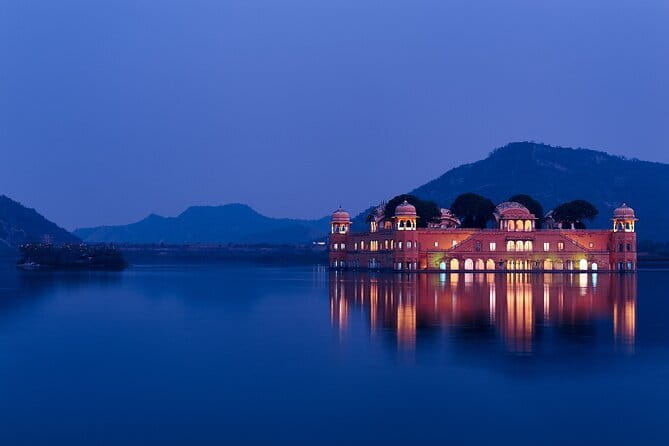
This tour is designed for travelers who want the big-name sites across three cities without turning the trip into a full-time logistics job. Expect packed days, short-to-medium sightseeing blocks, and long enough drives that you’ll feel the distance between Delhi, Agra, and Jaipur.
The upside of this pace is you’ll come away with a clear mental map: where Mughal power shows up in architecture, where royal Jaipur leans into symmetry and stonework, and where Agra holds the most famous love-story monument in the world. The tradeoff is that you won’t have hours to linger in every corner. If you like to take your time, plan to visit one or two monuments again on a future trip.
Delhi, Agra and Jaipur: more full circuits



Day 1 in Delhi: Jama Masjid, Raj Ghat, India Gate, and Lutyens’ Delhi
Day 1 is a heavy hitter mix: religious India, national mourning, and British-era Delhi, all before you switch into Mughal ruins and UNESCO sites. You’ll start with pickup from your location in Delhi or Gurugram (airport or anywhere in those areas are covered), then head straight into the heart of Old and New Delhi contrasts.
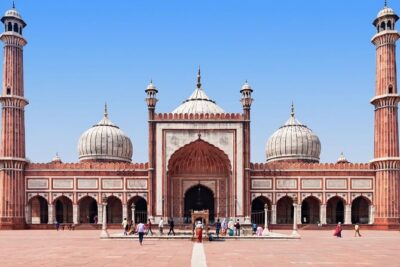
Jama Masjid is your first big stop in Old Delhi. Built in 1650–1656 under Mughal emperor Shah Jahan, it’s the kind of place where you feel the scale even before you read a single plaque. Expect a focused visit time (about an hour) and the chance to take in Delhi’s living, religious street energy around it.
Then you move to Raj Ghat, a memorial dedicated to Mahatma Gandhi on the Yamuna riverbanks. You’re looking at a black marble platform marking the cremation spot. It’s not a long stop, but it’s a grounding one, especially after the bustle of Jama Masjid.
India Gate follows: built by Edwin Lutyens in 1921, and designed to commemorate soldiers from the erstwhile British Indian Army. It’s quick, about 30 minutes, but it works well in this itinerary because it gives you a visual anchor for modern Delhi’s layout.
From Sansad Bhavan to Qutub Minar: Delhi’s architecture in one long day
After the central monuments, you’ll have stops tied to British-era city design, including Sansad Bhavan (Parliament House) and Rashtrapati Bhavan. These are the landmarks that define Lutyens’ Delhi—heavy stone, big geometry, and that official-civic feel.
Next comes Qutub Minar, one of Delhi’s most famous towers. It rises about 73 meters and is built from red sandstone and marble, and it’s often described as the highest brick minaret in the world. Your visit is timed at around two hours, which is perfect because you’ll want a little walking time to appreciate the tower and the surrounding complex without feeling rushed.
You end the day at Humayun’s Tomb, which the itinerary flags as a UNESCO Heritage site. It’s a major stop for understanding how Mughal tomb architecture evolves, and the visit time of about an hour gives you enough runway to notice the symmetry and layout rather than just snap photos.
The handoff to Agra: long drive, easy rhythm, and overnight setup
At the end of Day 1 you’ll drive to Agra and overnight there. The itinerary treats this as a straightforward transfer (around four hours of travel time shown), not a day packed with extra stops.
This part matters more than it sounds. After Delhi’s dense schedule, you’ll be ready for a calmer evening, and the Agra hotel setup gives you a proper base for the next day’s highlights. Past groups have found the Agra hotel to be the strongest of the three city stays, so even if you’re not chasing luxury, the sleep part is likely to feel worth it.
Day 2 Agra: Taj Mahal plus Agra Fort, then Fatehpur Sikri to Jaipur
Day 2 is the pivot day. You’ll breakfast in Agra, then get hit with the two largest Agra monuments in your schedule: the Taj Mahal and Agra Fort. After that, you transfer toward Jaipur, with Fatehpur Sikri added along the way.
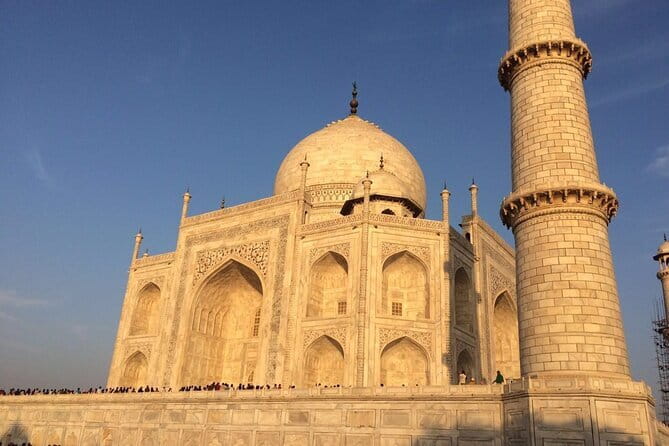
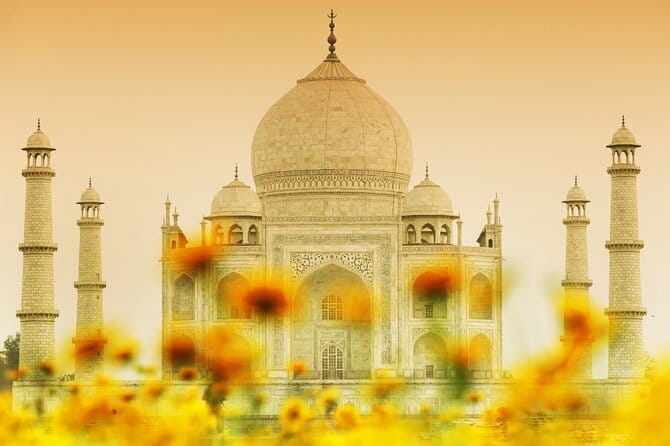
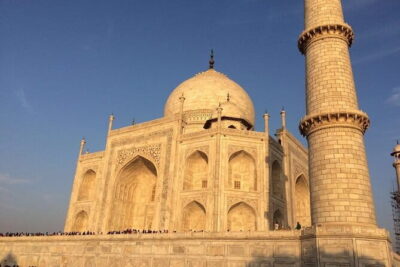
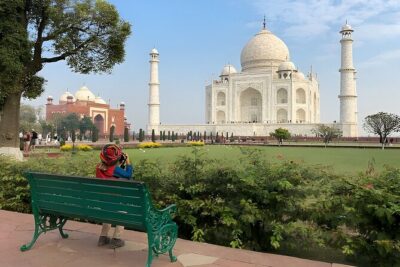
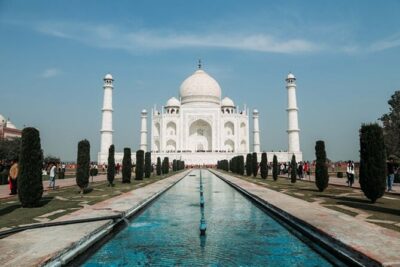
The Taj Mahal is the obvious center of gravity. Built between 1631 and 1653 under Shah Jahan, it’s a white marble mausoleum that reads like a single idea—beauty, order, and devotion. Your visit time is about two hours. That’s enough time to understand why it’s famous and still have energy to move on afterward.
Then you step into the heavier mood of Agra Fort, described as a massive red sandstone fort built in the 16th century by Akbar, later with additional marble decoration under Shah Jahan. It sits on the bank of the Yamuna. Your time here is around an hour, which works because fort complexes can sprawl; you’ll get the main experience without turning the day into a full-on archaeology marathon.
Worth putting side by side with this New Delhi pick:

Fatehpur Sikri: Akbar’s short-lived capital before you reach Jaipur
After Agra Fort, you head to Fatehpur Sikri, tied to Panch Mahal in the itinerary description. Fatehpur Sikri was a short-lived Mughal capital between 1572 and 1585, during Akbar’s reign. Your visit is set at about two hours, which feels right: long enough to learn the big story and walk through the key spaces, not so long you lose the connection to why it mattered.
What I like about placing Fatehpur Sikri on this day is the contrast. You go from the romantic iconic monument of the Taj to a city that was once a power center, then you roll forward into Jaipur. That sequencing helps you see North Indian history as a chain of shifts, not a set of disconnected tourist stops.
Finally, you drive to Jaipur and overnight there. Your Day 2 timing shows travel time that supports getting to Jaipur with daylight still possible depending on traffic, but the key is you don’t arrive exhausted with nothing planned—your Day 3 is still structured.
Day 3 Jaipur icons: Hawa Mahal, Amber Fort, City Palace, and Jantar Mantar

Jaipur day is where the Golden Triangle starts to feel like Rajasthan in full costume: strong color, dramatic architecture, and forts that look built for legends. You’ll breakfast in Jaipur, then start sightseeing with multiple major stops clustered into the day.
Hawa Mahal (Palace of Wind) is first, and it’s easy to see why it’s famous. The five-storey facade, built in 1799, is designed with lots of small windows. It’s about one hour in the schedule, which is enough to appreciate the front and understand the design logic without getting stuck in the most crowded angles too long.
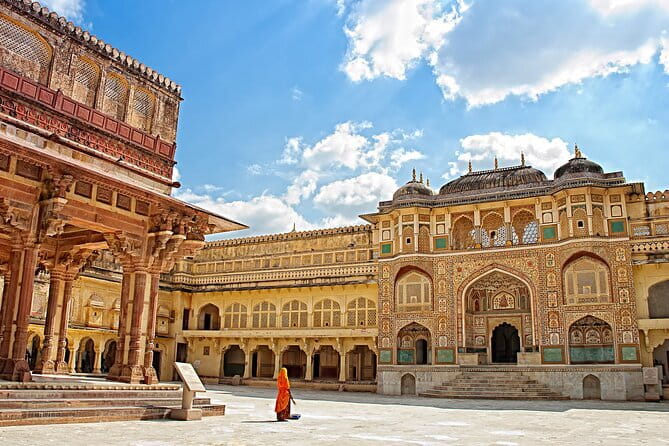
Next is Amber Fort. It’s located about 11 km from Jaipur and was built in 1592 by Raja Man Singh. Your time is roughly two hours. If you like photos, you’ll get plenty. If you like history, you’ll notice how the fort reads as a fortified palace rather than a simple wall-and-gate structure.
Then it’s City Palace of Jaipur. This is the royal center where the Maharaja ruled, and the itinerary notes parts like Chandra Mahal and Mubarak Mahal as included within the complex. You’ll have about two hours here. The strength of this stop is how it ties you directly to Jaipur’s identity as a designed city, not just a place with a fort nearby.
Jantar Mantar and Jaipur free time: balancing big sights with breathing room
After City Palace, you visit Jantar Mantar, an early 18th-century astronomical observation site with about 20 main fixed instruments. Your time is about an hour. It’s not a typical “look and leave” attraction; it gives you a chance to slow down and see how science and empire intersect in stone.
Then you get evening free for shopping. I like this because after three full sightseeing stops back-to-back, you can choose your pace: souvenirs, textiles, spices, or just a quiet walk. It’s also your chance to turn the city into something personal. If you like bargaining, do it gently and with a smile. If you hate bargaining, stick to places with clear pricing.
Day 4 back to Delhi: simple finish and flight planning
On Day 4, you’ll have breakfast in the hotel, then drive back to Delhi. The itinerary says you return to Delhi by around 2:00 pm, and then you’ll be transferred to the airport or to a Delhi hotel.
This timing is practical for a lot of flights, but you’ll still want a buffer. Traffic around Delhi can be chaotic, and the tour flags that exact transfer times depend on the time of day and traffic conditions. If you’re booking a late-day flight, you’ll feel calmer. If you must catch an earlier flight, communicate with the operator in advance so you can plan accordingly.
What you pay for (and what you don’t): value for a guided Golden Triangle
The price is $146 per person for the 4-day experience, with an average booking time around 33 days in advance. For that cost, you’re paying for the big-value parts that usually eat up time: guided sightseeing, pickup/drop-off, and an air-conditioned vehicle to move you between cities and between dispersed sights.
Here’s what’s clearly included:
- Guide services
- Pickup and drop off
- Air-conditioned vehicle
- Breakfast (4)
What’s not included is important for your budget:
- Food and drinks
- Most monument entrance fees, since the itinerary marks many stops as not included for admissions.
That said, you’re not left alone on the ticket part. The guide helps you buy entrance fees at monuments, so you shouldn’t waste time queuing to purchase. That’s a small detail that makes the day feel smoother, especially at the busiest sites.
In plain terms: if you were doing this on your own, you’d likely pay similarly once you add private transport, guide time, and entrance fees. The difference here is you’re buying a planned route so you can spend your energy on the sights, not the logistics.
Small details that matter: private tour format, rooms, and the Friday Taj Mahal rule
This is a private tour/activity, meaning only your group participates. That matters because it changes the vibe. You’re not constantly adjusting to strangers, and your guide can keep the pace aligned with your group’s energy.
Hotel room setup is typically twin-sharing. If you book three people, rooms may be triple-sharing by default, with an option to pay extra if you prefer two rooms. If you’re traveling with friends and really want a specific room arrangement, it’s worth clarifying upfront so expectations match.
Finally, the Taj Mahal closure rule is the one date issue you must plan around: the Taj Mahal is closed for all visitors on Friday. The itinerary notes a routing adjustment if you start on Thursday—Delhi → Jaipur → Agra → Delhi—so you still hit the Taj on a non-Friday. If your dates include a Friday start, check how your exact order of cities changes.
Should you book this 4-day Golden Triangle tour?
I think this is a strong choice if you want a focused overview of Delhi, Agra, and Jaipur without spending your trip fighting transport schedules. The guided approach is a big deal here: you’re not just walking into famous places; you’re moving from stop to stop with someone who can frame what you’re seeing.
Book it if:
- You want an organized itinerary with air-conditioned transfers
- You like the idea of hitting the major monuments plus a bit of breathing room in Jaipur
- You’d rather pay for planning than spend days researching routes and timing
Skip or reconsider if:
- You’re the type who needs long, slow stays at one site (this route is structured for breadth, not deep rest)
- You don’t want to handle entrance-fee budgeting at multiple monuments
If your main goal is the Golden Triangle highlights with a practical, guided rhythm, this tour hits the mark.
FAQ
What cities does the 4-day Golden Triangle tour cover?
It covers Delhi, Agra, and Jaipur across four days, with sightseeing in each city and return to Delhi on the fourth day.
Where does pickup happen, and is pickup included?
Pickup is included. You can be picked up from the airport or any location in Delhi/Gurugram.
Is transportation air-conditioned?
Yes. The tour includes transfers in an air-conditioned vehicle.
What time does the tour start?
The tour starts at 8:00 am.
Are monument entrance tickets included?
Many monument entrance tickets are marked as not included. Your guide will help you buy entrance fees at the monuments so you won’t have to wait in queue to purchase.
Is food included during the tour?
Breakfast is included for 4 days. Food and drinks are not included.
What happens if I start the tour on Thursday because of the Taj Mahal closure?
The Taj Mahal is closed on Friday. If you start on Thursday, the route is described as Delhi – Jaipur – Agra – Delhi to account for the closure.
What hotel room setup should I expect?
Rooms are generally twin-sharing. If you book 3 people, rooms are provided on triple-sharing by default, unless you pay an additional charge if you prefer 2 rooms.
Is this tour private or shared with other groups?
It’s private, so only your group participates.
What time will I be back in Delhi on the last day?
On the fourth day, you return to Delhi by around 2:00 pm, with transfers to the airport or your Delhi hotel.
More Tours in New Delhi
- Old & New Delhi City Tour – Half or Full Day Options Available
★ 5.0 · 4,811 reviews - Half Day Private Delhi City Tour
★ 5.0 · 4,474 reviews - Same Day Taj Mahal, Agra Fort & Baby Taj Tour from Delhi by Car
★ 5.0 · 4,304 reviews - Taj Mahal Day Tour from Delhi by Superfast Train – TOP RATED TOUR
★ 5.0 · 4,166 reviews - Delhi: Old and New Delhi Private Full or Half-Day Tour
★ 4.9 · 3,776 reviews
More Tour Reviews in New Delhi
- Old & New Delhi City Tour – Half or Full Day Options Available
★ 5.0 · 4,811 reviews - Half Day Private Delhi City Tour
★ 5.0 · 4,474 reviews - Same Day Taj Mahal, Agra Fort & Baby Taj Tour from Delhi by Car
★ 5.0 · 4,304 reviews - Taj Mahal Day Tour from Delhi by Superfast Train – TOP RATED TOUR
★ 5.0 · 4,166 reviews - Delhi: Old and New Delhi Private Full or Half-Day Tour
★ 4.9 · 3,776 reviews
The Full Golden Triangle, More Options
- 3-Days Private Golden Triangle Tour: Delhi, Agra & Jaipur by Car
★ 5.0 · 1,107 reviews - 3-Days Private Golden Triangle Tour: Delhi, Agra & Jaipur by Car
★ 5.0 · 1,098 reviews - 3-Day Delhi, Agra and Jaipur Private Tour – India Golden Triangle
★ 5.0 · 812 reviews - Four-Day Private Luxury Golden Triangle Tour to Agra and Jaipur From New Delhi
★ 5.0 · 807 reviews - 5 Nights 6 Days Private Golden Triangle Tour – Delhi Agra Jaipur
★ 5.0 · 574 reviews
Just added: more New Delhi reviews to browse
- 4 days Golden Triangle Tour★ 5.0 · 3 reviews
- Discover Old & New Delhi: Private Tour with Street Food★ 5.0 · 3 reviews
- Taj Mahal Tour From Delhi By Private Car★ 4.5 · 3 reviews
- Golden Triangle Tour 5 Days★ 5.0 · 3 reviews
- Taj Mahal: Express Entry Ticket For Sunset Tour with guide★ 5.0 · 3 reviews
- Agra Taj Mahal Sunrise & Sunset Tour from Delhi★ 5.0 · 3 reviews
Golden Triangle Tours, compared.
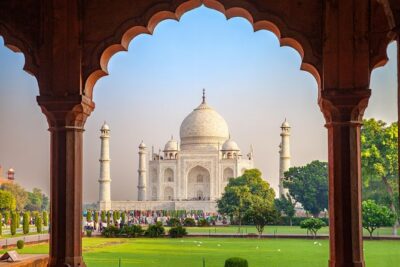 ★ 5.03-Days Private Golden Triangle Tour: Delhi, Agra & Jaipur by CarFrom $1271,107 reviews
★ 5.03-Days Private Golden Triangle Tour: Delhi, Agra & Jaipur by CarFrom $1271,098 reviews
★ 5.03-Days Private Golden Triangle Tour: Delhi, Agra & Jaipur by CarFrom $1271,107 reviews
★ 5.03-Days Private Golden Triangle Tour: Delhi, Agra & Jaipur by CarFrom $1271,098 reviews
 ★ 5.03-Day Delhi, Agra and Jaipur Private Tour – India Golden TriangleFrom $110812 reviews
 ★ 5.0Four-Day Private Luxury Golden Triangle Tour to Agra and Jaipur From New DelhiFrom $160807 reviews
 ★ 5.05 Nights 6 Days Private Golden Triangle Tour – Delhi Agra JaipurFrom $240574 reviews
 ★ 5.0Private Car and Drive for Golden Triangle (4N/5D)From $167451 reviews
 ★ 5.0Private Golden Triangle Tour Delhi Agra Jaipur ( Top Rated )From $148436 reviews
 ★ 5.03-Day Private Luxury Golden Triangle Tour to Agra and Jaipur From New DelhiFrom $164424 reviews