
Waking up for the Taj changes everything. For this Delhi–Agra–Jaipur Golden Triangle tour, I like how it blends “must-see” sights with real train-country logistics taken off your plate. I also love that you’re hitting UNESCO World Heritage sites in Delhi and a sunrise Taj Mahal moment in Agra, without you needing to juggle tickets and timing. One thing to consider: the schedule is early-heavy, with airport-style pick-ups and a very early Taj viewing plan.
Here’s the practical appeal: hotel pickup, a professional guide, local drives, and monument entry fees are bundled, so your days feel like a guided highlight reel rather than a scavenger hunt. The trade-off is that you’ll be walking and riding a fair amount across five days, and trains can be affected by weather or other “unfortunate condition” delays.
In This Review
- Quick hits from this 5-Day Golden Triangle Train Tour
- Why the Golden Triangle by train feels easier than doing it solo
- Day 1 in Delhi: Humayun’s Tomb, Qutub Minar, and Jama Masjid by rickshaw
- Humayun’s Tomb: the style-setting UNESCO stop
- Qutub Minar: towering symbolism, not just a tall view
- The “drive-by” monuments that still matter
- Jama Masjid: big scale, and a memorable way to get there
- Day 2 to Agra: a 6:00 am Shatabdi train and Mughal hits before sunset
- Agra Fort: scale, power, and the Taj connection
- Itmad-ud-Daula (“Baby Taj”): marble elegance with a quieter mood
- Mehtab Bagh: a Taj Mahal viewpoint by the river at sunset
- Sunrise Taj Mahal and Fatehpur Sikri: the day that makes or breaks your trip
- Taj Mahal at sunrise: why the timing matters
- Fatehpur Sikri en route to Jaipur: Akbar’s abandoned capital
- Late-day train to Jaipur: letting someone else handle the seat-finding
- Jaipur Day 4: Amber Palace, City Palace, and Jantar Mantar in one packed block
- Amber Palace: fortress-meets-palace views
- Jal Mahal and Hawa Mahal: best enjoyed from the road
- City Palace Museum: costumes and collections you can actually see
- Jantar Mantar: 18th-century astronomy in stone
- One potential question: Galta (Monkey Temple) on your plan
- Day 5: a very early train back to Delhi, then airport drop
- Price and value: what $200.54 really buys over five days
- The main trade-offs for the value
- Who this Golden Triangle train tour suits best
- Should you book this 5-Day Golden Triangle by Train?
- FAQ
- What time does the tour start on Day 1?
- Does the tour include hotel pickup and drop-off?
- Which UNESCO World Heritage sites are included?
- Are train tickets included, and which train is used from Delhi to Agra?
- What major sights will you see in Agra and Jaipur?
- What should I bring for this tour?
Quick hits from this 5-Day Golden Triangle Train Tour
- UNESCO in Delhi: Humayun’s Tomb and Qutub Minar are both included
- Taj Mahal sunrise plan: a dedicated early-morning Taj visit is built in
- Agra Fort + Itmad-ud-Daula (“Baby Taj”): you get more than just the postcard view
- Agra sunset photo time: Mehtab Bagh is included for a Taj viewpoint by the river
- Jaipur classics in one day: Amber Palace, City Palace Museum, and Jantar Mantar
- Hotel-and-station help: chauffeurs assist with boarding and coach-seat finding
Why the Golden Triangle by train feels easier than doing it solo
The Golden Triangle—Delhi, Agra, Jaipur—is famous for a reason. But it’s also a route that can turn into a logistics headache fast. This tour’s biggest value is that it handles the hard parts for you: train travel is included (2nd class tickets), and you also get private, air-conditioned transport for local sightseeing blocks.
You also get a real “flow” to your days. Instead of changing hotels every time you blink, you settle into four nights of accommodation while guides and drivers move you between cities. That matters, because on the Golden Triangle, time spent figuring out transport is time you don’t get back—especially when you’re trying to catch the Taj Mahal when the light is best.
It’s also a smart choice for first-timers who want rail travel as part of the experience. The tour is set up around train timing, including a very early departure day and another early start on the last morning. If you’re the type who hates last-minute ticket hunts and last-second directions, this package is designed for you.
Delhi, Agra and Jaipur: more full circuits



Day 1 in Delhi: Humayun’s Tomb, Qutub Minar, and Jama Masjid by rickshaw
Delhi can feel like sensory overload on your own. Day 1 is built to give you anchor points right away—big monuments with clear guide context—then uses short drives and tight time blocks to keep the day moving.
Humayun’s Tomb: the style-setting UNESCO stop
You start with Humayun’s Tomb, often described as the first major example of a new Mughal design style. Even if you don’t memorize architectural terms, the guide approach helps you “see the pattern”: symmetry, gardens, and the idea of a grand Mughal statement placed within Delhi.
This is also a great warm-up for what comes later in Agra. If you’re paying attention, Humayun’s Tomb gives you visual clues about the architectural language that eventually shapes the Taj Mahal world.
Qutub Minar: towering symbolism, not just a tall view
Next comes Qutub Minar, the tallest stone tower in India, connected to the rise of Muslim rule. It’s the kind of site where a guide makes a difference. Left to your own devices, you can end up just taking photos. With guidance, you understand the meaning behind the monument—why it was built, and what it was meant to project.
The “drive-by” monuments that still matter
You also pass by India Gate (the war memorial arch) and drive past the Red Fort and Raj Ghat. These aren’t long museum-style stops here, but they’re important anchors in the story of modern India. Even a pass-by viewpoint helps you map where major things sit in Delhi, so the city doesn’t feel like a random blur.
Worth putting side by side with this New Delhi pick:

Jama Masjid: big scale, and a memorable way to get there
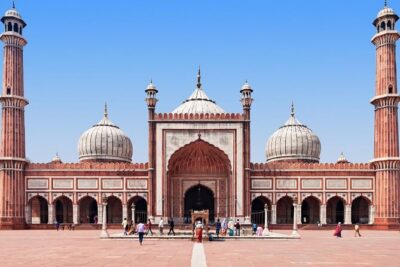
You finish with Jama Masjid, the largest mosque in Asia, with a guided visit by bicycle rickshaw. This part is charming and practical at once: it breaks up the walking rhythm and gets you moving through Old City energy faster than you could on foot.
The entry is listed as free, and the stop is about 45 minutes. That’s just enough time to appreciate the scale without feeling rushed to the point of exhaustion.
My practical advice: wear shoes you can walk in for a full day. Even with rickshaw help, Delhi’s Old City and monument zones add up quickly.
Day 2 to Agra: a 6:00 am Shatabdi train and Mughal hits before sunset
Agra is the easiest city to “fall in love with,” but only if you arrive with enough momentum to appreciate it. Day 2 is scheduled around a very early transfer: pickup at your hotel by 5:15 am, then boarding a Shatabdi train departing around 6:00 am.
That early start can sound brutal. But it’s also the smart way to gain daylight for sightseeing. Once you arrive, the guide meets you at the exit gate of your coach and handles the “now what” steps—escort to the car and help with hotel check-in.
Agra Fort: scale, power, and the Taj connection
You then explore Agra Fort. This isn’t a quick “look and leave” stop—it’s described as an outstanding example of Mughal architecture and a stronghold of the empire. If the Taj feels too perfect and polished (it is, after all), Agra Fort gives you a sturdier, more fortress-like reality.
You get about an hour here, plus admission included. With a guide, you’re better able to connect Agra’s political center to the royal building projects that came later.
Itmad-ud-Daula (“Baby Taj”): marble elegance with a quieter mood
Next is Itmad-ud-Daula’s Tomb, also known as the Baby Taj. The tour frames it clearly: a marble mausoleum built by Nur Jahan in memory of her father. The included time window is about 30 minutes.
This stop is valuable because it’s less crowded than the Taj Mahal for many visitor patterns, and it gives you a chance to notice details—marble work, garden layout ideas, and an in-between scale of Mughal splendor.
Mehtab Bagh: a Taj Mahal viewpoint by the river at sunset
Finally, you head to Mehtab Bagh for sunset views of the Taj Mahal across the river. This is one of the more photo-friendly parts of the trip, because you’re not just standing near the Taj; you’re looking at it from a different angle.
The tour notes a chance for breathtaking pictures from the river. Even if you don’t bring a camera, the experience helps you understand how the Taj sits in its landscape—this isn’t just a monument dropped into a city.
Sunrise Taj Mahal and Fatehpur Sikri: the day that makes or breaks your trip
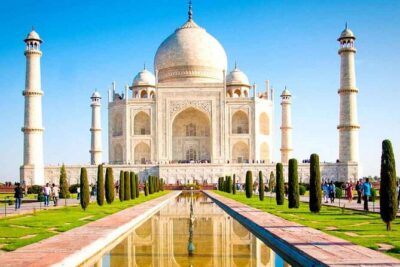
If you do one “big ticket” moment in India, let it be sunrise at the Taj Mahal. This tour builds that moment in as a dedicated Taj stop, with an approximately two-hour window and admission included.
Taj Mahal at sunrise: why the timing matters
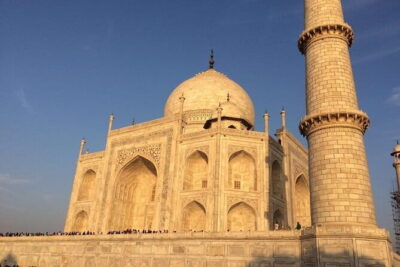
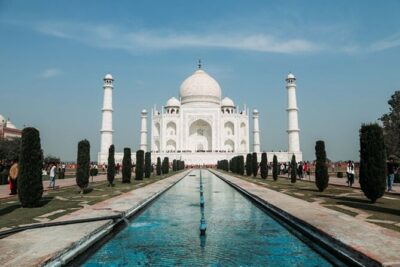
The Taj Mahal is famous for architecture and beauty. The sunrise version is famous for atmosphere. Early light softens the building’s edges and changes the way marble looks—less harsh glare, more “glow” quality.
You’re also getting a guide here, which matters. Even without technical art-history talk, you’ll learn how Shah Jahan’s vision shaped the complex and what to notice while you’re there (symmetry, inlaid marble effect, and how the whole composition reads from different vantage points).
One caution: sunrise days mean you need to be ready to move. If you’re the type who sleeps through alarms at home, build extra buffer the night before. Trains and chauffeurs are part of this machine, and your best Taj experience happens when you cooperate with the schedule.
Fatehpur Sikri en route to Jaipur: Akbar’s abandoned capital
After breakfast on day 3, you head toward Jaipur, stopping at Fatehpur Sikri—about 37 km from Agra, described here as Akbar’s abandoned capital. You get around an hour, with free admission listed.
This is a valuable inclusion because it turns the day’s travel into a history moment rather than a long car-and-train slog. You’ll get a sense of how Mughal power expressed itself through city-building—and how quickly it can become “abandoned” by political shifts.
Late-day train to Jaipur: letting someone else handle the seat-finding
In the evening, you board your train to Jaipur. Your guide helps you board and find your seat. That sounds minor until you’ve tried it yourself in a station with crowds and confusing signage. Here, someone is tasked with the “get it right” part for you.
When you arrive, the chauffeur meets you and drives you to the hotel for check-in.
Jaipur Day 4: Amber Palace, City Palace, and Jantar Mantar in one packed block
Jaipur is where the Golden Triangle gets more colorful—and also more spread out. This tour’s Jaipur day uses smart sequencing: big fort first, then the palace and museum area, then the observatory.
Amber Palace: fortress-meets-palace views
You start at Amber Palace (Amber Fort), about 1 hour 30 minutes with admission included. It’s positioned on a ridge outside Jaipur, surrounded by battlements and overlooking what’s described as Moata Lake (Jal Mahal is passed later).
If you only go to the Taj and skip Amber, Jaipur will feel incomplete. Amber adds a different architectural flavor—fortified, dramatic, and built for control as much as for comfort.
Jal Mahal and Hawa Mahal: best enjoyed from the road
After Amber, you pass by Jal Mahal, then Hawa Mahal (Palace of Winds). These aren’t long stops on the tour schedule, but getting a clear outside viewpoint is still useful.
From a travel perspective, you have two types of sights: ones where you need time inside, and ones where an exterior glance plus context is enough to “place” the landmark in your mind. Jal Mahal and Hawa Mahal fall into that second category here.
City Palace Museum: costumes and collections you can actually see
Next is the City Palace of Jaipur, including the City Palace Museum. You get about an hour and admission included. The guide-led focus you’re promised is practical: Rajasthani costumes and armor collections, including swords of different shapes and sizes with chiselled handles.
That kind of museum time is a nice break from pure outdoor walking. It also helps you understand Jaipur beyond facades—through what people wore and used.
Jantar Mantar: 18th-century astronomy in stone
Finally, you visit Jantar Mantar, a stone astrological and astronomical observatory built in the 18th century by Maharaja Jai Singh. The stop is about 30 minutes.
This is one of those places where you don’t need to be a science person to enjoy it. A guide can help you see how the stones were used to measure time and celestial patterns, so it doesn’t feel like random oversized metal-free instruments.
One potential question: Galta (Monkey Temple) on your plan
Your tour description highlights Galta (Monkey Temple) in Jaipur, but the day-by-day stops you’ve been given center on Amber, City Palace, and Jantar Mantar. If Galta is important to you, I’d ask your operator ahead of time whether it’s included in your exact departure. It’s listed as a highlight, so it’s worth confirming.
Day 5: a very early train back to Delhi, then airport drop
The last day keeps things efficient. You board an early morning train from Jaipur to New Delhi, and your chauffeur is at your hotel by 5:00 am to help you board and find your seat.
On arrival, another chauffeur is waiting in Delhi, and you’re dropped at the New Delhi airport or another place you specify.
This structure makes day 5 simple: sightseeing is done, and the tour shifts into “get you to your next step” mode. If you hate last-day wandering, this is a relief.
Price and value: what $200.54 really buys over five days
At $200.54 per person, the headline price is low compared with what many guided Golden Triangle trips charge in high season. The reason it can still be good value is that key costs are bundled:
- 4 nights accommodation in a 5 star hotel
- Professional guide
- Hotel pickup and drop off, plus airport pick up & departure
- Private fully air conditioned cab
- 2nd class train tickets between cities
- Monument entry fees
- Meals: buffet breakfast and 4 buffet lunches are included (and breakfast is listed for multiple days)
Value isn’t just “how cheap.” It’s how much of the complicated stuff you don’t have to manage: finding tickets, paying entrances one by one, and coordinating transport between cities and monuments.
The only cost that’s clearly outside the bundle is drinks and any snacks you pick up along the way. Souvenir photos and similar extras are also listed as not included.
The main trade-offs for the value
Because this is a structured tour, you’ll accept:
- early starts (including sunrise Taj and early trains),
- set time windows at each monument, and
- some “pass by” viewpoints instead of long stays.
If your ideal trip is slow and flexible, this might feel tight. If your ideal trip is “hit the top sights with a plan,” it’s built for that.
Who this Golden Triangle train tour suits best
This tour is a strong fit if:
- you’re a first-time visitor to India and want major sites without logistics stress,
- you like guided context at big monuments (UNESCO included),
- you’re comfortable with early morning wake-ups,
- you want train travel as part of the experience, not just a road trip.
It may feel less ideal if:
- you hate schedules and early departures,
- you want lots of free time in each city to wander at your own pace,
- you have limited tolerance for a day that includes multiple stops and walking zones.
Also, your planning should include the basics the tour requires: a current valid passport on the travel day and comfortable walking shoes.
Should you book this 5-Day Golden Triangle by Train?
I’d book it if you want a clean, well-structured Golden Triangle with Taj Mahal sunrise, UNESCO stops in Delhi, and a Jaipur day that covers the core highlights. The included guide, entrances, and hotel-and-station support are the reason this works—especially if you’re traveling without a local “fixer” in your pocket.
I’d think twice if you’re traveling with fatigue sensitivity. The schedule has early pickups (including around 5:15 am for the Agra train) and a sunrise Taj day. If you’re the kind of traveler who needs late mornings to feel human, plan to adjust your expectations.
FAQ
What time does the tour start on Day 1?
The start time is 9:00 am.
Does the tour include hotel pickup and drop-off?
Yes. It includes hotel pickup and drop-off, plus airport pick-up and departure.
Which UNESCO World Heritage sites are included?
Humayun’s Tomb and Qutub Minar are both UNESCO World Heritage sites and are included.
Are train tickets included, and which train is used from Delhi to Agra?
Yes, the tour includes 2nd class train tickets. From Delhi to Agra, it lists an early Shatabdi departure at 6:00 am.
What major sights will you see in Agra and Jaipur?
In Agra, you’ll visit the Agra Fort, Itmad-ud-Daula, Mehtab Bagh, and a sunrise Taj Mahal visit. In Jaipur, you’ll visit Amber Palace, City Palace, and Jantar Mantar.
What should I bring for this tour?
You’ll need a current valid passport on the day of travel, and comfortable walking shoes are recommended.
More Tours in New Delhi
- Old & New Delhi City Tour – Half or Full Day Options Available
★ 5.0 · 4,811 reviews - Half Day Private Delhi City Tour
★ 5.0 · 4,474 reviews - Same Day Taj Mahal, Agra Fort & Baby Taj Tour from Delhi by Car
★ 5.0 · 4,304 reviews - Taj Mahal Day Tour from Delhi by Superfast Train – TOP RATED TOUR
★ 5.0 · 4,166 reviews - Delhi: Old and New Delhi Private Full or Half-Day Tour
★ 4.9 · 3,776 reviews
More Tour Reviews in New Delhi
- Old & New Delhi City Tour – Half or Full Day Options Available
★ 5.0 · 4,811 reviews - Half Day Private Delhi City Tour
★ 5.0 · 4,474 reviews - Same Day Taj Mahal, Agra Fort & Baby Taj Tour from Delhi by Car
★ 5.0 · 4,304 reviews - Taj Mahal Day Tour from Delhi by Superfast Train – TOP RATED TOUR
★ 5.0 · 4,166 reviews - Delhi: Old and New Delhi Private Full or Half-Day Tour
★ 4.9 · 3,776 reviews
The Full Golden Triangle, More Options
- 3-Days Private Golden Triangle Tour: Delhi, Agra & Jaipur by Car
★ 5.0 · 1,107 reviews - 3-Days Private Golden Triangle Tour: Delhi, Agra & Jaipur by Car
★ 5.0 · 1,098 reviews - 3-Day Delhi, Agra and Jaipur Private Tour – India Golden Triangle
★ 5.0 · 812 reviews - Four-Day Private Luxury Golden Triangle Tour to Agra and Jaipur From New Delhi
★ 5.0 · 807 reviews - 5 Nights 6 Days Private Golden Triangle Tour – Delhi Agra Jaipur
★ 5.0 · 574 reviews
Just added: more New Delhi reviews to browse
- 4 days Golden Triangle Tour★ 5.0 · 3 reviews
- Discover Old & New Delhi: Private Tour with Street Food★ 5.0 · 3 reviews
- Taj Mahal Tour From Delhi By Private Car★ 4.5 · 3 reviews
- Golden Triangle Tour 5 Days★ 5.0 · 3 reviews
- Taj Mahal: Express Entry Ticket For Sunset Tour with guide★ 5.0 · 3 reviews
- Agra Taj Mahal Sunrise & Sunset Tour from Delhi★ 5.0 · 3 reviews
Golden Triangle Tours, compared.
 ★ 5.03-Days Private Golden Triangle Tour: Delhi, Agra & Jaipur by CarFrom $1271,107 reviews
★ 5.03-Days Private Golden Triangle Tour: Delhi, Agra & Jaipur by CarFrom $1271,098 reviews
 ★ 5.03-Day Delhi, Agra and Jaipur Private Tour – India Golden TriangleFrom $110812 reviews
 ★ 5.0Four-Day Private Luxury Golden Triangle Tour to Agra and Jaipur From New DelhiFrom $160807 reviews
 ★ 5.05 Nights 6 Days Private Golden Triangle Tour – Delhi Agra JaipurFrom $240574 reviews
 ★ 5.04 Days Golden Triangle TourFrom $146499 reviews
 ★ 5.0Private Car and Drive for Golden Triangle (4N/5D)From $167451 reviews
 ★ 5.0Private Golden Triangle Tour Delhi Agra Jaipur ( Top Rated )From $148436 reviews
Browse the lists this tour appears in