
Reviewed · DELHI MONUMENTS & LANDMARKS TOURS
Delhi: Qutub Minar UNESCO World Heritage Site Walking Tour
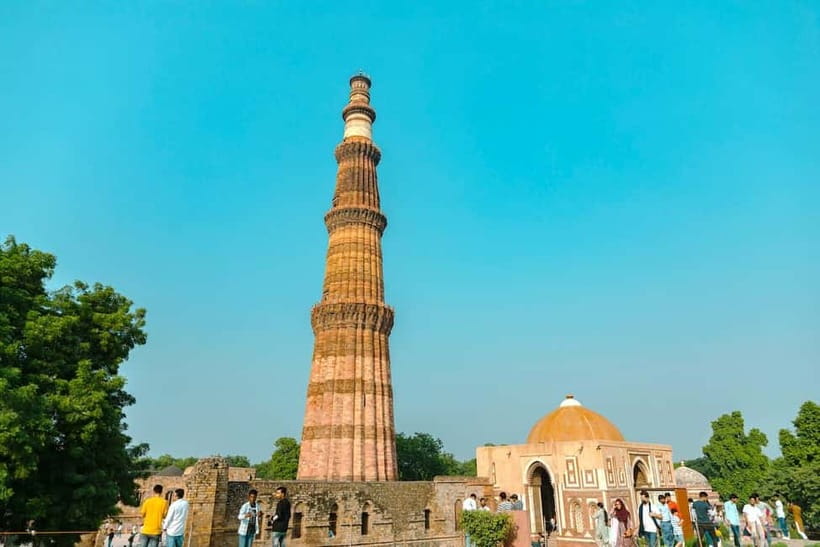
One tower, a whole empire in stone. This Qutub Minar walking tour is interesting because you get to study one of India’s most famous monuments up close, then connect it to the buildings around it in a very human way—by walking. I love seeing the 73-meter-high minaret in person, because the proportions look different when you’re actually at the base, not in a photo.
The other thing I really like is the mix of details you can’t easily spot on your own: Mamluk-era inscriptions and geometric patterns, plus the Iron Pillar standing there like a science experiment from the past. The only real consideration is time and weather—2 to 3 hours is long enough to feel it if you hit Delhi’s heat or sun, and you’ll be moving around an outdoor heritage site.
In This Review
- Key takeaways before you go
- Qutub Minar UNESCO complex, explained in walking form
- Starting at the base: Mamluk carvings you can actually see
- The Quwwat-ul-Islam Mosque: where architectural stories overlap
- The Iron Pillar: an up-close lesson in ancient metallurgy
- Alai Darwaza and the unfinished Alai Minar: beauty plus what didn’t happen
- Transfers, private group pace, and why $9 is good value
- What makes the guide experience matter (including Madhuvan)
- Who should book this Qutub Minar walking tour?
- Should you book it?
- FAQ
- How long is the Delhi Qutub Minar walking tour?
- What’s included in the price?
- What languages is the live guide available in?
- Is the tour wheelchair accessible?
- Is this tour a private group?
- Can I cancel for a refund?
Key takeaways before you go
- Read the minaret storeys: different designs on successive levels make the building feel like a timeline.
- Mamluk stonework details matter: Arabic inscriptions and geometric patterns give you something to focus on besides the height.
- Quwwat-ul-Islam shows reuse of older materials: columns and pillars repurposed from earlier Hindu and Jain temples.
- The Iron Pillar is rust-resistant: ancient metallurgy you can see without any special tools.
- Alai Darwaza and Alai Minar show what was planned: full beauty at the gate, unfinished ambition at the minaret.
- A strong guide helps a lot: English/Hindi narration that explains the context behind what you’re seeing (with Madhuvan specifically praised for engagement).
Qutub Minar UNESCO complex, explained in walking form
Qutub Minar isn’t just tall. It’s designed to be studied, level by level, with ornament that rewards a slow walk. A guided format helps because you’re not only looking at one building—you’re learning how the pieces of the Qutub Minar complex connect.
This tour is set up for a practical length, around 2 to 3 hours. That’s enough time to get the big sights—the minaret, the mosque, the Iron Pillar, Alai Darwaza, and the unfinished Alai Minar—without rushing so hard you forget what you just saw.
More of Delhi in stone: forts, tombs and gates




Starting at the base: Mamluk carvings you can actually see
You begin at the base of Qutub Minar, and that’s the right move. Up close, the minaret’s red sandstone and marble don’t just look decorative—they look engineered, with the surfaces built to carry patterns that catch light as you move.
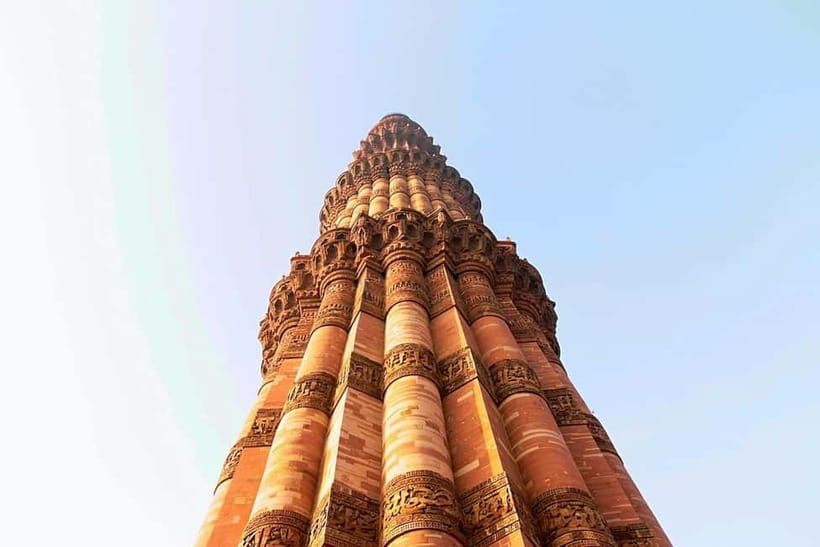
Here’s what I’d pay attention to first: the intricate carvings of Arabic inscriptions and geometric designs near the lower sections. The craftsmanship is the kind of detail you can miss if you’re only trying to photograph the full height.
Then you do the slow walk around the structure to catch the most important visual clue: each storey has a distinct design. The idea is that successive rulers added their own character to what already stood, so the minaret becomes a layered record of change rather than a single static monument.
A guide really matters in this part, because it’s easy to interpret carvings as random decoration. With a good explanation in English or Hindi, you start to see what those patterns and inscriptions are telling you about the builders and the style of the era.
The Quwwat-ul-Islam Mosque: where architectural stories overlap
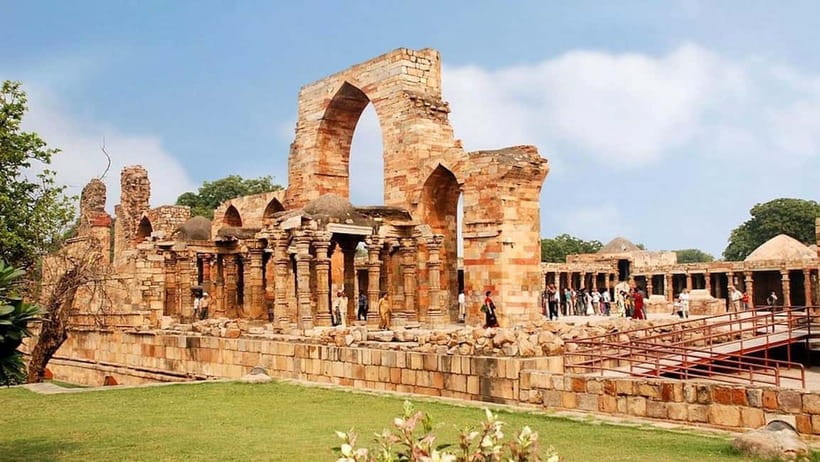
Next up is the Quwwat-ul-Islam Mosque, described as the first mosque built in India. What makes this stop especially compelling is the fusion you can see in the materials and shapes—arched gateways and pillars that come from earlier Hindu and Jain temples.
That detail changes how you look at the mosque. Instead of thinking of it as a purely new construction, you start noticing it as a conversion of existing art and building elements. It’s not subtle once someone points it out, because the reuse shows up in the columns and their character.
If you like architecture that has a paper-trail feel—like it carries evidence of decisions made at the time—this is a strong moment. The mosque is both a religious structure and a physical record of how societies shifted and repurposed what they inherited.
The Iron Pillar: an up-close lesson in ancient metallurgy
After you’ve taken in the mosque, you’ll come across the Iron Pillar, known for its rust-resistant surface. Even if you don’t get technical, this is one of those monuments that makes you stop. It looks simple at first glance, then becomes intriguing because it’s still standing with a surface that shouldn’t be surviving the way it has.
The value here is the contrast. You’re moving from heavy medieval carving and mosque architecture into a single object that represents engineering and material science. That change of pace is good for your brain, because it breaks the walking tour into clear segments.
Also, the pillar reinforces a theme across the complex: these aren’t just aesthetic buildings. They show skills—design, craftsmanship, and metalwork—that were advanced for their time.
If you want the tour to feel more than sightseeing, focus on how the Iron Pillar adds a different kind of proof to the site’s story: not just stone and faith, but technology.
Alai Darwaza and the unfinished Alai Minar: beauty plus what didn’t happen
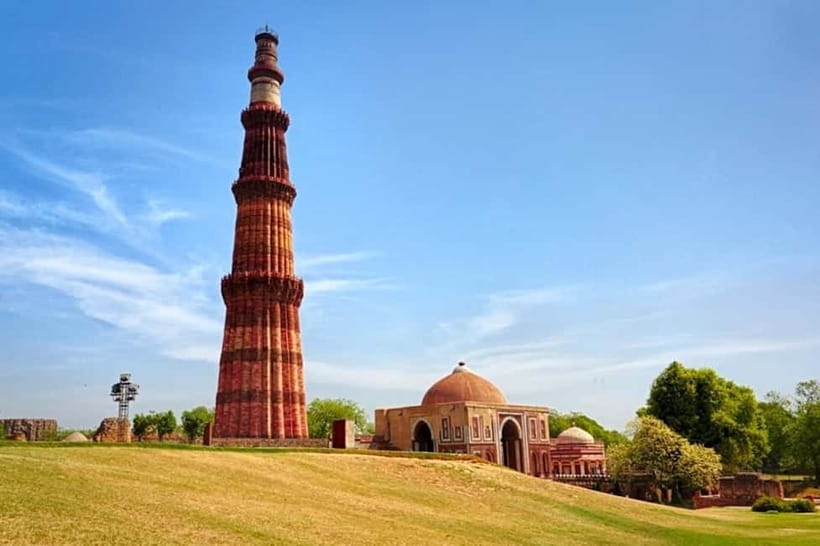
Then comes Alai Darwaza, an Indo-Islamic gate known for its stunning architecture. This is one of the stops where the style becomes easier to feel even if you don’t know the terminology yet. You can look at the proportions and how the gate frames the space around it, like it’s managing movement and viewpoint.
Immediately after, you’ll see the unfinished Alai Minar. This is where the tour gets emotionally interesting in a quiet way. The ambition is visible even in the fact that it’s not finished, and that helps you understand the site as something that changed because of real-world circumstances.
I like this pairing because it balances two kinds of history: what people built successfully and what they planned but couldn’t complete. The gate gives you payoff; the unfinished minaret gives you context and realism.
If you’re the kind of traveler who likes monuments with drama, don’t skip this part just because it’s not the tallest thing on the grounds. It’s a reminder that history includes delays, changes in leadership, and projects that got interrupted.
New Delhi at a walking pace, a few more routes



Transfers, private group pace, and why $9 is good value
The price is listed at $9 per person, and for this specific content, it’s surprisingly strong value. You’re getting a professional guide plus enough time—2 to 3 hours—to connect multiple major landmarks inside one UNESCO complex.
The private group format also matters for value. Smaller groups tend to move more smoothly, and you usually get room for questions without the guide having to speak over everyone.
There’s an optional transfer in a private car if you choose it. That can be worth it if you’re short on time or you’d rather reduce friction moving across Delhi. If you don’t add the transfer, you may still manage, but you should expect that getting to and from the site will use some of your energy.
One practical note: since this is a walking tour, wear shoes you trust. You’ll be on foot for most of the tour window, and the experience is better when you’re not thinking about your feet every minute.
What makes the guide experience matter (including Madhuvan)
The reviews highlight something important: the guide’s ability to make complex background feel understandable. One review specifically calls out Madhuvan as very engaging, and another mentions seeing the different buildings with complex background knowledge.
That fits what you experience at Qutub Minar. If you only look at the minaret’s height or snap a few photos, you’ll still enjoy the site. But if you can get explanations tied to what you’re seeing—Mamluk patterns, the mosque’s reused elements, why the Iron Pillar matters—you’ll come away with a real mental map.
I’d treat the guide as part of the attraction here, not just the person who keeps you on schedule. The carvings and architectural choices are dense, and a good guide helps you stop guessing.
Who should book this Qutub Minar walking tour?
This tour is a good fit if you want a focused, high-signal introduction to one of Delhi’s best-known UNESCO sites. It’s especially useful if you like architecture and want to understand the differences between buildings instead of treating them all as interchangeable stone.
It also works well for first-timers because the stops are the core landmarks: Qutub Minar, Quwwat-ul-Islam Mosque, Iron Pillar, Alai Darwaza, and the unfinished Alai Minar. You won’t leave wondering what the main points were.
If you’re limited on time and want to cover several highlights in one session, the 2 to 3 hours duration is a practical compromise between depth and efficiency.
If you hate walking and prefer very short visits, you might find this stretching your comfort zone. But if you’re okay with steady outdoor movement and you have a guide explaining what to notice, it’s an easy recommendation.
Should you book it?
Yes—this is worth booking if you want the Qutub Minar complex to make sense as a set. For the price, you’re buying a guided walkthrough through the big architectural elements, plus the kind of context that turns carvings and styles into an actual story.
I’d book it even more confidently if you care about details like Mamluk inscriptions, mosque reuse of older temple pillars, and why the Iron Pillar is famous. Those are the moments where a guide turns a pretty site into a memorable one.
FAQ
How long is the Delhi Qutub Minar walking tour?
The tour lasts about 2 to 3 hours.
What’s included in the price?
It includes a professional tour guide, and transfers in a private car if you select that option.
What languages is the live guide available in?
The guide offers live commentary in English and Hindi.
Is the tour wheelchair accessible?
Yes, the tour is listed as wheelchair accessible.
Is this tour a private group?
Yes, it’s a private group.
Can I cancel for a refund?
Free cancellation is available up to 24 hours in advance for a full refund.
More Tours in New Delhi
- Old & New Delhi City Tour – Half or Full Day Options Available
★ 5.0 · 4,811 reviews - Half Day Private Delhi City Tour
★ 5.0 · 4,474 reviews - Same Day Taj Mahal, Agra Fort & Baby Taj Tour from Delhi by Car
★ 5.0 · 4,304 reviews - Taj Mahal Day Tour from Delhi by Superfast Train – TOP RATED TOUR
★ 5.0 · 4,166 reviews - Delhi: Old and New Delhi Private Full or Half-Day Tour
★ 4.9 · 3,776 reviews
More Tour Reviews in New Delhi
- Old & New Delhi City Tour – Half or Full Day Options Available
★ 5.0 · 4,811 reviews - Half Day Private Delhi City Tour
★ 5.0 · 4,474 reviews - Same Day Taj Mahal, Agra Fort & Baby Taj Tour from Delhi by Car
★ 5.0 · 4,304 reviews - Taj Mahal Day Tour from Delhi by Superfast Train – TOP RATED TOUR
★ 5.0 · 4,166 reviews - Delhi: Old and New Delhi Private Full or Half-Day Tour
★ 4.9 · 3,776 reviews
Forts, Tombs and Gates of Delhi
- Delhi Hidden Gems: Mehrauli, Lodhi Art & Sunder Nursery
★ 5.0 · 108 reviews - Red Fort Delhi Entry tickets with Licensed Tour Guide
★ 4.5 · 78 reviews - Delhi: Yoga in Lodhi Garden
★ 4.9 · 53 reviews - Red Fort Skip-the-Line E-tickets & guide Delhi transfers
★ 4.6 · 49 reviews - New Delhi: Red Fort Entry Ticket with Optional Add-Ons
★ 4.7 · 47 reviews
Just added: more New Delhi reviews to browse
- 4 days Golden Triangle Tour★ 5.0 · 3 reviews
- Discover Old & New Delhi: Private Tour with Street Food★ 5.0 · 3 reviews
- Taj Mahal Tour From Delhi By Private Car★ 4.5 · 3 reviews
- Golden Triangle Tour 5 Days★ 5.0 · 3 reviews
- Taj Mahal: Express Entry Ticket For Sunset Tour with guide★ 5.0 · 3 reviews
- Agra Taj Mahal Sunrise & Sunset Tour from Delhi★ 5.0 · 3 reviews
Delhi Monuments & Landmarks Tours, compared.
 ★ 5.0Delhi Hidden Gems: Mehrauli, Lodhi Art & Sunder NurseryFrom $76108 reviews
 ★ 4.5Red Fort Delhi Entry tickets with Licensed Tour GuideFrom $3378 reviews
 ★ 4.9Yoga in Lodhi GardenFrom $3853 reviews
 ★ 4.6Red Fort Skip-the-Line E-tickets & guide Delhi transfersFrom $3549 reviews
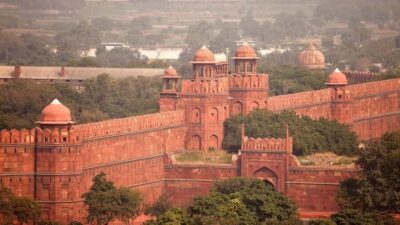 ★ 4.7Red Fort Entry Ticket with Optional Add-OnsFrom $947 reviews
 ★ 4.8Red Fort Light and Sound Show Guided TourFrom $2944 reviews
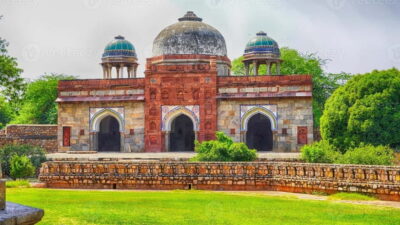 ★ 4.9Skip-the-Line Humayun’s Tomb Tour with TransfersFrom $741 reviews
 ★ 5.0Delhi Street Art Walk in Lodhi Art District with Chai & FoodFrom $3334 reviews
Browse the lists this tour appears in