
Reviewed · GOLDEN TRIANGLE TOURS
Golden Triangle Tour 3 Days with Accommodation & Entrance fee
Three days. Three cities. Zero planning headache. This Golden Triangle tour is built for first-time India visitors who want to move fast without feeling lost, with pickup and private air-conditioned transfers and entrance fees handled. I especially like the way it packages the major sights into a tight rhythm, so you can get your bearings fast and still see the big ticket icons. One heads-up: the days start early (with a 6:00 am start), and lunch and dinner are on you since only breakfast is included.
The best part, in my view, is that you’re not stuck sorting out tickets, timing, and routes city to city. You get a local guide for the sightseeing blocks, and guides like Javed Khan (praised for his Taj Mahal presentation) and Adnan (noted for making the Taj visit memorable) are exactly the kind of people you want when monuments come with centuries of context. The pace is efficient, but that also means you’ll want comfy shoes and a bit of patience for crowds around the top sites.
Because it’s a private tour for your group, it feels more like a guided plan than a cattle-call bus schedule. You also get a mobile ticket, bottled water, and breakfasts at the hotel—small perks that add up when you’re on the move.
In This Review
- Key moments to look forward to
- The real appeal: a Golden Triangle sprint with real support
- Day 1 in Delhi: India Gate, Rashtrapati Bhavan views, then Lotus Temple and Qutb Minar
- India Gate: a war memorial on the ceremonial axis
- Rashtrapati Bhavan and Parliament House area: imperial planning meets modern India
- Lotus Temple: open to all, with a calm that hits instantly
- Qutb Minar: UNESCO towers and early Delhi stonework
- The best part of Agra day: Taj Mahal in the morning, then Agra Fort
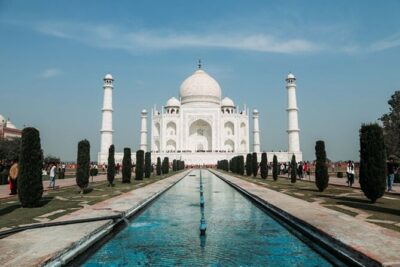
- Taj Mahal: the story behind the marble
- Agra Fort: don’t skip the second act
- The drive onward to Jaipur
- Jaipur in one day: Amber Palace, Hawa Mahal, Jal Mahal, City Palace
- Amber Palace: a fort set on a hill
- Hawa Mahal: the famous façade and the women’s quarters idea
- Jal Mahal: the palace in the lake (and a short stop)
- City Palace: Jaipur’s royal center
- How the included guide and transfers change the trip
- Price and value: is $680 per person reasonable for 3 days?
- Who this Golden Triangle tour is best for
- Should you book this 3-day Golden Triangle tour?
- FAQ
- What is included in the Golden Triangle 3-day tour price?
- Are entrance fees included?
- What cities and main sights does the tour cover?
- Where do you get picked up and what time does the tour start?
- How much time do you spend at the Taj Mahal and Agra Fort?
- Do you get hotel drop-off and transfers between cities?
- Is food included besides breakfast?
- What is the cancellation policy?
Key moments to look forward to
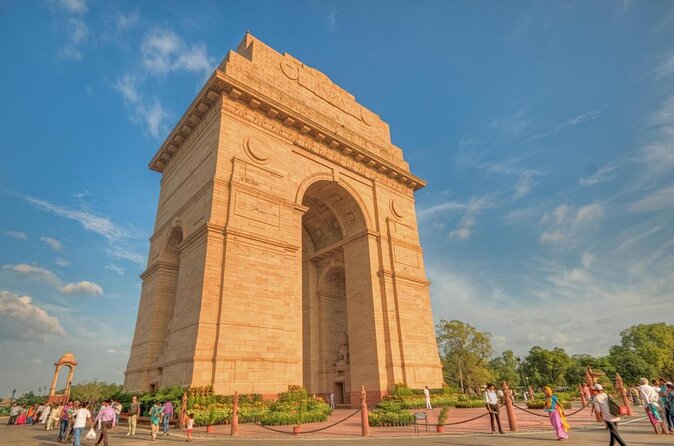
- Delhi highlights in one go: India Gate, Rashtrapati Bhavan area views, Lotus Temple, and the Qutb Minar UNESCO complex
- Taj Mahal time in the morning: an unhurried visit window before the day gets hotter and busier
- Agra Fort after the Taj: a second layer of Mughal-era atmosphere, not just one monument
- Jaipur’s mix of palaces: Amber Palace + Hawa Mahal + Jal Mahal + City Palace in one packed day
- Private transfers with hotel included: fewer logistics headaches across two overnights
- Local guides at each stop: better explanations than you’ll get on autopilot
The real appeal: a Golden Triangle sprint with real support
If you’ve only got a few days, the Golden Triangle can feel like a lot of “try to fit everything in” stress. This tour is designed to cut that down. Instead of you figuring out where to stay in each city, how to get between cities, and how to time entrances, you show up and follow a schedule that’s already stitched together.
You also get the comfort factor: transport by private vehicle and bottled water along the way. That matters because Delhi–Agra–Jaipur distances add up quickly, and you’ll feel it if you’re doing public transport or taxis back-to-back.
Value-wise, what you’re really paying for is convenience plus inclusions. The price is $680 per person, and it bundles 2 nights’ accommodation, monument entrance fees in Delhi, Agra, and Jaipur, and breakfast for two mornings. If you’ve ever tried to price out the same combo yourself—hotel + drivers + entrance tickets + guiding time—it stops being “cheap” and starts being “worth it,” especially for a 3-day trip.
Delhi, Agra and Jaipur: more full circuits



Day 1 in Delhi: India Gate, Rashtrapati Bhavan views, then Lotus Temple and Qutb Minar
Day 1 is your orientation day. It starts with pickup from your hotel or the airport, then you head straight into Delhi sightseeing. The route begins on Rajpath with India Gate, then works its way through major landmarks and ends at two of the city’s most memorable religious/architectural stops: Lotus Temple and Qutb Minar.
India Gate: a war memorial on the ceremonial axis
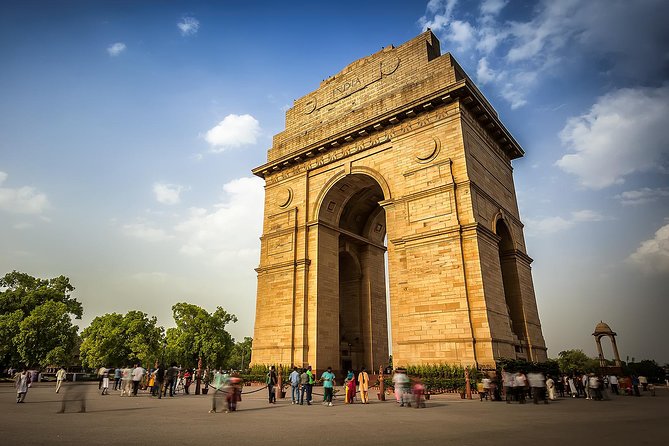
India Gate sits along the ceremonial “axis” of central Delhi (Rajpath), and it’s easy to understand why it’s the first stop on so many itineraries: it’s a big, recognizable anchor. If you’re trying to understand modern Delhi quickly—government areas nearby, wide avenues, monuments laid out with intention—this is a useful first picture.
Practical note: it’s outdoors, so plan for sun and wind on the early-to-mid daylight hours.
Rashtrapati Bhavan and Parliament House area: imperial planning meets modern India
Next comes the big government zone: Rashtrapati Bhavan, the President of India’s official residence, and nearby Parliament House area views. You’ll get the architectural story too—British architects Sir Edwin Lutyens and Sir Herbert Baker were involved in designing the administrative capital concept in the early 1910s. There’s also mention of a possible inspiration from the circular Chausath Yogini Temple structure (which is exactly the kind of detail that makes a stop more than just a photo).
Even if you can’t go inside, this area helps you grasp how Delhi’s built form was shaped.
Lotus Temple: open to all, with a calm that hits instantly
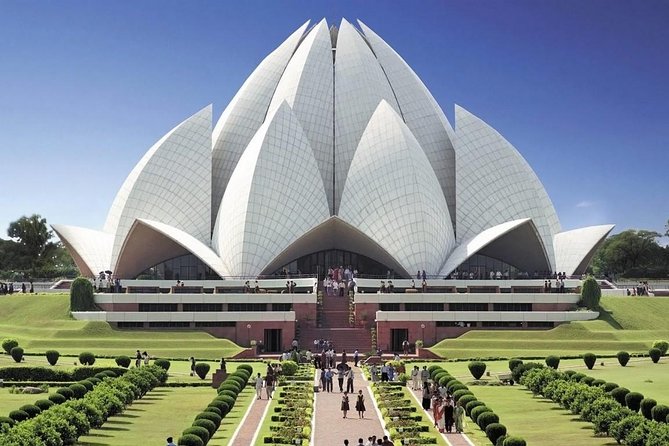
Then you’ll arrive at the Lotus Temple, a Bahá’í House of Worship dedicated in December 1986. I like it because it feels like a break from city noise without needing a long “escape” plan. The temple’s flower-like design isn’t just pretty—its message is part of the experience: it’s open to everyone regardless of religion.
Plan for a slower pace here. You’ll want a few minutes to sit, watch how visitors move, and enjoy the light on the white structure.
Worth putting side by side with this New Delhi pick:

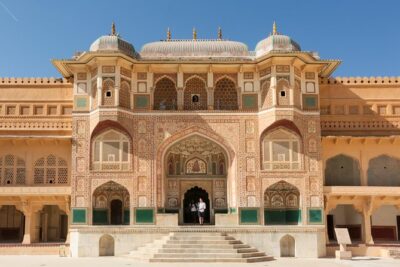
Qutb Minar: UNESCO towers and early Delhi stonework
Finally, you reach the Qutb Minar complex, a UNESCO World Heritage Site. The minaret itself is about 73 meters tall, built in five storeys with a taper, starting around 14.3 meters at the base and narrowing to about 2.7 meters near the top.
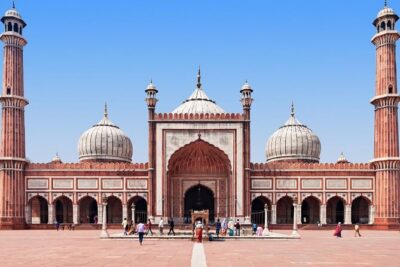
If you’ve only ever seen Taj Mahal-style marble, Qutb Minar gives you a different feeling: older stone textures, inscriptions, and the sense of layers of Delhi history stacking on each other.
The best part of Agra day: Taj Mahal in the morning, then Agra Fort
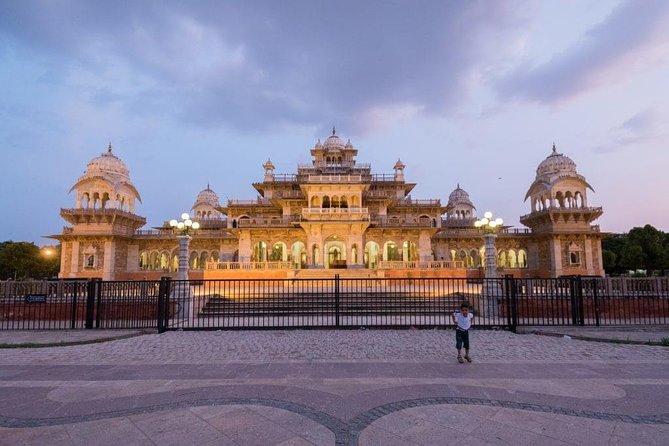
Day 2 is the reason most people book the Golden Triangle. After Delhi sightseeing on Day 1, you’re taken to Agra for a morning visit to the Taj Mahal (about two hours), then you move on to Agra Fort (also about two hours). After that, you drive to Jaipur, where you’ll be transferred to your hotel for your night stay.
Taj Mahal: the story behind the marble
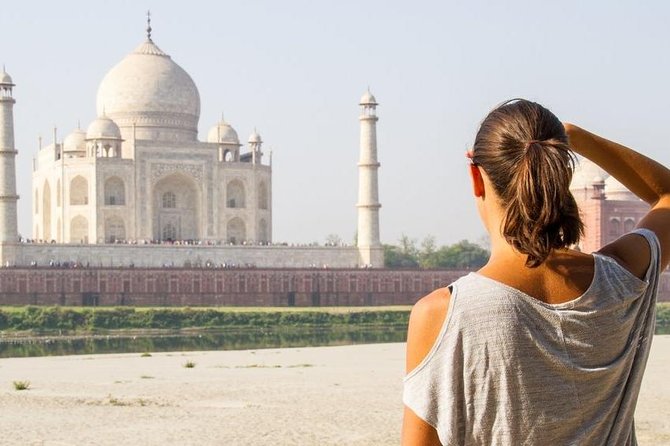
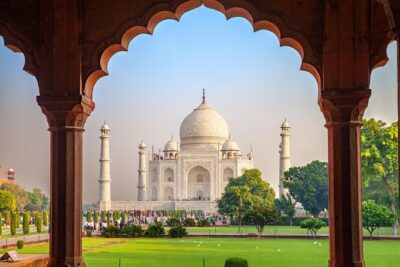
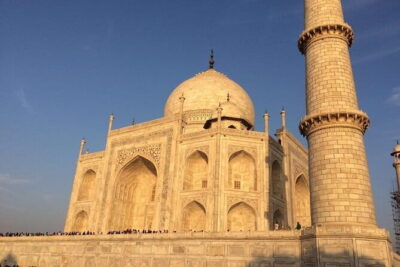
You’ll see the Taj Mahal described the way it always is for a reason: it’s an ivory-white marble mausoleum on the south bank of the Yamuna River. It was commissioned in 1632 by Mughal emperor Shah Jahan to house the tomb of his wife Mumtaz Mahal, and it also contains Shah Jahan’s own tomb.
What makes a guided visit valuable here is what happens beyond the postcard. When someone explains the commission story and the intended symbolism, the Taj turns from a photo location into a place with emotional weight—romantic, yes, but also heavy with loss.
Agra Fort: don’t skip the second act
After the Taj, Agra Fort keeps the Mughal theme going. This fort served as the main residence for Mughal emperors until 1638, when the capital shifted from Agra to Delhi. The site also links to later occupants, including the Marathas before British capture.
I like pairing the Taj with Agra Fort because it changes your frame. The Taj is one monumental masterpiece. Agra Fort is a whole atmosphere of power—walls, corridors, and the sense of how ruling worked day to day.
The drive onward to Jaipur
Once Agra sightseeing is done, you’ll travel to Jaipur, and your chauffeur will transfer you to your hotel for the night. This structure is practical: you avoid wasting the evening trying to scramble for transport when you’re tired.
Jaipur in one day: Amber Palace, Hawa Mahal, Jal Mahal, City Palace
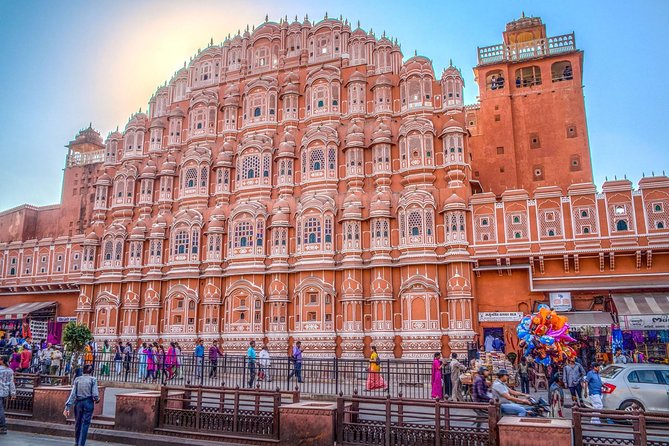
Day 3 is a full Jaipur day with palaces and landmark architecture. You’ll start at Amber Palace (Amer Fort), then see Hawa Mahal, stop at Jal Mahal, and finish at City Palace, before returning by car to Delhi afterward.
A quick reality check: with Amber Palace and the City Palace each taking about two hours, plus extra stops, your legs will feel it. The upside is that Jaipur’s most famous sights are clustered enough that you don’t need to hop hotels or re-plan.
Amber Palace: a fort set on a hill
Amber Palace (Amer Fort) is located about 11 kilometers from Jaipur and sits high on a hill, which is a big part of why it looks so dramatic in photos. It’s the principal tourist attraction in Jaipur, and you get around two hours there—enough time to walk major areas and still breathe.
Tip: go in with water and plan to slow down for shade where you can.
Hawa Mahal: the famous façade and the women’s quarters idea
Next is Hawa Mahal, the palace known for its red and pink sandstone façade. It sits on the edge of the City Palace and extends toward the zenana (women’s chambers). It was built in 1799 by Maharaja Sawai Pratap Singh, the grandson of Sawai Jai Singh, who founded Jaipur.
Even if you don’t spend ages indoors (and your time is scheduled as part of the day), the exterior is worth it because it’s so distinctive that you’ll recognize it instantly later from anywhere in Jaipur.
Jal Mahal: the palace in the lake (and a short stop)
Then you’ll visit Jal Mahal, the palace in the middle of Man Sagar Lake. You’ll have about 30 minutes here, which is just enough for photos and a quick appreciation of the way the architecture sits in water.
It’s a short stop on purpose, and that’s smart: you’ll get the idea without losing the rest of the day to one location.
City Palace: Jaipur’s royal center
The final major site is City Palace of Jaipur. It was established around the same time as the city itself, by Maharaja Sawai Jai Singh II, who moved his court to Jaipur from Amber in 1727.
Your time here is about two hours. This is the place where the day starts to feel “rounded out.” Amber gave you fort life; Hawa Mahal gave you façade and identity; City Palace ties it together with the royal administrative heart.
After Jaipur sightseeing wraps, you’ll drive back to Delhi and get transferred to your hotel or the airport.
How the included guide and transfers change the trip
A tour like this isn’t just a list of monuments. The included guide time is the difference between watching buildings and understanding them.
On the Taj Mahal side, people have specifically highlighted the impact of strong guide presentation—names like Adnan and Javed Khan show up in the kinds of comments that matter. If your guide can explain the “why” behind the dates, patrons, and layout, the Taj becomes more than an Instagram moment.
On the logistics side, the private vehicle and pickup/drop-off reduce the biggest stressors of a short trip:
- you’re not negotiating transport between cities,
- you’re not chasing tickets on your own,
- you’re not trying to time monument visits when you’re jet-lagged or unfamiliar with the area.
Also, the tour offers a mobile ticket. When you’re moving between multiple sites, that’s one less thing to worry about.
Price and value: is $680 per person reasonable for 3 days?
For $680 per person, you’re getting a package that includes:
- 2 nights accommodation (double/triple sharing)
- breakfast twice at the hotel
- local guide
- monument entrance fees across Delhi, Agra, and Jaipur
- private round-trip transfers by vehicle
- bottled water and fuel surcharge
Is it “budget”? Not really. Is it good value? In many cases, yes—because the inclusions are the expensive headaches. If you try to recreate this on your own, the costs usually spread out into hotel differences, multiple drivers, entrance tickets you might forget to plan for, and paid guiding time you can’t easily DIY once you’re on the clock.
Where you might feel the cost is if you’re a very slow traveler or if you plan to spend most of your day off-menu searching for food and side stops. The tour is efficient by design, so the value shows up best when you’re comfortable following a plan and taking meals as you go.
Who this Golden Triangle tour is best for
This is a strong fit if:
- it’s your first time in India and you want a clear structure,
- you care about the major icons (Taj Mahal, Amber Palace) but want context,
- you’d rather pay for convenience than spend hours mapping logistics.
You might want a different style of trip if:
- you dislike early starts and fixed timings,
- you expect meals to be fully included (only breakfast is provided here),
- you want lots of free time for wandering without a schedule (this is built for coverage).
Should you book this 3-day Golden Triangle tour?
If your goal is to see Delhi, Agra, and Jaipur in a short window without turning your trip into a spreadsheet, I think this is a smart choice. The biggest wins are the private transfers, hotel + breakfast, and the fact that entrance fees are included—those are exactly the pieces that derail independent plans.
Book it if you’re excited about the big sights and you want your time used on what matters: actually seeing the monuments and having someone explain what you’re looking at. Skip it if you’d rather travel slowly, build your own routes, and treat the Golden Triangle as a flexible, day-by-day exploration instead of a packed sprint.
FAQ
What is included in the Golden Triangle 3-day tour price?
The price includes 2 nights of accommodation (double/triple sharing), fuel surcharge, bottled water, hotel breakfasts (2), a local guide, hotel pickup and drop-off, private tour and transport by private vehicle, round-trip private transfer, and monument entrance fees in Delhi, Agra, and Jaipur.
Are entrance fees included?
Yes. Entrance fees for monuments in Delhi, Agra, and Jaipur are included.
What cities and main sights does the tour cover?
Delhi sightseeing includes India Gate, Rashtrapati Bhavan/Parliament House area, Lotus Temple, and Qutb Minar. Agra includes a morning Taj Mahal visit and Agra Fort. Jaipur includes Amber Palace, Hawa Mahal, Jal Mahal, and City Palace.
Where do you get picked up and what time does the tour start?
Pickup is offered from your hotel or airport, and the start time is listed as 6:00 am.
How much time do you spend at the Taj Mahal and Agra Fort?
The Taj Mahal visit is listed as 2 hours, and Agra Fort is also listed as 2 hours.
Do you get hotel drop-off and transfers between cities?
Yes. The tour includes hotel pickup and hotel drop-off, plus round-trip private transfers and transport by private vehicle between Delhi, Agra, and Jaipur.
Is food included besides breakfast?
No. Food and drinks are not included unless specified. The only included meals are breakfast at the hotel (2).
What is the cancellation policy?
You can cancel for a full refund if you cancel at least 24 hours in advance of the experience’s start time. Free cancellation is allowed up to that window. If you cancel less than 24 hours before, the amount paid is not refunded.
More Tours in New Delhi
- Old & New Delhi City Tour – Half or Full Day Options Available
★ 5.0 · 4,811 reviews - Half Day Private Delhi City Tour
★ 5.0 · 4,474 reviews - Same Day Taj Mahal, Agra Fort & Baby Taj Tour from Delhi by Car
★ 5.0 · 4,304 reviews - Taj Mahal Day Tour from Delhi by Superfast Train – TOP RATED TOUR
★ 5.0 · 4,166 reviews - Delhi: Old and New Delhi Private Full or Half-Day Tour
★ 4.9 · 3,776 reviews
More Tour Reviews in New Delhi
- Old & New Delhi City Tour – Half or Full Day Options Available
★ 5.0 · 4,811 reviews - Half Day Private Delhi City Tour
★ 5.0 · 4,474 reviews - Same Day Taj Mahal, Agra Fort & Baby Taj Tour from Delhi by Car
★ 5.0 · 4,304 reviews - Taj Mahal Day Tour from Delhi by Superfast Train – TOP RATED TOUR
★ 5.0 · 4,166 reviews - Delhi: Old and New Delhi Private Full or Half-Day Tour
★ 4.9 · 3,776 reviews
The Full Golden Triangle, More Options
- 3-Days Private Golden Triangle Tour: Delhi, Agra & Jaipur by Car
★ 5.0 · 1,107 reviews - 3-Days Private Golden Triangle Tour: Delhi, Agra & Jaipur by Car
★ 5.0 · 1,098 reviews - 3-Day Delhi, Agra and Jaipur Private Tour – India Golden Triangle
★ 5.0 · 812 reviews - Four-Day Private Luxury Golden Triangle Tour to Agra and Jaipur From New Delhi
★ 5.0 · 807 reviews - 5 Nights 6 Days Private Golden Triangle Tour – Delhi Agra Jaipur
★ 5.0 · 574 reviews
Just added: more New Delhi reviews to browse
- 4 days Golden Triangle Tour★ 5.0 · 3 reviews
- Discover Old & New Delhi: Private Tour with Street Food★ 5.0 · 3 reviews
- Taj Mahal Tour From Delhi By Private Car★ 4.5 · 3 reviews
- Golden Triangle Tour 5 Days★ 5.0 · 3 reviews
- Taj Mahal: Express Entry Ticket For Sunset Tour with guide★ 5.0 · 3 reviews
- Agra Taj Mahal Sunrise & Sunset Tour from Delhi★ 5.0 · 3 reviews
Golden Triangle Tours, compared.
 ★ 5.03-Days Private Golden Triangle Tour: Delhi, Agra & Jaipur by CarFrom $1271,107 reviews
★ 5.03-Days Private Golden Triangle Tour: Delhi, Agra & Jaipur by CarFrom $1271,098 reviews
 ★ 5.03-Day Delhi, Agra and Jaipur Private Tour – India Golden TriangleFrom $110812 reviews
 ★ 5.0Four-Day Private Luxury Golden Triangle Tour to Agra and Jaipur From New DelhiFrom $160807 reviews
 ★ 5.05 Nights 6 Days Private Golden Triangle Tour – Delhi Agra JaipurFrom $240574 reviews
 ★ 5.04 Days Golden Triangle TourFrom $146499 reviews
 ★ 5.0Private Car and Drive for Golden Triangle (4N/5D)From $167451 reviews
 ★ 5.0Private Golden Triangle Tour Delhi Agra Jaipur ( Top Rated )From $148436 reviews